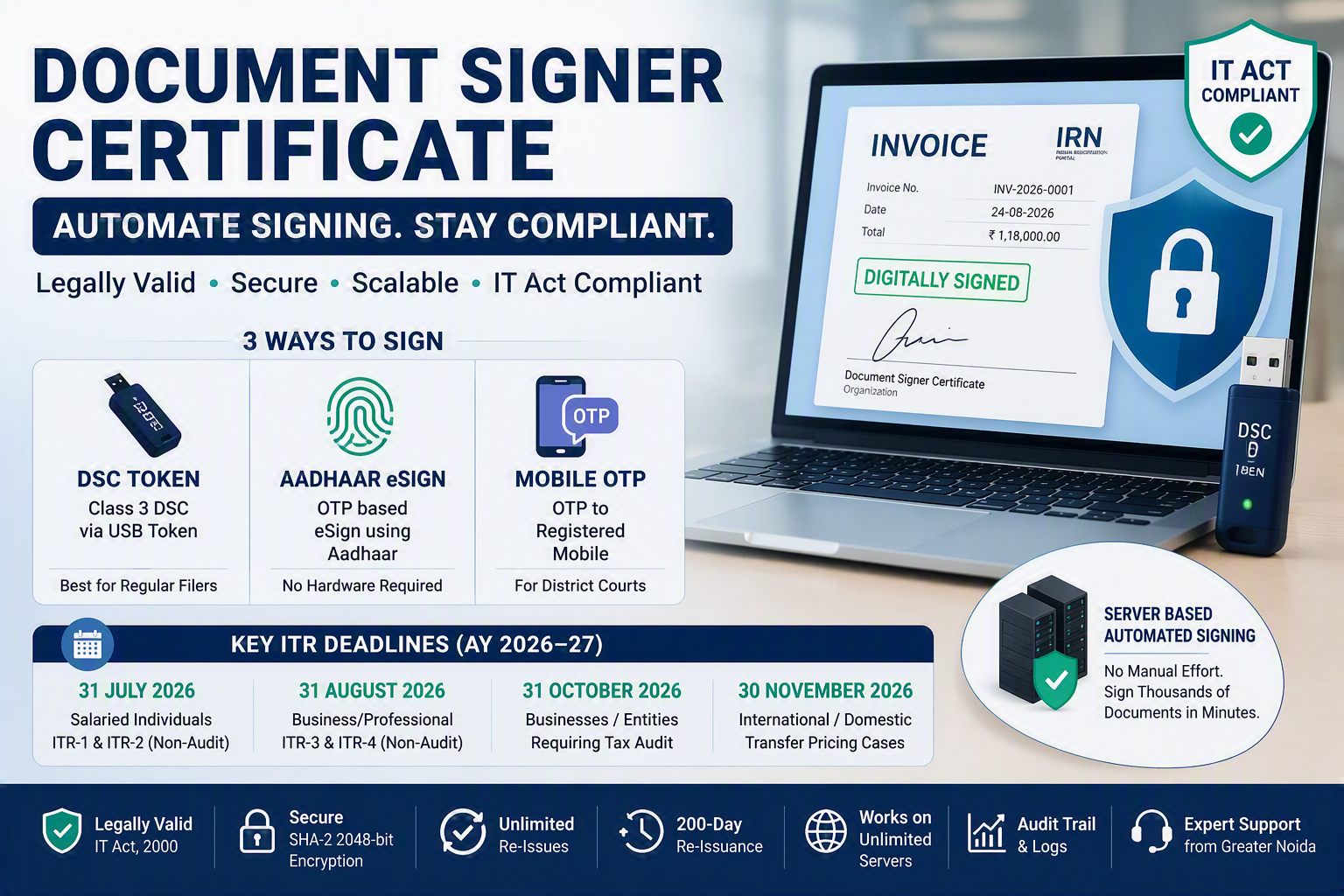
Document signer certificate technology is what separates a finance team that signs 4,000 invoices a month automatically from one that has a director plugging in a USB token 4,000 times. With the audited ITR deadline of 31 October 2026 approaching, that difference stops being an inconvenience and becomes a bottleneck.
This guide explains what a document signer certificate is, how it differs from the individual DSC your directors hold, where it legally applies, what it costs, and how to integrate it into your accounting, billing or ERP software.
What is a document signer certificate?
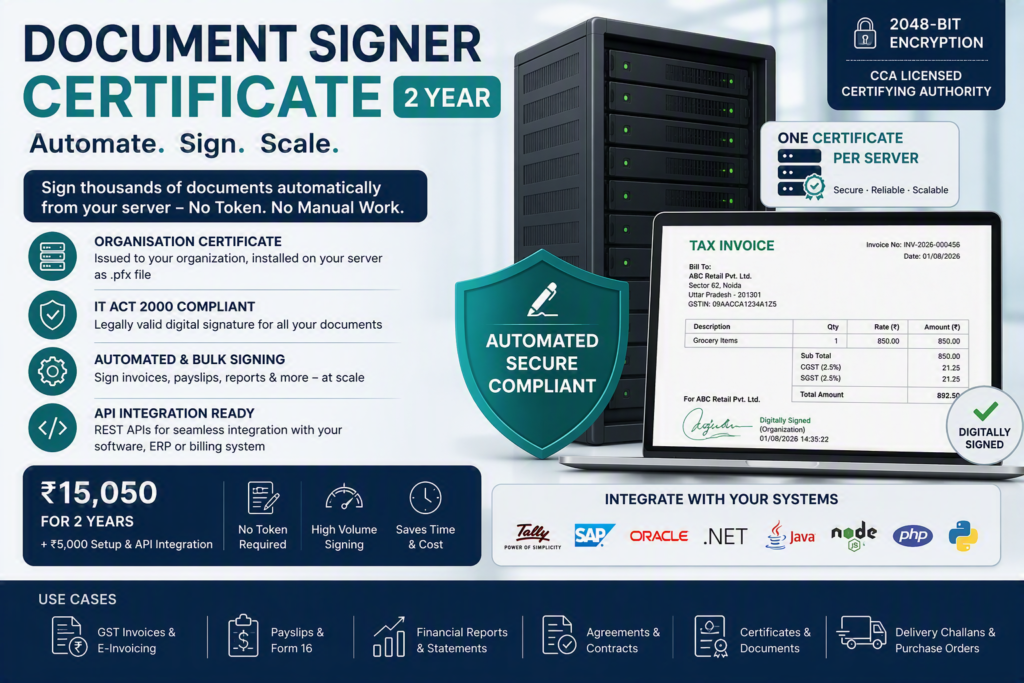
A document signer certificate is a digital certificate issued to an organisation rather than an individual, installed on a server instead of a USB token. It lets your software sign documents automatically, with no human present at the moment of signing.
The legal basis is identical to any digital signature. Under Section 3 of the ministry of electronics and information technology, a document signed with a valid certificate from a CCA-licensed Certifying Authority carries the same standing as a handwritten signature and is admissible in Indian courts and other government departments.
The practical difference is where the key lives. An individual DSC sits on a token in someone’s pocket. A document signer certificate sits on your server, wired into your application.
Order a Document Signing Certificate

Document Signer Certificate (1 Year)
₹16,000.00Document Signer Certificate (2 Year) — Automated Bulk Signing with API Setup
Original price was: ₹21,000.00.₹15,050.00Current price is: ₹15,050.00.Document Signer Certificate (3 Year)
₹31,000.00

Document signer certificate vs individual DSC
This is the distinction most businesses get wrong, and it costs them either money or compliance.
| Individual DSC | Document signer certificate | |
|---|---|---|
| Issued to | A named person | The organisation |
| Stored on | USB crypto token | Server or HSM |
| Signing | Manual, one at a time | Automated, unlimited volume |
| Human needed? | Yes, every signature | No |
| Right for | MCA, GST returns, ITR, tenders | Invoices, statements, payslips, reports |
| Validity | 1–3 years | 2 years |
You need both. Directors still require individual DSCs for MCA forms, GST returns and income tax filings, because those demand a named authorised signatory. A document signer certificate cannot replace them, and any vendor claiming otherwise is selling you a compliance problem.
Key ITR deadlines for AY 2026–27
The compliance calendar is what makes this quarter the pressure point. Confirm current dates on the Income Tax Portal before you plan around them:
| Deadline | Who it applies to |
|---|---|
| 31 July 2026 | Salaried individuals filing ITR-1 or ITR-2 (non-audit) |
| 31 August 2026 | Business or professional income, ITR-3 or ITR-4, without tax audit |
| 31 October 2026 | Businesses and entities requiring a tax audit |
| 30 November 2026 | International or domestic transfer pricing cases |
Two failures repeat every year at exactly this point. Directors discover their individual DSC expired weeks ago, and there is no grace period. And finance teams discover that hand-signing several hundred documents during their busiest fortnight is not a plan.
A further date matters if you are buying now: FIPS 140-3 certified tokens become mandatory for new tokens issued after 21 September 2026. Confirm the token specification before you purchase.
7 places a document signer certificate does the work
- GST e-invoicing and B2C invoices. The Invoice Registration Portal stamps its own signature on the IRN and QR code. But B2C invoices, credit notes, debit notes and certain government procurement documents need the issuing entity’s own signature.
- Audited financial statements. Balance sheets, P&L statements and schedules generated in bulk during audit season.
- Salary slips and Form 16. A 300-person company issues 300 payslips monthly and 300 Form 16s annually.
- Delivery challans and purchase orders. Supply chain documents needing verifiable trails across plants and vendors.
- Insurance policies and loan statements. High-volume customer documents requiring tamper-evidence.
- Certificates and transcripts. Educational institutions issuing at scale.
- Contracts and vendor agreements. Recurring paperwork signed from templates.
What a document signer certificate costs in India
Indicative pricing from our own engagements:
| Item | Cost |
|---|---|
| Document signer certificate, 2-year validity | ₹15,050 |
| Utility and API setup, single server | ₹5,000 |
The constraint that catches everyone: one server, one certificate. Separate production, staging and DR environments each need their own. Budget for that rather than discovering it mid-deployment.
Weigh it against the alternative. A finance executive on ₹40,000 a month spending a quarter of their time token-signing costs ₹1.2 lakh a year in salary alone, before the errors, delays and audit exposure of a certificate nobody noticed had expired.
Documents required to apply
Have these ready; incomplete applications are the main cause of delay:
- Authorised signatory’s PAN, photograph, email ID and valid ID proof
- GSTIN with GST verification document
- Company address as per GSTIN, plus address proof
- Bank statement
- Authorisation letter from the company, with ID proof of the authorising person
- List of directors
Certifying Authorities are licensed and regulated by the Controller of Certifying Authorities(CCA). Video verification is mandatory after submission, so the authorised signatory must be available.
Integrating a document signer certificate into your software
This is where most organisations stall. They buy the certificate, then find their software cannot use it.
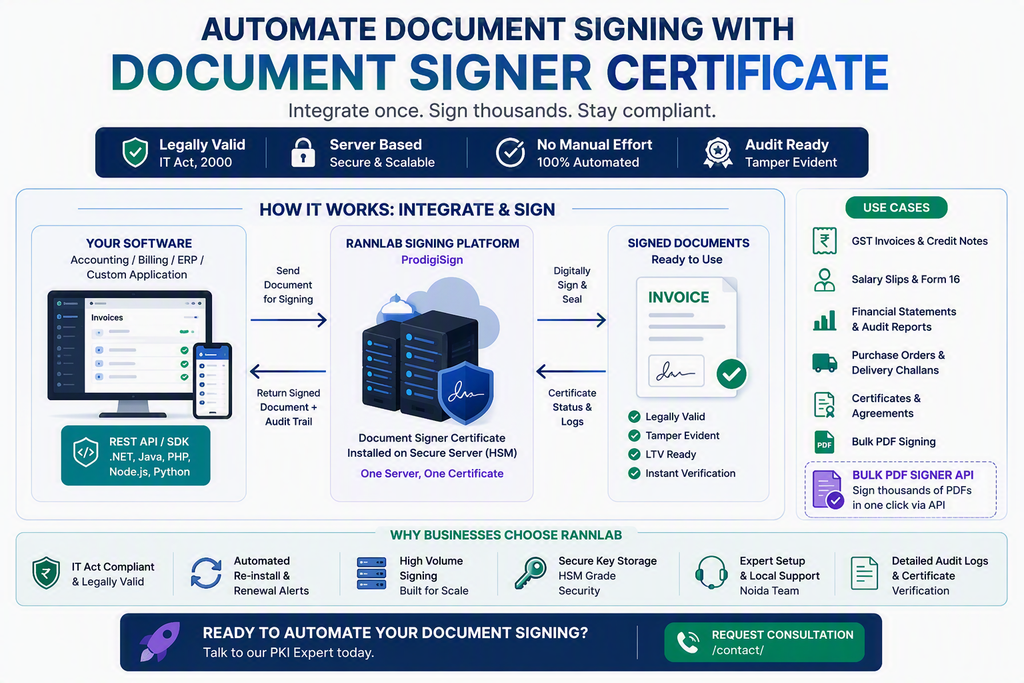
Proper integration means your application calls a signing service through an API the moment a document is generated. No manual step, no token, no queue. That requires:
- REST APIs for signing, verification and certificate extraction
- Hash and file signing, so large documents need not transfer in full
- Visible signature placement with page-level positioning, timestamp and reason
- Bulk and batch signing with parallel or sequential routing
- LTV-ready certificates, so signatures stay verifiable after expiry
- Revocation checking via CRL and OCSP
- Audit trails with document hashes and verification links
- Webhooks so your system knows when signing completes
Whether your stack is SAP, Oracle, Tally or a custom .NET or Java application, the pattern is the same. Only the SDK and deployment model change.
Why choose RannLab for your document signer certificate
RannLab Technologies builds digital trust infrastructure — DSC, eSign, eKYC and PKI — and operates its partner signing platform, ProdigiSign. We are not reselling somebody else’s API and hoping it holds. We run the stack, and our engineers debug it.
What we deliver:
- Certificate procurement, including application, documentation and video verification coordination
- Server setup and utility configuration, tested before handover
- API integration into your accounting, billing, ERP or custom software, with sandbox access first
- Individual DSC supply for directors, with renewal tracking so nothing expires during audit season
- Aadhaar eSign integration for customer-facing consent flows
- Verification services — certificate chain validation, revocation status, document integrity
We integrate with the stack you already run
Documented REST APIs, SDK support and a clear sandbox‑to‑production path. Most deployments go live in days, not months.
- .NET
- Java
- Node.js
- PHP
- Python
Get your document signer certificate before the deadline
Tell us how many documents you sign monthly, what software generates them, and whether your directors also need individual DSCs. We will come back with certificate type, server count, integration approach and firm cost.
Get your document signer certificate before the deadline
Tell us three things and we will do the rest:
- How many documents you sign each month
- What software generates them
- Whether your directors also need individual DSCs
We come back with the certificate type, server count, integration approach and a firm cost — not a brochure.
RannLab Technologies Pvt. Ltd. — Greater Noida, Delhi NCR. DSC · eSign · eKYC · PKI · IT Act compliant.
Frequently asked questions
What is a document signer certificate?
A digital certificate issued to an organisation rather than a person, installed on a server so software can sign documents automatically at volume. It carries the same legal validity as a handwritten signature under the Information Technology Act, 2000.
Can it replace my director’s DSC?
No. MCA filings, GST returns and income tax returns require a DSC belonging to a named authorised signatory. A document signer certificate handles system-generated documents such as invoices, payslips and statements. Most organisations need both.
How many certificates do I need?
One per server. Production, staging and disaster recovery environments each require their own.
What does a document signer certificate cost?
Indicatively ₹15,050 for two-year validity, plus around ₹5,000 for utility and API setup on a single server. Additional servers need additional certificates.
Is it valid for GST e-invoicing?
Yes, for documents requiring the issuing entity’s own signature — B2C invoices, credit notes, debit notes and certain government procurement documents. The IRP signs separately when returning the IRN.
How long does issuance take?
A few working days once complete documentation is submitted and video verification is done. Integration and server configuration follow.
Can it integrate with Tally, SAP or custom software?
Yes. Signing is exposed through REST APIs, so any application that can make an HTTP call can integrate, whether packaged ERP or bespoke .NET or Java.
What happens if it expires?
Signing stops, and documents signed after expiry are invalid. There is no grace period, which is why renewal tracking matters more than renewal itself.
