
By the middle of 2026, the artificial intelligence conversation inside corporate boardrooms has dramatically shifted. The question is no longer, “Should we integrate Generative AI?” The directive is now, “How do we deploy AI that actually understands our proprietary business data without bankrupting our cloud infrastructure budget?”
Off-the-shelf Large Language Models (LLMs)—whether it is GPT-4o, Claude 3.5, or open-source titans like Llama 3—are incredibly powerful reasoning engines. However, out of the box, they are completely ignorant of your company’s internal reality. If an executive asks a baseline model to summarize the Q3 internal compliance policy or draft a response based on a specific, confidential client contract, the AI will do one of two things: it will apologize for its lack of knowledge, or worse, it will hallucinate a highly convincing lie.
To bridge this massive gap, Chief Information Officers (CIOs) and Chief Technology Officers (CTOs) are confronted with a critical architectural crossroads: Do we invest in LLM fine tuning vs RAG (Retrieval-Augmented Generation)?
Choosing the wrong methodology will not merely result in subpar AI performance. It can expose highly sensitive corporate data, violate data privacy frameworks, and generate staggering cloud computing bills that can cripple IT budgets.
In this comprehensive, 2500-word guide, we will conduct a deep technical and financial dive into both approaches. We will break down the true costs, the underlying security implications, and the deployment realities, ultimately explaining why enterprise RAG architecture has emerged as the undisputed, cost-effective standard for corporate AI integration.
The Danger of “Naked” LLMs in the Enterprise
To fully appreciate the solution, we must first dissect the problem with deploying a “naked” LLM. A naked LLM is a foundational model used exactly as it comes from the provider, relying solely on its baseline, pre-trained neural weights.
While a naked LLM is excellent at drafting generic marketing emails or writing basic Python scripts, it fails spectacularly in complex enterprise environments for three fundamental reasons:
- Strict Knowledge Cutoffs: The model only “knows” the world up to its last training date. It possesses zero knowledge of the proprietary software product you launched yesterday, the internal memo sent this morning, or the customized pricing tiers negotiated with a VIP client.
- Severe Data Privacy Risks: Pasting sensitive client data, Protected Health Information (PHI), or financial records into a public LLM prompt window is a massive security violation. It breaches SOC 2, HIPAA, and GDPR compliance, potentially exposing the company to millions in fines.
- The Hallucination Factor: When an LLM lacks specific, factual knowledge, its underlying statistical architecture is designed to guess what the next word should be. In a highly regulated industry like healthcare or finance, a hallucinated policy detail is not a quirky glitch—it is a catastrophic legal liability.
To transform an LLM into a reliable employee, you must tether it to your internal corporate brain. Let’s examine the two primary methodologies for achieving this.
Deep Dive: What is LLM Fine-Tuning?

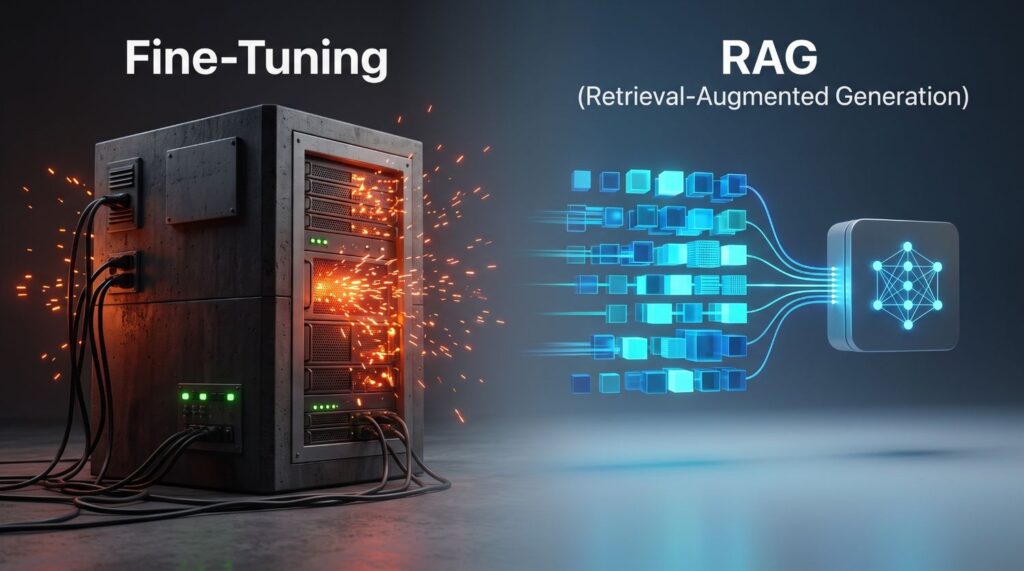
Fine-tuning involves taking a pre-trained open-source model (such as Mistral or Llama) and conducting a secondary, intensive training phase. You feed the model thousands—or millions—of examples of your proprietary data, physically altering the underlying mathematical “weights” (the neural pathways) of the model itself.
To use an analogy, think of fine-tuning like sending a general practitioner to a highly specialized, multi-year cardiology residency. You are permanently and fundamentally changing their baseline knowledge, their vocabulary, and how they speak.
The Hidden Costs of Fine-Tuning
When evaluating LLM fine tuning vs RAG, enterprise leaders must understand that the costs of fine-tuning are heavily front-loaded and continuously recurring.
- Exorbitant Compute Costs (GPUs): Training an LLM requires massive, sustained computational power. You will need to rent clusters of high-end GPUs (such as NVIDIA H100s) from AWS, Azure, or Google Cloud. A single fine-tuning run can cost tens of thousands to hundreds of thousands of dollars, depending on the dataset size.
- Labor-Intensive Data Preparation: You cannot simply dump raw PDFs and messy SharePoint files into a fine-tuning algorithm. You must hire specialized data scientists and machine learning engineers to create highly structured, clean “prompt-completion” pairs. This manual data labeling is incredibly expensive and time-consuming.
- The Re-Training Trap (Data Stagnation): If your company updates a single, crucial compliance document, your fine-tuned model does not automatically know about the change. To update its knowledge, you have to run the expensive, time-consuming fine-tuning process all over again.
- Catastrophic Forgetting: This is a well-documented phenomenon in machine learning. When you force an LLM to learn a massive amount of new, highly specific corporate information, it often begins to “forget” its general reasoning capabilities. You might train it perfectly to understand your legal contracts, only to discover it suddenly struggles with basic grammar, summarization, or logical deduction. Fixing this requires even more expensive training cycles.
When is Fine-Tuning Actually the Right Choice?
Despite the astronomical costs, fine-tuning is necessary in one specific scenario: when you need to change the behavior, tone, or format of the model, rather than just giving it new facts. For example, if you need an AI to write code in a highly specific, proprietary programming language that no other AI has ever seen, fine-tuning is required.
However, if you just want the AI to know your internal HR policies, retrieve customer history, or reference a technical manual, fine-tuning is massive, expensive overkill.
Deep Dive: What is Enterprise RAG Architecture?

Retrieval-Augmented Generation (RAG) takes a completely different, highly efficient approach. Instead of changing the physical “brain” (the neural weights) of the LLM, RAG gives the LLM a highly secure, incredibly fast, and hyper-accurate search engine.
Think of enterprise RAG architecture like a brilliant student taking an open-book exam. The student (the LLM) already knows how to read, write, and reason perfectly. When asked a complex question, the student doesn’t rely on memory; instead, they first search the textbook (your proprietary corporate database), retrieve the exact right paragraph, and then use that paragraph to formulate a flawless, fact-based answer.
The Mechanics: How Enterprise RAG Architecture Works
A robust RAG pipeline operates through a seamless, multi-step process:
- Ingestion & Chunking: All your unstructured company data (PDFs, Confluence pages, Slack messages, EMR records) is extracted and broken down into smaller, logical pieces (chunks), usually around 300 to 500 words each.
- Vectorization (Embeddings): These text chunks are passed through an embedding model, which translates the human text into massive arrays of numbers (vectors) that capture the semantic meaning of the words.
- The Vector Database: These vectors are stored in a highly specialized vector database (e.g., Pinecone, Milvus, Weaviate, or pgvector).
- The Semantic Retrieval: When a user asks a question (e.g., “What is the uptime SLA for Client X?”), the system converts the question into a vector and searches the database for the most mathematically and semantically relevant pieces of text.
- The Augmented Generation: The system pulls the retrieved text and packages it with the user’s original question. It sends this combined package to the LLM with strict instructions: “Answer the user’s question using ONLY the provided text. If the answer is not in the text, state that you do not know.”
LLM Fine Tuning vs RAG: The Ultimate Technical & Cost Comparison

For IT Directors and CFOs looking to maximize their AI ROI, the battle between LLM fine tuning vs RAG is almost entirely won by RAG. Below is a comprehensive breakdown of why RAG is the superior choice for corporate knowledge retrieval.
| Architectural Feature | LLM Fine-Tuning | Enterprise RAG Architecture | The Winner |
|---|---|---|---|
| Initial Setup & Compute Cost | Extremely High (Requires vast GPU clusters and data labeling) | Moderate (Requires pipeline integration and vector DB setup) | RAG |
| Ongoing Maintenance Cost | High (Requires constant re-training runs for new data) | Very Low (Simply upload or delete text in the vector database) | RAG |
| Data Freshness | Stale (Only knows data up to its last intensive training run) | Real-Time (Instantly knows when a document is added or updated) | RAG |
| Cloud Infrastructure Footprint | Heavy GPU reliance for hosting and training | Lightweight CPU/Memory reliance (Vector DBs are highly efficient) | RAG |
| Hallucination Mitigation | Moderate (Still relies on internal memory and statistical guessing) | Very Low (Answers are strictly grounded in retrieved, verifiable facts) | RAG |
| Source Citation | Impossible (Cannot tell you where it learned a fact) | Built-In (Can link directly to the exact PDF or page it used) | RAG |
When analyzing LLM fine tuning vs RAG, the ability for a system to cite its sources is often the deciding factor for enterprise adoption. Because RAG retrieves physical documents, the UI can easily display citations. If a user doubts the AI’s answer, they can click a link and read the source document for themselves. A fine-tuned model simply cannot do this.
Are skyrocketing cloud compute costs stalling your AI roadmap?
You don’t have to choose between cutting-edge innovation and your IT budget. Talk to the AI engineers at RannLab Technologies about deploying a cost-effective, secure RAG solution today.
Schedule an AI Architecture Consultation with RannLab Technologies
The Security Imperative: Why RAG Wins in the Enterprise

Beyond cloud costs and data freshness, the most critical factor for enterprise architects is security, compliance, and identity governance. In 2026, data breaches are unforgiving, and deploying AI insecurely is a massive corporate risk.
The Fatal Security Flaw of Fine-Tuning
When you fine-tune an LLM, your proprietary data is baked directly into the neural weights of the model itself. Crucially, you cannot apply role-based access control (RBAC) to a neural network.
If you fine-tune a model on all company documents, including the CEO’s compensation package and unreleased merger details, the model “knows” this information. If a curious intern asks the model a cleverly phrased question, the model might accidentally reveal that highly classified data. There is no reliable way to tell a fine-tuned model, “Only share this fact if the user is a C-level executive.”
Zero-Trust Security in Enterprise RAG Architecture
RAG solves the access control problem elegantly and decisively. Because the LLM does not actually “know” your data—it is simply reading the documents provided to it by the retrieval system at the exact moment of the query—you can apply strict Zero-Trust security at the database level.
When an employee interacts with an enterprise RAG architecture, the system first authenticates their Active Directory (AD) or Okta credentials.
- If the CFO asks, “What was our Q3 revenue margin?”, the retrieval system verifies their clearance, pulls the financial documents, and passes them to the LLM to generate the answer.
- If a junior developer asks the exact same question, the retrieval system checks their clearance and blocks access to the financial documents. The LLM receives no context, and simply replies, “I do not have access to that information.”
This level of granular, document-level security is technologically impossible with fine-tuning. For highly regulated industries—such as healthcare dealing with HIPAA, or finance dealing with PCI-DSS—RAG is the only viable option.
Industry Case Studies: RAG in the Wild
To move beyond theory, let’s examine how enterprise RAG architecture is currently transforming highly regulated sectors in 2026.
Case Study 1: Healthcare & Clinical Decision Support
A massive hospital network needed an AI assistant to help physicians quickly reference complex, constantly changing clinical guidelines and drug interaction protocols.
- The Fine-Tuning Risk: Fine-tuning a model on medical protocols was deemed too dangerous; if a protocol changed, the model might hallucinate outdated, life-threatening medical advice before a re-training run could be completed.
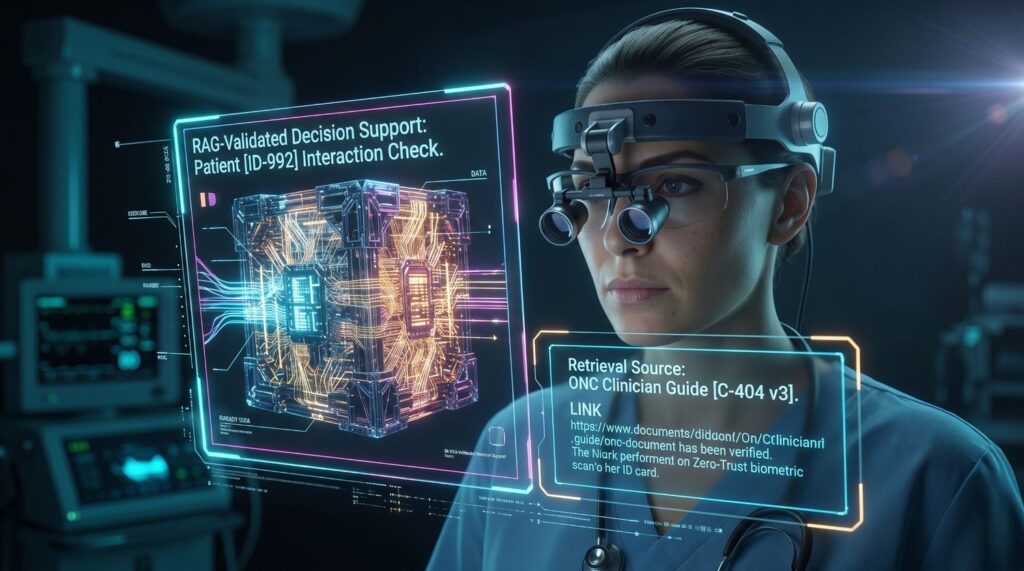
- The RAG Solution: The hospital deployed a secure RAG system. All clinical guidelines were vectorized. Now, when a doctor queries the AI, it retrieves the most up-to-date protocol, provides a summary, and links directly to the source medical document. If a drug is recalled, the IT team simply deletes the old PDF from the vector database, and the AI’s “knowledge” is updated instantly.
Case Study 2: Fintech & Compliance Auditing

A global fintech firm needed a way to help its compliance officers quickly audit thousands of pages of new international banking regulations.
- The Fine-Tuning Risk: The sheer cost of constantly fine-tuning a massive LLM on daily regulatory updates from global governments would have drained their cloud budget. Furthermore, data privacy laws prevented them from baking internal audit histories into a foundational model.
- The RAG Solution: By utilizing RannLab Technologies, the fintech firm deployed an enterprise RAG architecture using an open-source LLM hosted on their own private servers. Compliance officers can now ask complex queries about European banking regulations, and the RAG system securely retrieves the exact legal clauses, citing the specific regulatory framework, saving hundreds of hours of manual legal reading.
A Step-by-Step Guide to Implementing Enterprise RAG Architecture
If you have recognized that RAG is the right path for your enterprise, the challenge shifts to flawless execution. How do you build it without creating a messy, unmanageable architecture? Here is a high-level playbook for IT leaders.
Step 1: Audit, Clean, and Govern Your Data
The golden rule of AI remains true: Garbage In, Garbage Out. An enterprise RAG architecture is only as intelligent as the data inside its vector database. If your company’s SharePoint is filled with three different, conflicting versions of the employee handbook from 2021, 2023, and 2026, the RAG system will retrieve all of them. The LLM will then provide a confused, contradictory answer. Before building the AI infrastructure, invest serious time in data governance. Archiving obsolete data is the fastest, cheapest way to improve RAG accuracy.
Step 2: Master Your Chunking Strategy
You cannot feed a 500-page PDF into a vector database as a single document. It must be chunked. However, simple “fixed-size” chunking (e.g., cutting the text every 500 words) often cuts sentences or paragraphs in half, destroying the semantic meaning. Advanced implementations use semantic chunking, which uses Natural Language Processing (NLP) to break documents down by logical sections, headers, or complete paragraphs, preserving the context for the AI.
Step 3: Choose the Right Embedding Model
To put text into a vector database, it must be converted into numbers using an embedding model. Do not simply default to the most expensive, proprietary API on the market (like OpenAI’s embeddings). Often, smaller, open-source embedding models (like BGE-M3 or Nomic-Embed) are incredibly cost-effective, can run locally on your own servers for enhanced privacy, and offer retrieval performance that rivals expensive commercial options.
Step 4: Implement Advanced Retrieval Techniques (Re-Ranking)
Basic RAG simply retrieves the top 5 most mathematically similar chunks of text. In a complex enterprise query, this isn’t enough. You must implement a “Re-Ranker” (like Cohere Re-rank or a Cross-Encoder). After the vector database retrieves the top 20 documents, the Re-Ranker model analyzes them against the user’s specific query and sorts them by actual relevance, ensuring only the absolute best context is sent to the LLM. This drastically reduces hallucinations and improves answer quality.
Step 5: Optimize Token Usage to Control Cloud Costs
Every word sent to a commercial LLM via an API costs money. If your RAG system retrieves 20 pages of text for a simple question, your API bill will explode. Your architecture must include strict prompt engineering rules to ensure the LLM only receives the exact, concise sentences required to answer the prompt.
The Hybrid Approach: Retrieval-Augmented Fine-Tuning (RAFT)

It is worth noting that in advanced 2026 enterprise architectures, LLM fine tuning vs RAG is not always a strict binary choice. For organizations with massive AI budgets and highly specialized needs, the most sophisticated systems utilize a hybrid approach, sometimes referred to as RAFT (Retrieval-Augmented Fine-Tuning).
In this scenario, a company might lightly fine-tune a smaller, highly efficient open-source model (like Llama 3 8B) so that it understands the company’s specific brand voice, highly specialized industry acronyms, and desired output formats. They will then wrap that fine-tuned model inside an enterprise RAG architecture to handle the actual factual retrieval and strict document access control.
This hybrid approach gives you the best of both worlds: a model that speaks your exact corporate language, backed by a real-time, highly secure, hallucination-free knowledge base. However, this is a complex engineering feat and should only be undertaken after a standard RAG system has been successfully deployed, tested, and pushed to its limits.
Conclusion: The Path Forward for Corporate AI
The era of AI experimentation and hype has ended. Enterprise leaders are no longer impressed by generic, hallucinating chatbots; they demand secure, highly accurate, and deeply cost-effective AI systems that deliver measurable business value and ROI.
When conducting a thorough evaluation of LLM fine tuning vs RAG, the reality is undeniable. For 95% of enterprise use cases—where the primary goal is to safely query proprietary documents, automate compliance checks, or assist internal support agents—fine-tuning is an expensive, insecure, and inefficient distraction.
A well-architected enterprise RAG architecture empowers you to leverage the reasoning power of the world’s most advanced AI models while keeping your proprietary data locked down, your cloud costs highly predictable, and your answers completely grounded in verifiable fact.
The technology to unlock your enterprise data exists today. The only question is whether you will architect it correctly.
Don’t burn your IT budget on the wrong AI strategy. Designing an efficient, secure, and hallucination-free AI ecosystem requires deep, specialized engineering expertise.
Partner with RannLab Technologies to build a scalable, Zero-Trust enterprise RAG architecture tailored perfectly to your business needs and compliance requirements.
Request a Free AI Architecture Audit with RannLab Technologies Today
