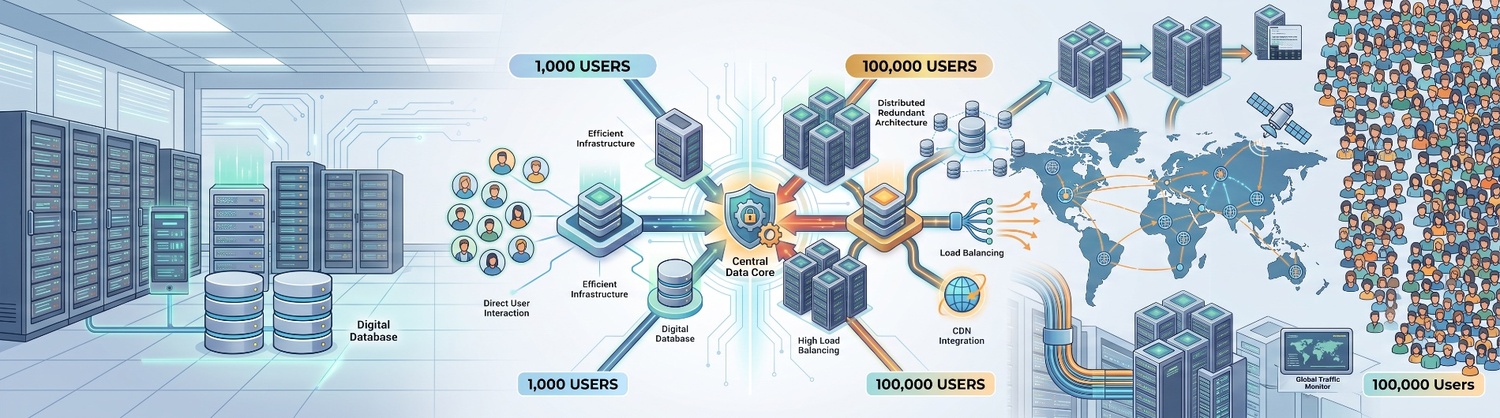
Hitting your first 1k active users is a massive milestone for any startup. It proves product-market fit, validates your core business model, and brings in critical early revenue. However, the engineering reality is that scaling from 1k to 100k users requires a complete paradigm shift in how your software architecture is designed, deployed, and managed.
At 1k users, standard, out-of-the-box infrastructure can mask sloppy code. A single monolithic server and a basic database can easily handle the low volume of concurrent requests. But as you push toward the 100k-user mark, those minor inefficiencies compound exponentially. Systems that previously responded in milliseconds suddenly grind to a halt, database connections exhaust, and users are greeted with 504 Gateway Timeouts.
For growing tech companies, infrastructure failure is a business-critical threat that causes churn and damages brand reputation. In this comprehensive guide, we will break down the six fatal architectural bottlenecks that emerge during hyper-growth and provide actionable, enterprise-grade strategies to bypass them.
The Engineering Reality of Scaling from 1k to 100k Users
Before addressing specific bottlenecks, CTOs and technical founders must understand how system load changes non-linearly. When traffic increases by 100x, resource consumption often increases by 500x due to data contention, memory limits, and network input/output (I/O) strain.
| Infrastructure Component | State at 1k Users | State at 100k Users |
|---|---|---|
| Concurrency & Traffic | Negligible simultaneous requests; minimal thread contention. | Massive traffic spikes; high risk of server thread starvation. |
| Database Queries | Unindexed queries execute fast enough to go unnoticed. | Full table scans lock the database, causing cascading failure. |
| Asset Delivery | Single server easily serves all images, CSS, and JS. | Bandwidth limits reached; requires Edge Networks and CDNs. |
| State Management | Local server memory handles user sessions perfectly. | Stateless architecture required to prevent session drops. |
If your system is not explicitly decoupled to handle this shift, it will inevitably collapse under its own weight. Here are the bottlenecks you must eliminate.
Bottleneck 1: The Monolithic Database Chokepoint
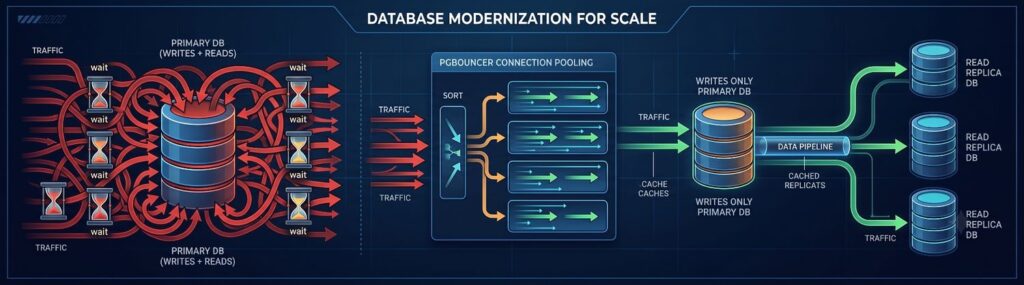
When an application begins to fail under heavy load, the root cause is almost always the data layer. Early-stage development typically relies on a single relational database instance (like PostgreSQL or MySQL) to process both write transactions and heavy read operations.
Why It Breaks Under Load
As you approach 100k users, the volume of open connections to your single database multiplies rapidly. Complex analytics queries or multi-table joins start competing for compute power with simple, critical transactional writes (like a user updating a password or completing a checkout). The database engine spends more time managing row locks and context-switching than actually returning data.
The Remediation Strategy
Successfully scaling from 1k to 100k users means treating your primary database as a strictly protected asset.
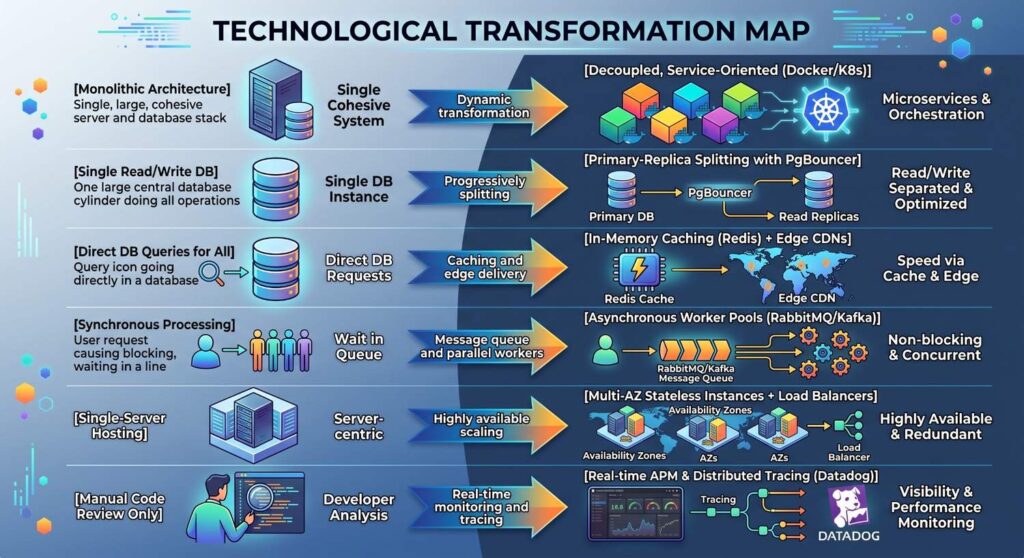
- Read/Write Splitting (Primary-Replica): Direct all data-modifying queries (INSERT, UPDATE, DELETE) to a primary instance. Asynchronously replicate that data to one or more Read Replicas. Route all heavy SELECT queries to the replicas to instantly free up your primary engine.
- Connection Pooling: Do not open and close a direct database connection for every HTTP request. Use a pooler (like PgBouncer) to maintain a warm pool of reusable connections, drastically reducing memory overhead.
- Database Indexing: Audit your slow query logs. Adding a simple B-Tree index to frequently queried columns can reduce query times from seconds to milliseconds.
Bottleneck 2: The Absence of a Multi-Tier Caching Strategy
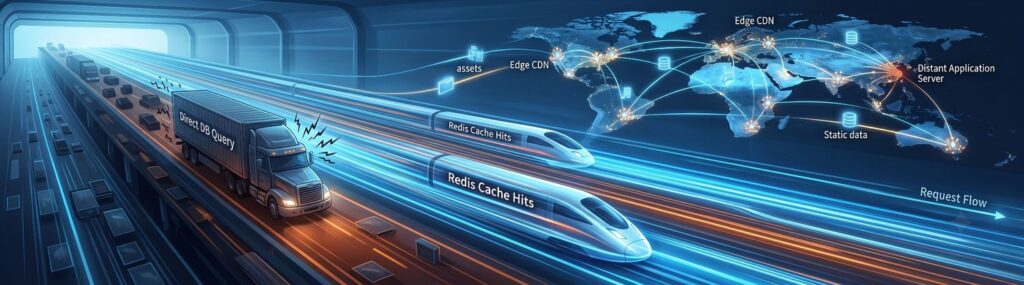
One of the fastest ways to crash a server is forcing it to re-calculate or re-fetch data that has not changed since the last request.
Why It Breaks Under Load
If every user navigating to your homepage triggers a database query to load the same static product catalog, you are wasting expensive compute resources. At higher scales, these redundant requests create a “thundering herd” effect that overwhelms your application servers.
The Remediation Strategy
An enterprise scaling architecture relies heavily on returning data from memory rather than disk.
- In-Memory Key-Value Stores: Position a caching layer like Redis or Memcached between your application and database. Store slow-moving data (user profile settings, navigational menus, static configurations) in RAM for microsecond retrieval.
- Content Delivery Networks (CDNs): Never serve static assets (images, videos, compiled JavaScript) directly from your application server. Offload all static delivery to a global CDN like Cloudflare or AWS CloudFront to serve data from the geographic edge closest to the user.
Bottleneck 3: Synchronous Processing of Background Tasks
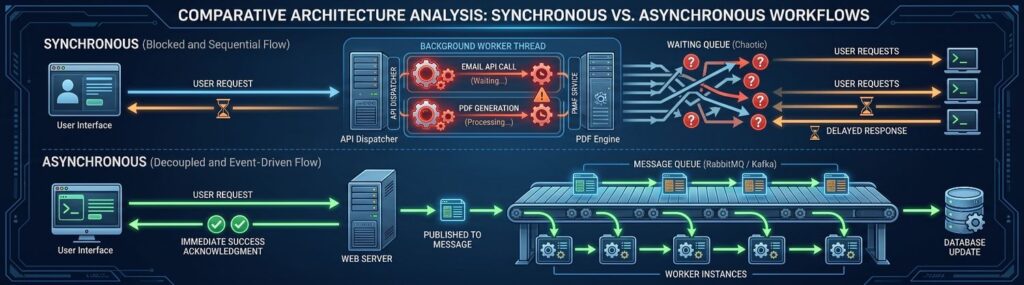
If your application executes third-party API calls, email dispatches, or heavy file processing directly within the user’s HTTP request cycle, it will not survive hyper-growth.
Why It Breaks Under Load
Web servers are configured with a finite number of worker threads. If a user requests an action that takes four seconds (e.g., generating a massive PDF report), that worker thread is completely blocked. When thousands of users do this simultaneously, all server threads become occupied. Any new user attempting to simply log in will be placed in a queue and eventually time out.
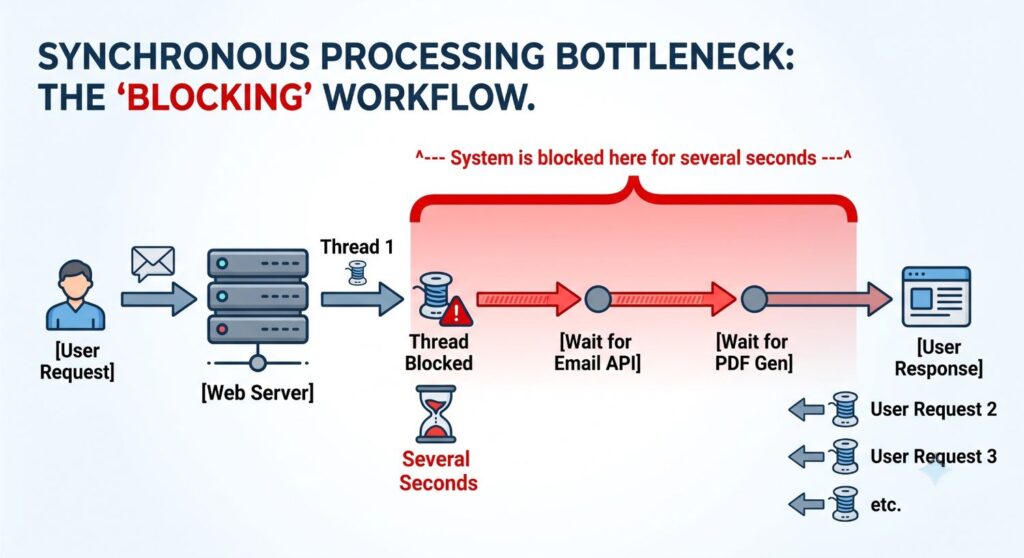
The Remediation Strategy
A non-negotiable step in scaling from 1k to 100k users is shifting from synchronous to asynchronous processing.
- Message Brokers: Introduce an event-driven queue like RabbitMQ, Apache Kafka, or Amazon SQS. When a user triggers a heavy task, the server publishes a lightweight message to the queue and instantly returns a
200 OKresponse to the user. - Dedicated Worker Pools: Deploy separate background worker instances that pull jobs from the queue at their own pace. This protects your main web servers from CPU spikes and ensures the user interface remains snappy.
Bottleneck 4: Tightly Coupled Monolithic Codebases
Monolithic architecture—where your entire application is housed in a single codebase and deployed as a single unit—is the standard for MVP development. But at scale, it becomes a severe liability.
Why It Breaks Under Load
In a monolith, all features share the same CPU and memory pool. If a highly specific feature (like a bulk data importer) experiences a massive surge in usage, it will consume all available server resources, taking down completely unrelated features (like user authentication or the payment gateway). Furthermore, you cannot scale the high-demand feature independently; you must clone the entire massive monolith, wasting cloud budget.
The Remediation Strategy
You do not need to adopt an ultra-complex microservices architecture overnight, but you must begin logically decoupling domains.
- Service-Oriented Architecture (SOA): Identify the most resource-intensive modules of your application and extract them into their own independent services.
- Containerization: Package these extracted services using Docker and orchestrate them with Kubernetes or Amazon ECS. This allows you to define granular auto-scaling rules—for example, automatically adding five new servers to your “Payment Service” during peak hours while keeping your “Notification Service” running on minimal compute.
Bottleneck 5: Single Points of Failure (SPOFs)
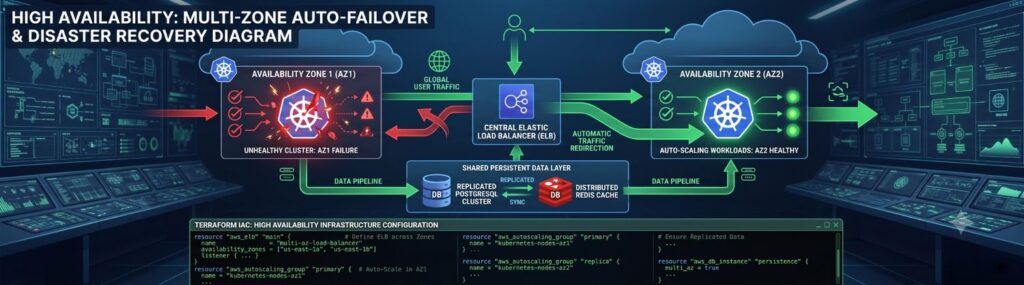
Many startups host their initial application on a single, powerful cloud instance. While cost-effective, this creates a catastrophic single point of failure.
Why It Breaks Under Load
Hardware degrades, networks fail, and cloud providers experience regional outages. If your entire business runs on one server node, any infrastructure hiccup results in total platform downtime. Rebuilding a crashed server manually takes hours—hours that a high-traffic platform cannot afford.
The Remediation Strategy
High availability requires redundancy at every layer of the tech stack.
- Stateless Web Servers: Ensure your web servers hold no local state. User sessions should be stored in Redis, and user-uploaded files should go directly to Amazon S3. If a web server dies, a new one can replace it instantly without losing user data.
- Elastic Load Balancing: Deploy an automated Load Balancer (like AWS ALB). It will constantly monitor the health of your servers, routing traffic away from failing nodes and distributing requests evenly across healthy ones.
- Multi-Availability Zone (Multi-AZ) Deployment: Distribute your servers and database replicas across multiple physical data centers. If one data center loses power, your load balancer instantly shifts traffic to the surviving zone.
Bottleneck 6: Operating in a Blind Spot (Lack of Observability)

You cannot fix performance issues if you do not know exactly where they are originating. Guessing is not a viable engineering strategy at scale.
Why It Breaks Under Load
With a small 1k user base, a developer can SSH into a server and read text-based log files to find an error. When your architecture evolves into a distributed system handling tens of thousands of concurrent requests across multiple containers, manual debugging is impossible.
The Remediation Strategy
Implement the three pillars of modern observability: Metrics, Logs, and Traces (MELT).
- Application Performance Monitoring (APM): Integrate tools like Datadog, New Relic, or open-source Prometheus. APMs provide code-level insights, highlighting the exact database query or API endpoint causing latency.
- Centralized Logging: Aggregate all server, database, and application logs into a centralized dashboard using the ELK Stack (Elasticsearch, Logstash, Kibana) or AWS CloudWatch.
- Distributed Tracing: Use OpenTelemetry to track a single user request as it bounces between your load balancer, web server, caching layer, and database, making it incredibly easy to spot structural friction.
Partner with Rannlab Technologies for Seamless Scaling
The journey of scaling from 1k to 100k users is paved with complex technical decisions. Attempting to patch these architectural bottlenecks with short-term fixes only deepens your technical debt, leading to bloated cloud bills and inevitable platform outages.
At Rannlab Technologies, we specialize in transforming early-stage startup codebases into highly available, resilient, enterprise-grade platforms. Our senior systems architects understand exactly where systems break under load and how to preemptively secure them.
Our Scaling Solutions Include:
- Comprehensive Architecture Audits: Identifying hidden bottlenecks in your database, code, and cloud infrastructure.
- Zero-Downtime Migrations: Moving from fragile single-server setups to highly available, auto-scaling Kubernetes clusters.
- Database Modernization: Refactoring data layers with advanced indexing, primary-replica splitting, and Redis caching.
Don’t wait for a critical system crash to take your infrastructure seriously.
Contact Rannlab Technologies today to schedule a deep-dive architectural review, and let us build the technical foundation your business needs to confidently welcome your next 100k users.
