
Choosing the best Moodle development company is an important decision for any organization planning to build, customize, or improve its Learning Management System (LMS). Moodle is a highly flexible platform, but getting the best results depends greatly on the expertise of the development team you choose.
A good Moodle development company can help you configure the platform, develop custom features, integrate third-party systems, improve performance, and provide ongoing support. On the other hand, choosing a partner without the right technical experience can result in delays, unnecessary costs, security issues, and maintenance challenges.
Here are the key factors to consider when selecting the right Moodle development company.

1. Check Their Moodle Experience
The first thing to evaluate is the company’s experience with Moodle. Moodle is more than a standard website, and working effectively with it requires a specialized Moodle development company that understands its architecture, plugins, themes, roles, permissions, APIs, database structure, and upgrade process.
Look for a development partner that offers robust Moodle development services and has experience working on projects similar to yours. For example, if you need a university LMS, a Moodle development company with experience in educational institutions and large student numbers can be valuable. If you need corporate training, experience with employee learning and reporting requirements may be more relevant.
Ask about their previous Moodle projects and the type of functionality they have implemented.
2. Understand Their Development Capabilities
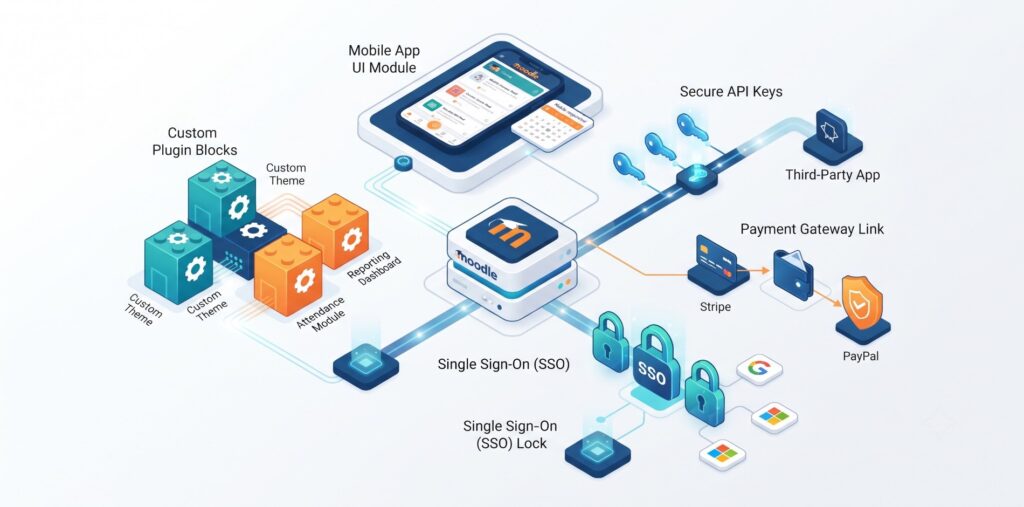
Not every Moodle requirement can be solved through configuration or existing plugins. Some projects require custom plugin development, API integrations, custom reports, or changes to the user experience.
Before selecting a Moodle development company, understand whether its team can handle both Moodle customization and custom Moodle development.
A capable partner specializing in Moodle LMS customization should be comfortable working with areas such as:
- Custom Moodle plugins
- Moodle themes and UI customization
- API and third-party integrations
- Authentication and Single Sign-On (SSO)
- Custom reports and dashboards
- Payment integrations
- Microsoft Teams or video-conferencing integrations
- Mobile app customization
- Database and performance optimization
This becomes especially important when your requirements are expected to grow over time.
3. Review Their Portfolio and Case Studies
A company’s portfolio can provide valuable insight into its practical experience. Don’t only look at screenshots or general website projects. Try to understand what problems the Moodle development company solved and how Moodle was used to achieve the desired outcome.
Ask questions such as:
- Have they developed similar LMS platforms?
- Have they created custom Moodle plugins?
- Have they integrated Moodle with external systems?
- Have they worked with Moodle mobile applications?
- Have they handled large user bases?
- Can they provide references or case studies?
A strong portfolio demonstrates not only technical skills but also the ability to understand and solve real business requirements.
4. Evaluate Technical and Integration Expertise
Modern LMS platforms rarely operate independently. Organizations often need Moodle to communicate with other systems such as HR software, student information systems, CRM platforms, payment gateways, communication platforms, or identity providers.
Therefore, your chosen Moodle development company should have strong integration capabilities as a dedicated Moodle integration partner.
For example, if your organization needs Moodle to synchronize users and courses with another application, the development team from the Moodle development company should understand APIs, authentication methods, web services, data synchronization, and error handling.
Good integration architecture can also reduce manual work and improve the overall user experience.
5. Ask About Security and Performance
Security should be a major consideration when selecting a Moodle development company. LMS platforms can contain sensitive information such as student records, employee data, grades, course information, and authentication details.
The development company should follow secure development practices and understand Moodle’s security model.
You should also ask how they handle:
- Moodle version upgrades
- Security updates
- Database optimization
- Server configuration
- Backup and recovery
- Access control
- Plugin security
- Performance optimization
A platform that works well with a small number of users may require additional optimization as the number of users increases.
6. Understand Their Support and Maintenance Model

Moodle development does not necessarily end after the platform goes live. Regular updates, security patches, plugin compatibility, bug fixes, backups, and performance monitoring may be required.
Before signing an agreement with a Moodle development company, ask what support is included after deployment.
Important questions include:
- Is technical support available after launch?
- How quickly are critical issues handled?
- Are Moodle upgrades included?
- Is bug fixing covered?
- Do they provide server or hosting support?
- Can they develop new features later?
A long-term support arrangement can be particularly useful for organizations that depend heavily on Moodle for their daily learning operations.
7. Consider Communication and Project Management
Technical expertise is important, but communication is equally valuable. Moodle projects can involve multiple stakeholders, including administrators, teachers, students, IT teams, and management.
A professional Moodle development company should have a clear process for collecting requirements, tracking development, testing features, and handling feedback, including:
- Clear project milestones
- Defined deliverables
- Regular progress updates
- Task and issue tracking
- Testing and quality assurance
- Documentation
- A clear escalation process
Good communication helps prevent misunderstandings and reduces project delays.
8. Compare Cost With Value
Price is an important factor, but the cheapest Moodle development company is not necessarily the best choice.
A low initial quotation may exclude important services such as testing, deployment, documentation, maintenance, or future upgrades. Similarly, an expensive proposal does not automatically guarantee better quality.
Instead of comparing only the total price, compare the overall value provided by the Moodle development company. Consider their experience, development methodology, support model, security practices, technical capabilities, and expected long-term maintenance requirements.
9. Check Scalability and Future Flexibility
Your Moodle platform may start with a small number of users but grow significantly over time. Therefore, when you hire Moodle developers, ensure the chosen team considers future requirements while designing the platform.
For example, your organization may later need:
- More users and courses
- Additional integrations
- Advanced analytics
- New learning workflows
- Mobile application features
- Automated notifications
- Additional languages
- More complex reporting
A good development partner should build solutions that can evolve rather than creating a system that works only for the current requirements.
10. Ask the Right Questions Before Hiring

Before making the final decision, have a detailed discussion with the shortlisted Moodle development company candidates.
Some useful questions include:
- How many Moodle projects have you completed?
- Do you develop custom Moodle plugins?
- Can you integrate Moodle with our existing systems?
- How do you handle Moodle upgrades?
- What testing process do you follow?
- What support is provided after deployment?
- Who will manage our project?
- How do you handle changes in requirements?
- Can you provide relevant case studies?
- What is included and excluded from the proposed cost?
The answers can help you identify whether the company is simply offering Moodle installation services or can actually act as a long-term Moodle technology partner.
Choosing the right Moodle development company requires more than comparing quotations. You should evaluate the company’s Moodle expertise, development capabilities, portfolio, integration experience, security practices, scalability approach, communication, and post-launch support.
The right partner should understand both your technical requirements and your organization’s learning objectives. They should also be capable of supporting the platform as your requirements evolve.
Ultimately, the best Moodle development company is not necessarily the one offering the lowest price. It is the one that can deliver a secure, scalable, maintainable, and user-friendly Moodle solution while providing reliable support throughout the platform’s lifecycle.
