In today’s digital education landscape, Moodle has established itself as one of the world’s most trusted Learning Management Systems (LMS). From schools and colleges to universities, coaching institutes, EdTech companies, and corporate training organizations, thousands of institutions rely on Moodle to deliver engaging and scalable online learning experiences.
One of the biggest reasons behind Moodle’s popularity is its flexibility. Unlike many LMS platforms that restrict customization, Moodle allows organizations to tailor the platform according to their academic and business requirements. Whether you want to improve the look and feel of your LMS or build completely new features, Moodle makes it possible.
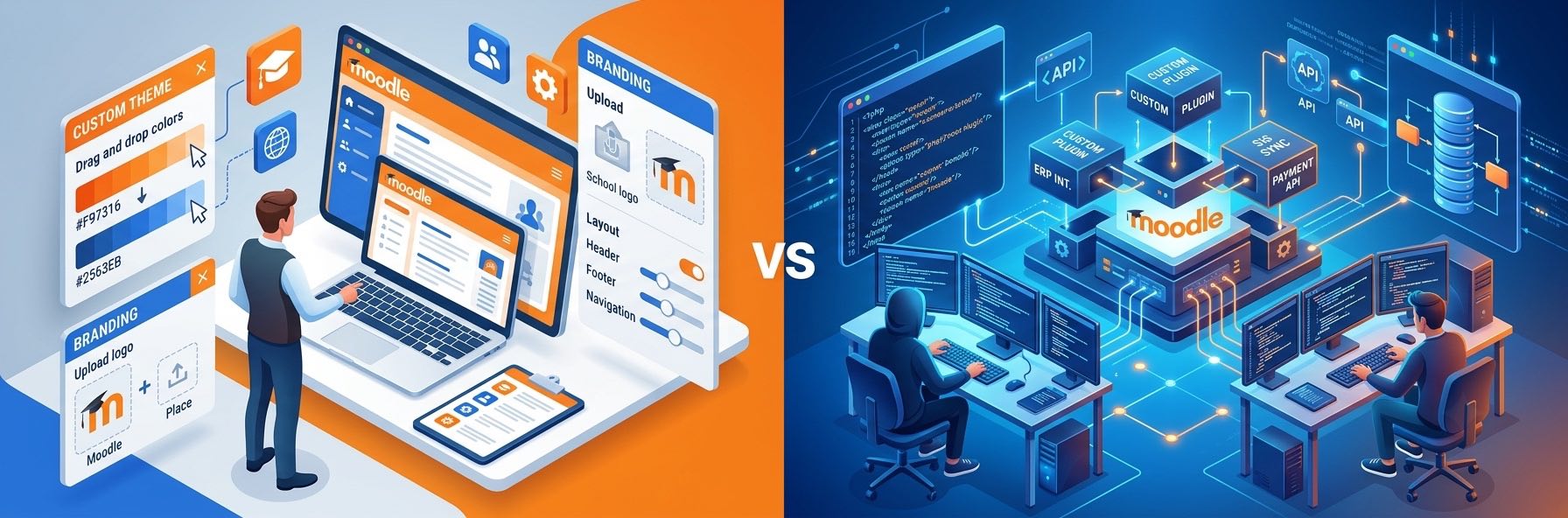
When planning a Moodle project, two terms often come up: Moodle Customization and Custom Moodle Development. While these terms are closely related, they serve different purposes. Understanding the difference will help you make better decisions and maximize the value of your Moodle investment.
Why Moodle Stands Out
Before discussing customization and development, it’s important to understand why Moodle is preferred by educational institutions worldwide.
Moodle is an open-source LMS designed to adapt to different learning environments. Instead of forcing institutions to change their processes, Moodle can be configured and extended to match existing workflows. This flexibility allows organizations to start with a simple LMS and gradually transform it into a feature-rich learning platform as their requirements grow.
This ability to evolve is what makes Moodle different from many off-the-shelf learning platforms.
What is Moodle Customization?
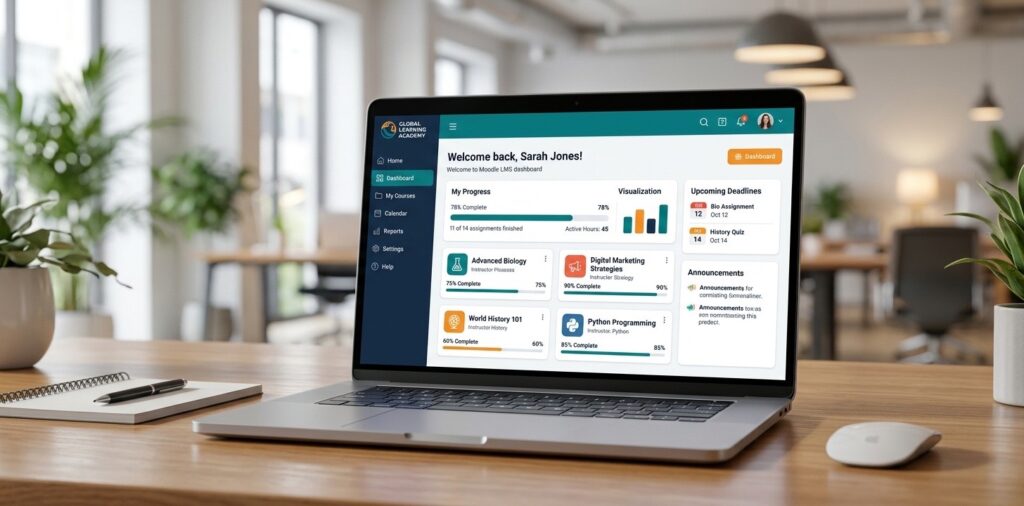
Moodle customization is the process of modifying and configuring Moodle’s existing features to better align with your institution’s branding, user experience, and learning processes. It focuses on enhancing the platform without changing its core functionality.
Customization allows institutions to create a personalized learning environment while continuing to benefit from Moodle’s regular updates, security improvements, and community support.
Some common Moodle customization services include:
- Custom homepage design
- Institution branding with logos and colors
- Student and teacher dashboards
- Custom navigation menus
- Course page improvements
- Certificate customization
- User role configuration
- Report customization
- Installing and configuring Moodle plugins
- Mobile-responsive interface improvements
For many schools, colleges, and coaching institutes, these enhancements are enough to create a professional and engaging learning platform.
What is Custom Moodle Development?
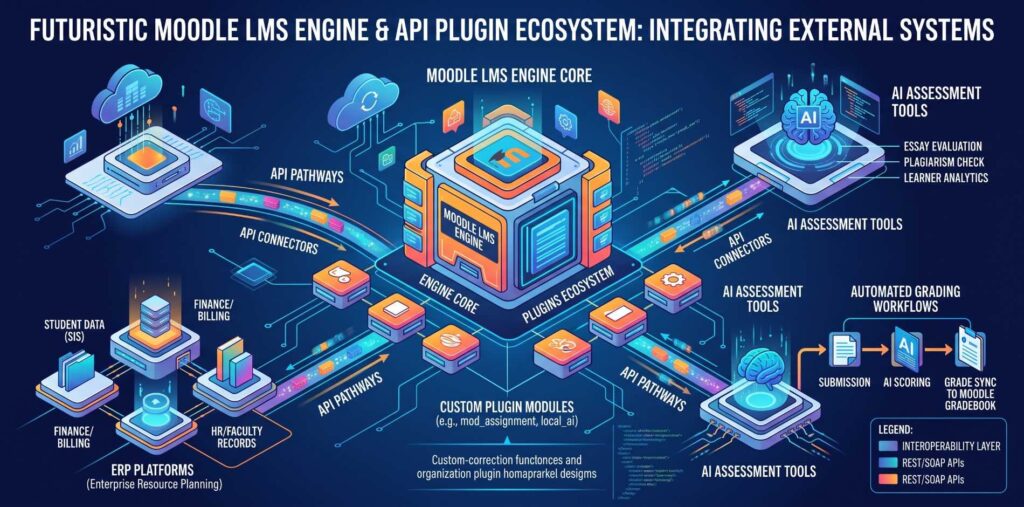
Custom Moodle development takes Moodle a step further by adding entirely new capabilities that are not available in the standard platform.
Every educational institution has unique operational requirements. Some need custom examination workflows, while others require ERP integration, AI-powered assessments, advanced reporting, or specialized approval processes. These requirements often cannot be fulfilled through configuration alone.
This is where custom Moodle development becomes valuable.
Custom Moodle development may include:
- Custom plugin development
- ERP and Student Information System integration
- HRMS integration
- Payment gateway integration
- AI-powered assessment tools
- Automated approval workflows
- Advanced reporting dashboards
- Digital library integration
- Attendance management systems
- Learning analytics
- Custom APIs
- Mobile application enhancements
Instead of replacing Moodle, custom development extends its capabilities while preserving the platform’s reliability and scalability.
Moodle Customization and Custom Development Work Together
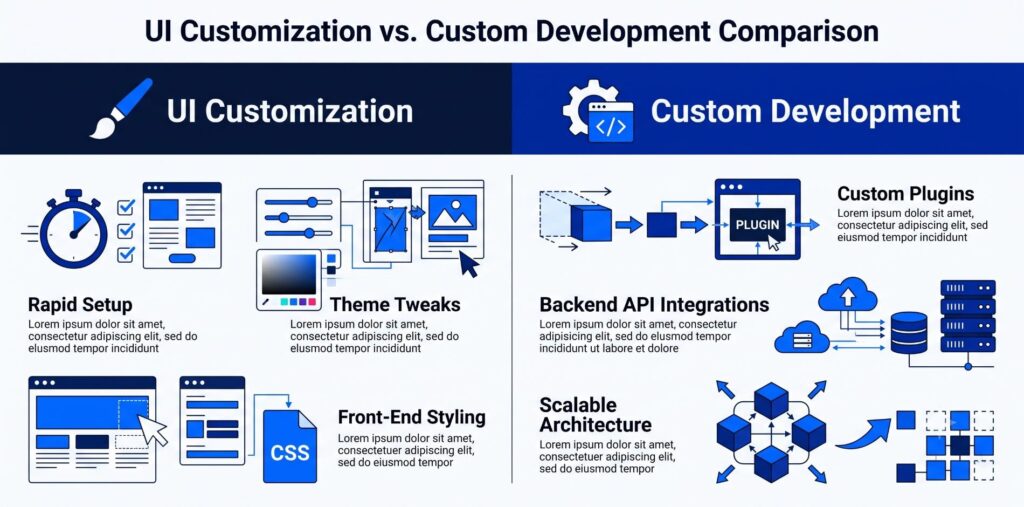
One common misconception is that organizations must choose between customization and development. In reality, they complement each other.
Most successful Moodle implementations begin with customization. Once the institution becomes familiar with the platform and identifies additional requirements, custom development is introduced to address specific business needs.
For example, a university may initially customize Moodle by applying its branding, creating faculty dashboards, and configuring courses. Later, it may add custom plugins for examination management, student approvals, academic analytics, or ERP integration.
This phased approach allows institutions to grow their LMS without replacing the platform or disrupting the learning experience.
Key Differences
Although both approaches improve Moodle, they serve different purposes.
| Feature | Moodle Customization | Custom Moodle Development |
| Purpose | Enhance existing Moodle features | Add entirely new functionality |
| Focus | User experience and configuration | Business-specific solutions |
| Development Time | Shorter | Longer |
| Cost | Lower initial investment | Higher depending on complexity |
| Flexibility | Uses existing Moodle capabilities | Extends Moodle beyond default features |
| Scalability | Excellent | Unlimited possibilities |
| Best For | Branding and workflow improvements | Advanced institutional requirements |
Rather than competing approaches, customization and development are two ways of unlocking Moodle’s full potential.
When Should You Customize Moodle?
Customization is ideal when your institution wants to improve the appearance and usability of the LMS while using Moodle’s existing capabilities.
For example, a coaching institute may require branded dashboards, customized certificates, structured course pages, and online assessments. A school may want role-based access for teachers, students, and parents along with customized reports.
These improvements can significantly enhance the user experience without requiring extensive development.
Customization is particularly useful because it enables institutions to:
- Launch their LMS quickly
- Create a professional appearance
- Improve navigation
- Strengthen institutional branding
- Increase learner engagement
- Maintain compatibility with future Moodle updates
When is Custom Moodle Development the Right Choice?
As educational institutions grow, their operational processes often become more specialized. Standard LMS functionality may no longer be sufficient to support complex academic or administrative workflows.
Custom Moodle development becomes the right choice when organizations need features specifically designed for their operations.
Examples include:
- Online admission workflows
- Examination approval systems
- AI-powered essay evaluation
- Faculty workload management
- Department-wise analytics
- Student progression tracking
- Multi-campus administration
- Integration with ERP or HR software
- Subscription-based learning platforms
- Custom mobile applications
Instead of adapting institutional processes to fit the software, Moodle can be extended to support the institution’s existing workflows.
This flexibility is one of Moodle’s greatest strengths.
The Biggest Advantage of Moodle
Unlike many proprietary LMS platforms, Moodle does not limit organizations to predefined features.
As your institution grows, Moodle grows with you.
You can begin with a basic implementation and gradually add new modules, integrations, dashboards, reports, mobile features, and automation whenever required.
This means your LMS remains relevant for years without needing a complete replacement.
For educational institutions looking for a long-term digital learning solution, this scalability offers significant value.
Why Educational Institutions Prefer Moodle
Educational institutions across India continue to invest in Moodle because it offers:
- Complete ownership of the platform
- No licensing costs for the LMS itself
- Strong security and reliability
- Thousands of community-supported plugins
- Easy scalability
- Mobile-friendly learning
- Regular updates
- Flexibility to customize every aspect of the learning experience
- Integration with third-party software
- Support for institutions of every size
Whether you’re managing 500 students or 50,000 learners, Moodle provides the flexibility to meet your current needs while preparing for future growth.
Choosing the Right Moodle Partner

While Moodle provides exceptional flexibility, achieving the best results depends on how it is implemented.
An experienced Moodle development partner can help identify which features should be customized, which require custom development, and how to build a scalable LMS that supports your institution’s long-term goals.
A well-planned Moodle implementation not only improves the learning experience but also simplifies administration, enhances reporting, and reduces manual work for educators and administrators.
Conclusion
The discussion shouldn’t be “Custom Moodle Development vs Moodle Customization.” Instead, it should be how to make the most of Moodle’s flexibility.
Customization allows institutions to personalize and optimize Moodle’s existing capabilities, while custom development extends the platform with new features tailored to specific academic and business requirements. Together, they create a powerful, scalable, and future-ready learning ecosystem.
Whether you’re a school implementing digital classrooms, a university managing multiple campuses, a coaching institute delivering online courses, or an EdTech company building an innovative learning platform, Moodle provides the flexibility to support your vision at every stage.
At Rannlab Technologies, we specialize in helping educational institutions unlock the full potential of Moodle through professional customization, custom plugin development, third-party integrations, performance optimization, and enterprise LMS solutions. Our goal is to build Moodle platforms that are secure, scalable, easy to manage, and designed to grow alongside your institution.
With the right implementation strategy and an experienced Moodle development partner, Moodle becomes more than just an LMS—it becomes the foundation of a complete digital learning ecosystem.
