Emergency response technology decides what happens in the ninety seconds after a child is found alone at a ghat. Nashik Simhastha 2027 is projected to draw 10 to 12 crore pilgrims across a mela running from flag hoisting on 31 October 2026 to closing rites in July 2028. At that scale, the constraint is never compassion. It is information.
This guide sets out the four-layer readiness model we use, what the 2025 Maha Kumbh proved about digital reunification, and where the remaining gap sits.
What is emergency response technology at a mass gathering?
Emergency response technology is the system that turns an unidentified person into an identified one, fast. It links identity, critical medical information, family contacts and responder coordination into a single verified record a first responder can reach in seconds, without needing the person to speak.
That is the whole test of emergency response technology. Crowd cameras count people. Command centres route resources. Neither tells a volunteer holding a frightened six-year-old who her mother is, or warns a paramedic that the unconscious man in front of him is on blood thinners.
Why Nashik 2027 demands better emergency response technology
The Maharashtra government has designated the 2027 Simhastha a Technology-Enabled Kumbh, with the Nashik-Trimbakeshwar Kumbh Mela Authority overseeing AI-driven crowd monitoring, a pilgrim mobile app and an e-pass system under administrative review.
The scale explains why emergency response technology moves from useful to essential. The 2015 Nashik Kumbh recorded roughly 2.5 crore pilgrims. The 2027 projection is four to five times larger, concentrated across two sites 28 km apart — Ramkund in Nashik and Kushavarta Kund in Trimbakeshwar — with peak density on three Amrit Snan dates: 2 August, 31 August and 11–12 September 2027.
Millions arrive within hours on those days. Many are elderly. Many travel from states whose language they will not hear at the help desk.
What the 2025 Maha Kumbh actually proved
This is the part most vendors skip, and it matters.
At Prayagraj in 2025, ten digital lost-and-found centres equipped with AI-based facial recognition, machine learning and multilingual support reunited more than 20,000 people with their families. On Mauni Amavasya alone, 8,725 devotees were reunited. Basant Panchami accounted for 813, Makar Sankranti 598.
Those numbers are a genuine success for emergency response technology, and they set the benchmark Nashik will be measured against. They also expose the structural limit.
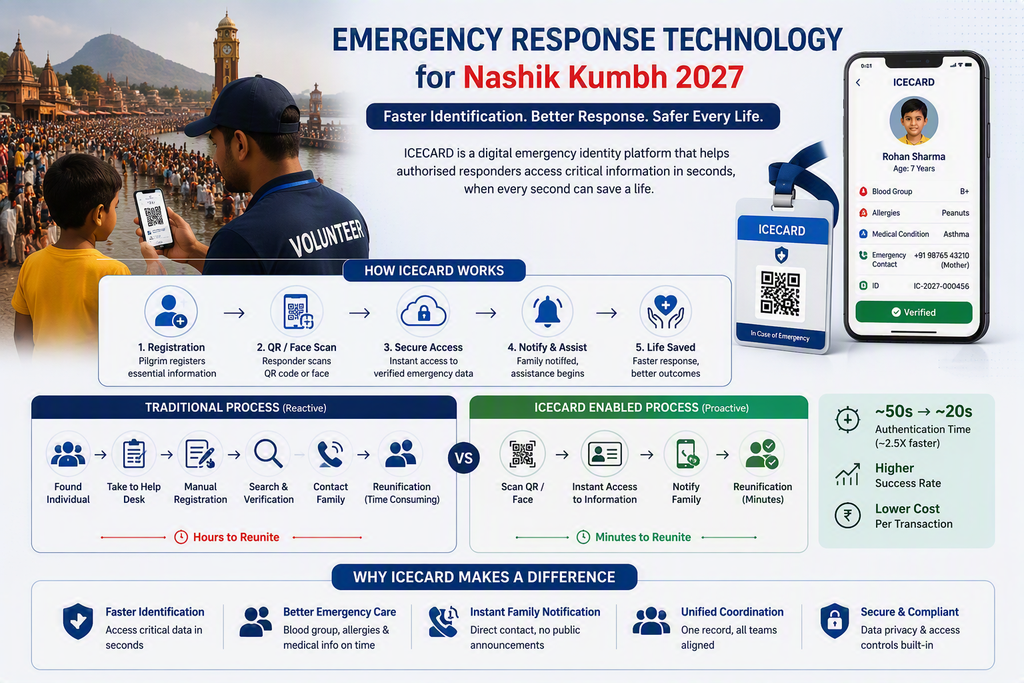
Every one of those reunifications began after the person was already lost. Someone had to find them, bring them to a centre, photograph them, register them, and wait for a cross-match. The planned 2027 system improves this further with a centralised cloud database linking every Bhule Bhatke camp, police outpost and medical station for real-time cross-matching.
It is still reactive. The record is created at the moment of crisis.
The gap: identity created before the crisis, not during it
Reactive emergency response technology works when the found person can be photographed and matched against a report someone else filed. It struggles in three specific cases.
No report exists yet. A family may not realise a child is missing for twenty minutes. Until they report, there is nothing to match against.
The person cannot contribute information. An unconscious patient, a child too young to give a surname, a pilgrim with dementia. Facial recognition matches a face to a database entry. It cannot invent one that was never created.
Medical urgency outruns identification. Knowing who someone is does not tell a paramedic their blood group, allergies or current medication.
Pre-registered emergency response technology inverts the sequence. The record exists before the person arrives at the mela. Recognition becomes retrieval, not investigation.
How ICECARD delivers emergency response technology
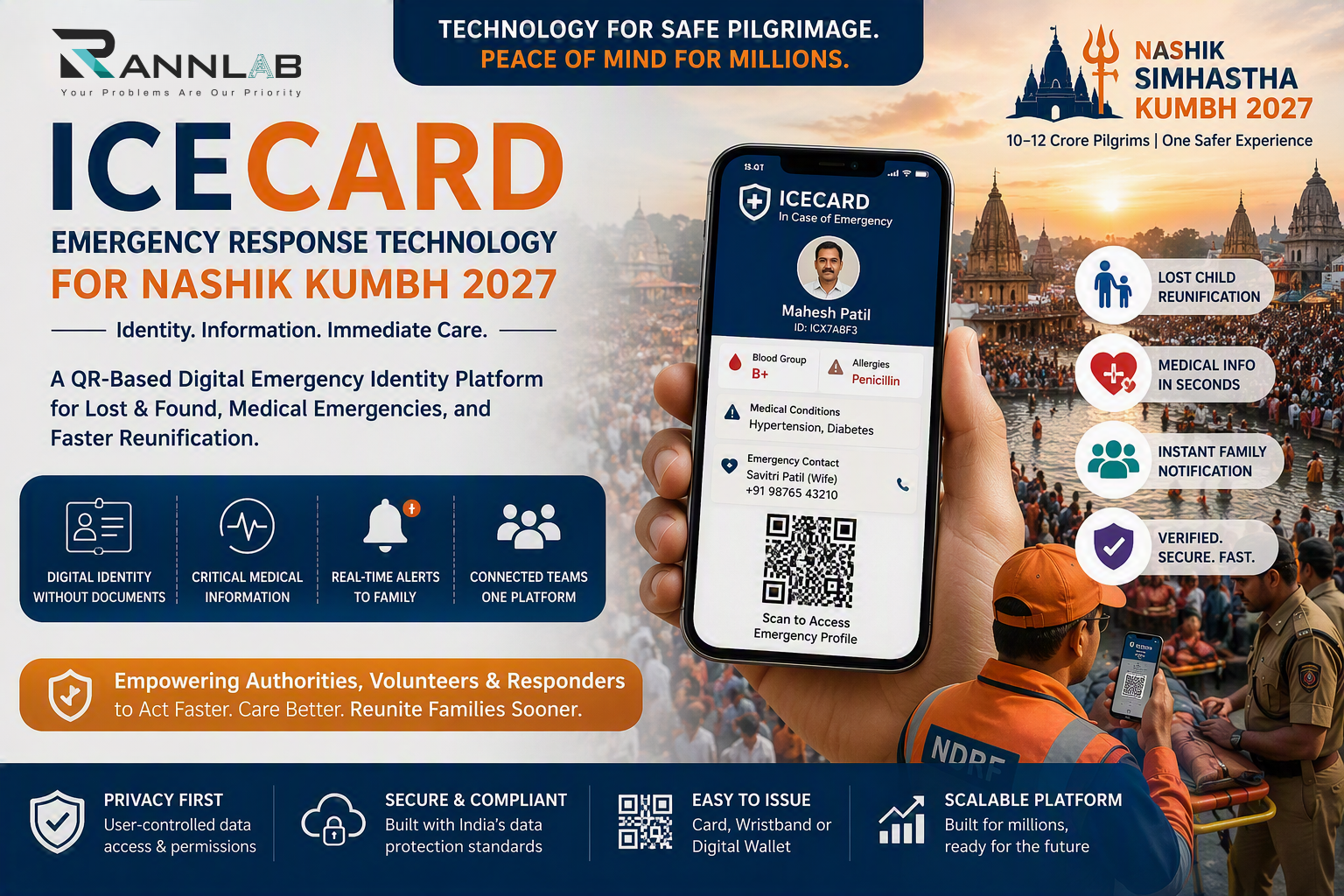
ICECARD is a digital identity and emergency response platform built by RannLab Technologies, live on Android and iOS.
Registration. A pilgrim creates an emergency response technology profile carrying emergency contacts, blood group, medical conditions, allergies, organ donor status, insurance details and profiles for accompanying children.
Two retrieval paths. A responder can scan the person’s QR code — on a card, wristband or event badge — or use face scan, which matches against the registered profile. The second path is the one that matters at a mela, because a lost child may have no card, no phone and no way to explain who she is.
Controlled disclosure. An anonymous scan surfaces only designated public health information. Authorised contacts see more, governed by permissions the user sets at registration.
Notification. Emergency contacts are alerted through app, push and SMS. Where the user has enabled it, location can be shared with the people trying to reach them.
Organisation deployment. Profiles are issued in bulk under an organisation account via API, so an authority, temple trust or NGO can onboard pilgrims at registration desks rather than one at a time.
Four layers every emergency response technology must cover
Every large gathering should be able to answer four questions. We assess deployments against them.
| Layer | Question | Failure looks like |
|---|---|---|
| 1. Identity | Who is this person? | Hours of manual verification; unclaimed children held overnight |
| 2. Medical | What must a clinician know now? | Treatment delayed while history is reconstructed |
| 3. Notification | Can family be reached directly? | Public announcements into a crowd of lakhs |
| 4. Coordination | Do all agencies see the same record? | Police, medical and volunteer teams on separate registers |
Most event platforms strengthen layer 4 and assume layers 1 to 3 resolve themselves. They do not. Emergency response technology has to hold all four.
The cost of a gap in emergency response technology
Work this in your own numbers rather than accepting ours.
Prayagraj 2025 produced over 20,000 reunifications through digital centres. If Nashik sees even a third of that volume, that is roughly 6,700 incidents. Assume an average of two hours per case under a reactive process — finding, transporting, registering, matching, verifying, releasing — staffed by two people.
That is roughly 26,800 volunteer and officer hours consumed by identification. Compress that step and a meaningful share of capacity returns to crowd control, medical response and ghat management on the days it is scarcest.
The harder cost is not administrative. It is the interval during which a parent does not know where their child is.
Emergency response technology self-audit for event authorities
Six questions. Each “no” is a gap you will discover under pressure rather than in planning.
- Can a volunteer identify a lost child who carries no document and cannot state a surname?
- Can a paramedic access blood group and allergy information for an unconscious patient in under a minute?
- Can your team contact a family directly, rather than announcing a name over a public address system?
- Do police, medical and volunteer teams read from the same record, or separate registers?
- Can a pilgrim be identified before anyone has filed a missing-person report?
- Is consent for holding this data captured, logged and time-bound?
Scoring. Five or six yes: genuinely ready. Three or four: you have a defined remediation path before October 2026. Fewer than three: identification, not crowd flow, is your critical path.
Where this applies beyond the Kumbh
The same emergency response technology model holds wherever people gather or where someone may need help while unable to speak for themselves.
- Temple trusts and pilgrimage circuits with recurring high-density days
- Schools managing student emergency contacts and medical alerts
- Hospitals needing patient information at triage
- Senior living communities, corporate campuses, marathons and stadium events
Honest limits of emergency response technology
It is not crowd management, and it does not prevent a stampede. It does not replace the Bhule Bhatke camps, the police outposts or the volunteers who do the actual work of caring for people.
Emergency response technology also depends on adoption. A platform nobody registered for helps nobody. That makes onboarding at railway stations, registration desks and accommodation check-ins an operational question, not a technical one — and it is the single largest determinant of whether a deployment works.
Any system holding health and identity data must satisfy India’s Digital Personal Data Protection Act, 2023, with explicit consent, purpose limitation, defined retention and controlled access.
What we are proposing for Nashik 2027
RannLab Technologies is a Greater Noida technology company building healthcare IT, digital trust infrastructure and public safety platforms. ICECARD is our emergency response technology product, and Nashik Simhastha 2027 is the deployment we have built toward.
Our position is straightforward. Emergency response technology should sit beneath the mela authority’s crowd intelligence and command systems, not compete with them — closing the last-mile identity gap so that when a volunteer finds a child, identification takes seconds rather than hours.
We are seeking conversations with the Nashik-Trimbakeshwar Kumbh Mela Authority, district administration, police, health departments, temple trusts and NGOs at the mela.
Talk to our public safety team
When a volunteer finds a lost child, identification should take seconds. Tell us three things and we will show you where your gap sits.
- Expected footfall and peak-day concentration
- Agencies involved — police, medical, volunteers, NGOs
- How identification works today
You get back a deployment plan, onboarding model and integration approach — assessed honestly, including where you do not need us.
Tell us your expected footfall, the agencies involved, and how identification works today. We will assess your emergency response technology gap honestly and return a deployment plan, onboarding model and integration approach.
Frequently asked questions
How does emergency response technology help at the Kumbh?
It closes the last-mile information gap. Command centres track crowd density, but a responder still needs to know who the individual in front of them is. A pre-registered profile delivers identity, blood group, allergies and family contacts in seconds, so teams act instead of investigating.
How does ICECARD differ from the 2025 lost-and-found centres?
Those centres registered people after they were found, then cross-matched against reports. ICECARD creates the record before the mela, so a scan retrieves an existing profile rather than building one mid-crisis. The approaches complement each other.
What if a lost child has no card or phone?
Face scan is the primary path. If the child was registered under a guardian’s profile, a scan surfaces the guardian’s contact details without the child needing to say anything.
Who is allowed to scan a profile?
Access is tiered. An anonymous scan reveals only designated public health information. Fuller details require authorisation, with permissions set by the user at registration.
Does it work without internet connectivity?
Connectivity behaviour depends on deployment configuration, and authorities should confirm this during technical evaluation.
Is the data compliant with Indian privacy law?
Any deployment must satisfy the Digital Personal Data Protection Act, 2023 — explicit consent, purpose limitation, defined retention and controlled access.
Can it be issued as a wristband or event badge?
Yes. The profile works through a digital card, printed ID, wristband or badge, matching your existing accreditation format.
Can this emergency response technology integrate with a command centre?
Organisation accounts and API-based issuance support integration with existing systems. Scope depends on the authority’s architecture and is defined during technical assessment.
