

The era of relying solely on a basic SSL certificate, a strong admin password, and a generic perimeter firewall is long gone. In 2026, web applications are no longer isolated digital brochures; they are hyper-connected, complex ecosystems heavily integrated with third-party APIs, serverless cloud infrastructure, and AI-driven microservices. Consequently, the digital attack surface has never been broader—or more vulnerable.
Automated botnets, sophisticated software supply chain compromises, and AI-assisted exploitation tools mean that vulnerabilities are now discovered and weaponized in minutes, not months. For modern engineering teams, website security best practices can no longer be an afterthought applied right before a site goes live. Security must be woven into the very fabric of the codebase from day one.
Summary:
- Systemic Failures: The latest OWASP Top 10 highlights a definitive shift from isolated code bugs to systemic infrastructure flaws, with Broken Access Control remaining the absolute top threat.
- Shift-Left Security: Integrating automated security testing (SAST/DAST) directly into the CI/CD pipeline is now the industry standard, making vulnerability remediation drastically cheaper and faster.
- Zero Trust Architecture: Never assume internal traffic is safe. Every input, user, and API call must be continuously validated, regardless of origin.
- Authentication: Passwordless authentication (WebAuthn) and mandatory Multi-Factor Authentication (MFA) are critical requirements to preventing account takeovers and credential stuffing.
- Supply Chain Transparency: Generating a Software Bill of Materials (SBOM) for every build is mandatory in 2026 to track and manage vulnerabilities in open-source components.
What are Website Security Best Practices?
Website security best practices are the collective strategies, secure coding protocols, and runtime defenses utilized by software developers and engineers to protect web applications and user data from cyber threats. In 2026, this encompasses implementing “shift-left” automated vulnerability scanning within CI/CD pipelines, enforcing strict Role-Based Access Control (RBAC), utilizing parameterized queries to prevent SQL injections, and securing third-party API dependencies to mitigate software supply chain compromises.
1. The 2026 Threat Landscape: Understanding the OWASP Shifts
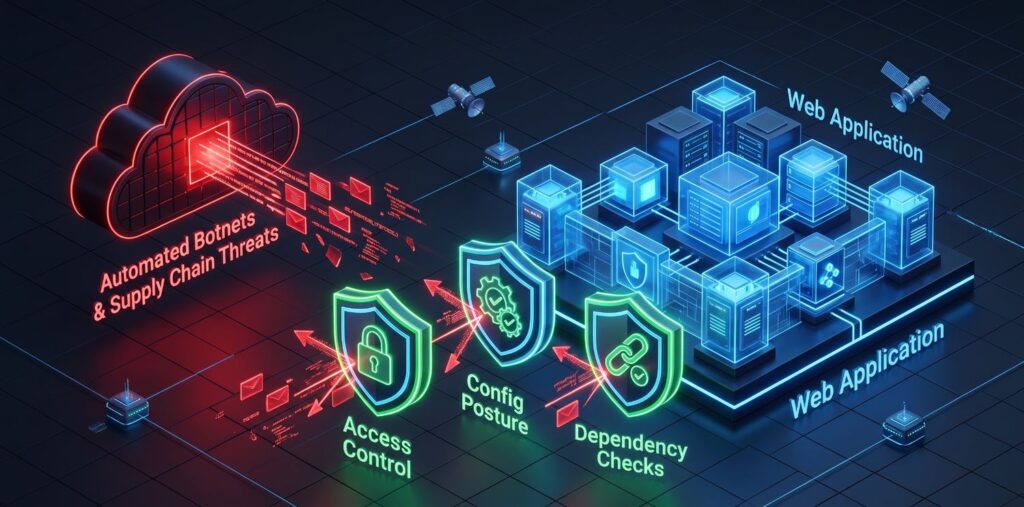
To effectively defend a digital system, you must first understand exactly how it is being attacked. The Open Worldwide Application Security Project (OWASP) Top 10 list has shifted its focus over the last few years to reflect modern architectural realities. It is no longer just about classic SQL injections; the focus is heavily on systemic architectural flaws and logic abuses.
According to recent data breach investigation reports, web application attacks consistently account for the largest share of data breaches globally, driven primarily by stolen credentials and access control failures.
The Top Modern Vulnerabilities
- Broken Access Control: This remains the highest risk. Attackers manipulate URLs, API parameters, or application state to view restricted data, bypass authorization checks, or gain administrative privileges. This is a flaw in business logic, making it notoriously difficult for automated tools to catch without manual human testing.
- Cryptographic Failures: Moving beyond just missing SSL certificates, this involves weak encryption algorithms, poor API key management, and the improper hashing of passwords. In 2026, data must be encrypted both in transit and at rest.
- Security Misconfiguration: With the rapid rise of complex cloud environments (AWS, Azure, Google Cloud), leaving default permissions open, neglecting security headers, or misconfiguring cloud storage buckets is a leading cause of massive enterprise data leaks.
- Software Supply Chain Failures (Vulnerable Components): You are only as secure as your weakest third-party dependency. If a popular open-source JavaScript (npm) or Python (pip) package you use is compromised, your entire application is instantly vulnerable.
To ensure your overall site structure naturally mitigates configuration risks, read our companion guide on SEO-Friendly Website Architecture, which covers secure, flat data hierarchies.
2. Shift-Left: The DevSecOps Revolution
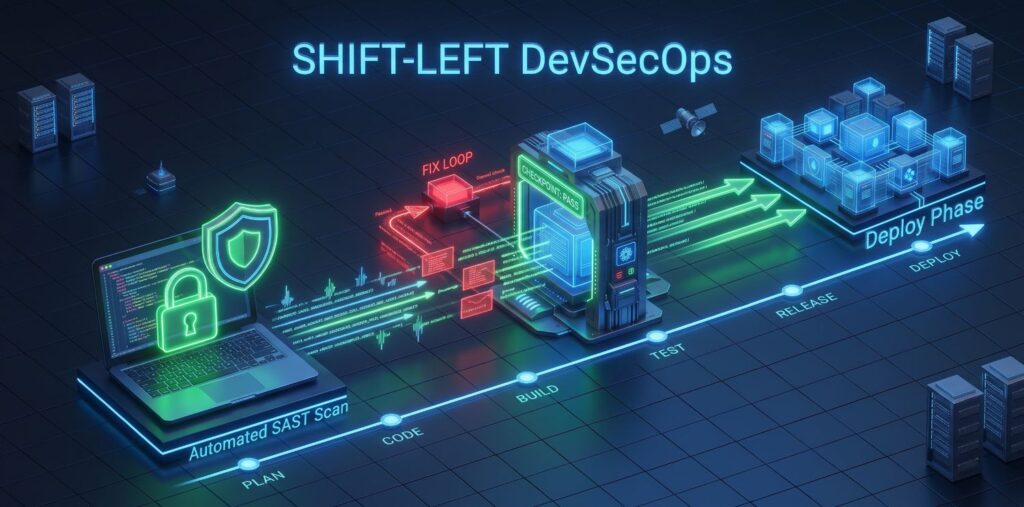
Historically, cybersecurity testing happened at the very end of the Software Development Life Cycle (SDLC)—often just days before launch. By then, fixing deep architectural flaws was incredibly expensive and delayed deployment.
The most important of all website security best practices in 2026 is the “Shift-Left” approach. This means integrating security into the earliest possible phases of development, transforming DevOps into DevSecOps.
A. Pre-Commit Hooks and Local Scanning
Security starts on the developer’s local machine. Implement pre-commit hooks to automatically check for exposed secrets (like AWS keys or database passwords), run code linting, and perform static analysis before the code even reaches the shared repository.
B. Automated Pipeline Scanning (SAST & DAST)
- SAST (Static Application Security Testing): Integrate SAST tools (like Snyk, SonarQube, or GitHub Advanced Security) to read and analyze your source code for vulnerabilities as you write it.
- DAST (Dynamic Application Security Testing): Once the code is compiled into a staging environment, DAST tools simulate real-world attacks (like cross-site scripting or injection attempts) from the outside in to see how the running application reacts.
C. The Software Bill of Materials (SBOM)
In 2026, maintaining an SBOM is a critical compliance standard. An SBOM is a formally structured list of all open-source libraries, frameworks, and third-party dependencies used in your application. If a zero-day vulnerability (like the infamous Log4j flaw) is announced, your SBOM allows you to instantly know if you are affected and where to patch.
3. Core Secure Coding Practices for Developers

No amount of expensive external firewalls can protect fundamentally flawed code. Developers must enforce these strict, proactive secure coding practices to prevent modern cyber attacks.
A. Input Validation and Sanitization
Never, under any circumstances, trust user input. Whether a user is submitting a standard contact form, uploading an avatar image, or modifying a URL search parameter, the data must be rigorously validated and sanitized on the server side.
- Preventing SQL Injection (SQLi): Always use parameterized queries (Prepared Statements) or an Object-Relational Mapper (ORM) to interact with databases. This ensures that the database engine treats user input strictly as data, never as executable code.
- Preventing Cross-Site Scripting (XSS): Strictly encode all data before rendering it in the browser. This prevents attackers from injecting malicious JavaScript payloads into your users’ active sessions.
B. Modern Authentication and Authorization (Zero Trust)
Weak passwords and poor session management are massive liabilities. The modern web operates on a “Zero Trust” model—meaning you verify every request, regardless of whether it originates from inside or outside the network.
- Implement WebAuthn and Passkeys: Move aggressively toward passwordless authentication utilizing device biometrics (FaceID, TouchID, Windows Hello).
- Strict RBAC (Role-Based Access Control): Apply the principle of least privilege. A user or a service account should only be granted the absolute minimum permissions necessary to perform its specific function.
- Note on Ecommerce: If you are processing financial transactions, tokenization and strict PCI-DSS compliance are legally mandatory. Review our specific financial security protocols for digital retail in Ecommerce Website Development: Architecture Best Practices.
C. Secure Error Handling
Failing to handle errors securely can inadvertently leak sensitive system architecture details to attackers. Limit the detail in public-facing error messages (avoid showing stack traces to end-users). Design systems to “fail securely”—meaning if an authorization check crashes, it should default to denying access rather than granting it.
4. Defending the API Ecosystem

Modern web application security 2026 is deeply intertwined with API security. Modern decoupled applications (as detailed in our guide to Custom Web Application Development) are essentially collections of APIs talking to frontend frameworks and third-party microservices. Your API endpoints are your new primary perimeter.
- Rate Limiting and Throttling: Implement strict rate limiting to prevent brute-force login attempts, credential stuffing, and Distributed Denial of Service (DDoS) attacks against your endpoints.
- Token Security and Expiration: Use securely signed, short-lived JSON Web Tokens (JWTs) for API authentication. Ensure you have a robust revocation mechanism to instantly invalidate tokens if a user session is compromised.
- API Gateways: Route all incoming API traffic through a centralized, secure API gateway. This allows you to enforce consistent security policies, monitor for traffic anomalies, and prevent direct endpoint exposure.
5. Runtime Protection and Server-Side Defenses
Even with perfectly written code and rigorous automated testing, zero-day vulnerabilities can and will emerge. You need defensive layers that protect the application dynamically while it runs in the production environment.
Web Application Firewalls (WAF)
A modern Web Application Firewall (such as Cloudflare, AWS WAF, or Fastly) sits in front of your origin server and inspects all incoming HTTP traffic. It identifies and blocks malicious payloads, botnet scrapers, and volumetric DDoS attacks before they ever reach your application code.
Content Security Policy (CSP)
A robust Content Security Policy (CSP) header is a browser-side mechanism that tells the user’s browser exactly which domains are permitted to load executable scripts, CSS styles, and images. A well-configured CSP effectively neutralizes the vast majority of Cross-Site Scripting (XSS) attacks by refusing to execute inline scripts or scripts loaded from untrusted external domains.
Centralized Security Logging and Monitoring (SIEM)
You cannot stop an attack if you are completely blind to it. Missing or insufficient logging is a critical OWASP Top 10 failure.
- Pipe all security events (failed logins, privilege escalations, firewall blocks, critical errors) into a centralized SIEM (Security Information and Event Management) system to detect anomalies in real-time.
- Privacy Warning: Ensure that sensitive data (like passwords, credit card numbers, or PII) is aggressively masked or excluded from these logs entirely to maintain compliance.
Budgeting Note: High-level security retainers, continuous vulnerability scanning tools, and premium enterprise WAF licenses significantly add to your project overhead.
Frequently Asked Questions (FAQ)
What is the difference between authentication and authorization in web security? Authentication is the process of verifying who you are (e.g., logging in with a username, password, and MFA code). Authorization is the process of verifying what you are allowed to do once the system knows who you are (e.g., an editor can write a blog post, but only a super-admin can delete a user account).
Is an SSL certificate (HTTPS) enough to secure my website? Absolutely not. An SSL/TLS certificate encrypts the data traveling between the user’s web browser and your server, protecting it from interception (man-in-the-middle attacks). However, it does nothing to stop an attacker from submitting malicious executable code (like a SQL injection or XSS payload) directly through that secure, encrypted connection.
How often should developers run vulnerability scans? In 2026, vulnerability scanning must be continuous. Instead of performing a single scan right before a launch or once a quarter, automated SAST and dependency scanning tools should run in the background during every single code commit or pull request. This ensures vulnerabilities are caught and remediated by developers before the flawed code is ever merged into the main production branch.
What is a Zero Trust Architecture? Zero Trust is a security framework that eliminates the concept of a “trusted internal network.” It operates on the principle of “never trust, always verify.” Regardless of whether an API call or user request originates from a corporate office network or an external public IP, the system requires strict identity verification and device validation before granting access to resources.
Why are APIs targeted so heavily by hackers in 2026? APIs (Application Programming Interfaces) are heavily targeted because they often expose the core business logic and direct database connections of an application. If an API endpoint is poorly secured or lacks proper rate limiting, an attacker can extract massive amounts of raw, structured data much faster than trying to scrape a traditional frontend website.
Is Your Application Architecture Truly Secure?
Cybersecurity is not a static product you purchase; it is a continuous, evolving process that you must engineer into your daily operations. If your development team is relying on outdated CMS plugins, lacking a modern Web Application Firewall, or failing to automatically scan code dependencies during the build process, your business data—and your customers’ trust—is currently at severe risk. Don’t wait for a costly data breach and a ruined reputation to take action.
Contact us for a Comprehensive Application Security Audit Today
