
You can write the most compelling, beautifully formatted content in your industry, but if search engine bots cannot effectively crawl and understand your website, no one will ever read it.
In 2026, the landscape of search is evolving rapidly with the integration of AI-powered Answer Engines. However, the foundational rules of technical SEO remain absolute. Search engines—whether traditional crawlers or modern LLM bots—rely on a logical, SEO-friendly website architecture to discover, categorize, and rank your content.
If your site resembles a disorganized maze of broken links, infinite scroll traps, and orphaned pages, you are actively sabotaging your organic growth.
Summary:
- The 3-Click Rule: A flat architecture ensures that search engines and users can reach your most valuable pages within three to four clicks from the homepage.
- Crawl Budget: Google allocates a limited “crawl budget” to your site. Wasting it on duplicate pages or faceted navigation means important content goes unindexed.
- AI Readiness: In 2026, structuring data with robust Schema markup and utilizing
llms.txtfiles directly aids in surfacing your content in AI Overviews.- Indexability: Without proper internal linking, bots cannot flow through your site, resulting in “orphan pages” that generate zero search traffic.
What is SEO-Friendly Website Architecture?
An SEO-friendly website architecture refers to the logical, hierarchical organization of a website’s pages, categories, and internal links. Its primary goal is to provide a seamless user experience while allowing search engine crawlers (like Googlebot) to efficiently discover, crawl, and index the site’s content. A well-planned architecture distributes “link equity” evenly and prevents valuable pages from being buried too deep in the site structure.
1. The Foundation: Crawlability vs. Indexability
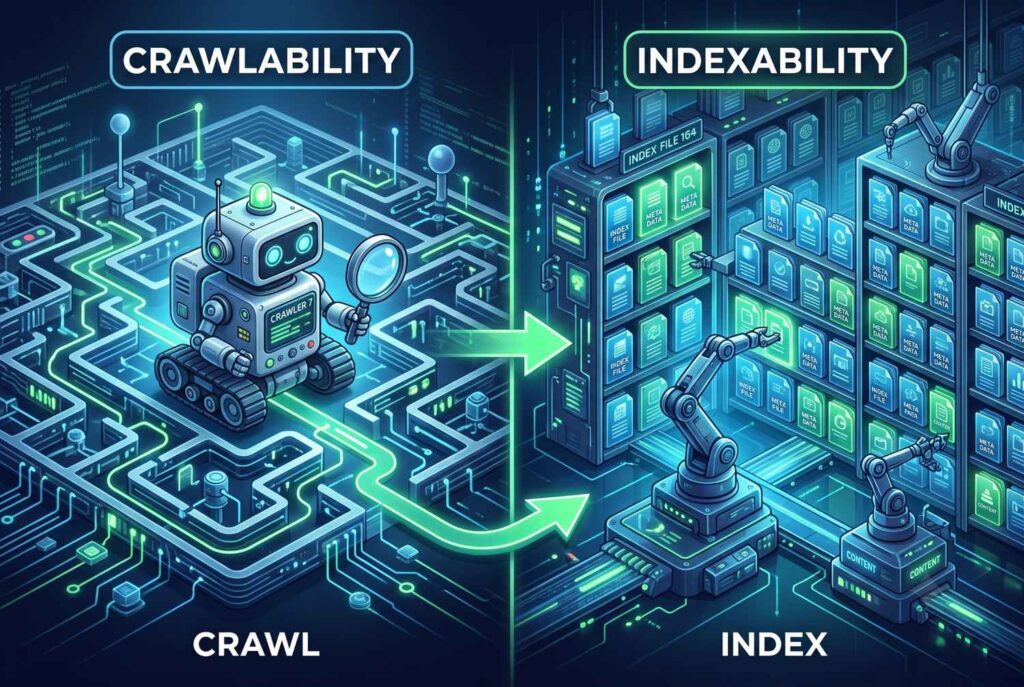
Before optimizing your structure, you must understand the two distinct phases of how search engines process your website:
- Crawlability: This is Google’s ability to actually find and navigate your web pages. Crawlers use internal links as a roadmap. If a page has no links pointing to it (an orphan page), the crawler hits a dead end.
- Indexability: Just because Google crawled a page does not mean it will save it. Indexability refers to Google’s ability to analyze the content and add it to its database. If a page has thin content, a
noindextag, or severe canonicalization issues, it will be crawled but excluded from the index.
Your architecture dictates both. A clean structure ensures 100% crawlability and highly targeted indexability.
2. Flat vs. Deep Website Architecture
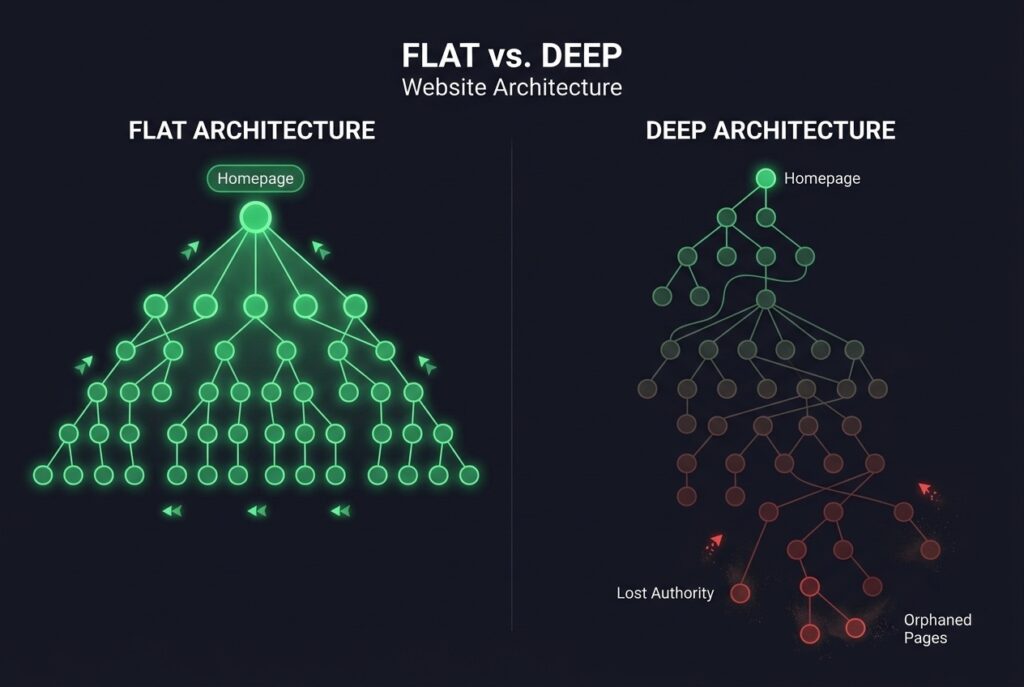
Website architecture generally falls into two categories: flat and deep. For modern SEO, flat website architecture is the undisputed champion.
The Flat Architecture Advantage
A flat site structure ensures that any page on your website is only a few clicks away from the homepage.
- Homepage ➔ Category ➔ Subcategory ➔ Product/Article
This shallow hierarchy dramatically improves crawl efficiency. Search engine bots assign the highest authority to your homepage. The closer a page is to the homepage, the more of that “link equity” (or link juice) it receives.
Conversely, a deep architecture buries content under six or seven layers of navigation. By the time the crawler reaches the bottom layer, the perceived authority of that page is virtually zero, and it may never be indexed.
3. URL Structure and Taxonomy
Your URLs are the signposts for your architecture. They should be clean, readable, and keyword-focused. Search engines and users should be able to guess what a page is about just by looking at the URL string.
- Poor URL:
www.example.com/store/items?id=8675309&category=shoes - SEO-Friendly URL:
www.example.com/store/mens-shoes/running-sneakers
Maintain a logical folder hierarchy. If you move a product or article, ensure you implement strict 301 single-hop redirects. Avoid redirect chains (A ➔ B ➔ C), as these dilute link equity and frustrate crawlers.
4. Internal Linking and Breadcrumbs
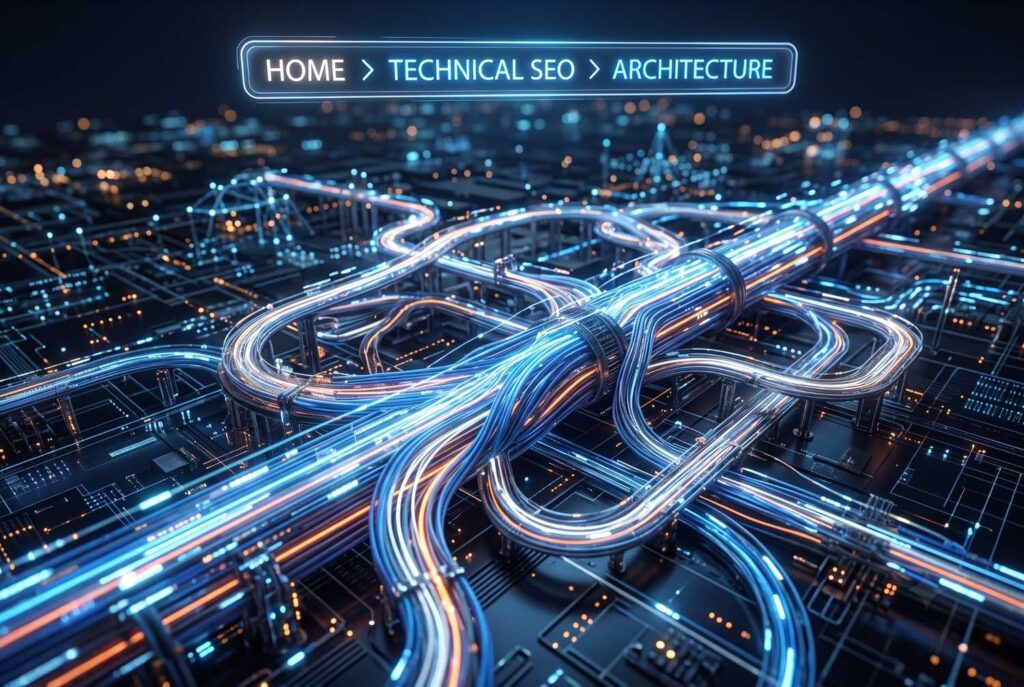
Think of internal links as the plumbing of your website. They dictate how authority flows from high-traffic pages to lower-traffic pages.
- Contextual Linking: Do not just rely on your top navigation menu. Embed links naturally within the body text of your articles, just as we link to our guide on Mobile-First Web Design: Why Responsive Website Development is Now Non-Negotiable.
- Breadcrumb Navigation: Breadcrumbs (e.g., Home > SEO Services > Technical SEO > Website Architecture) provide a secondary navigation path. They improve the user experience and automatically generate highly structured internal links that search engines love.
5. Maximizing Your Crawl Budget
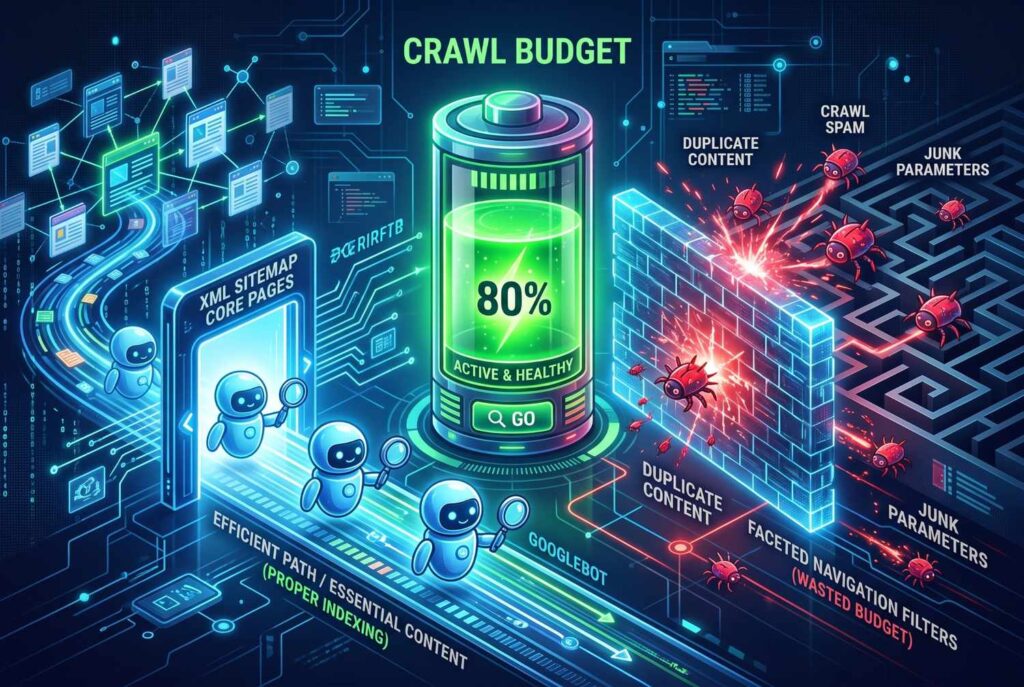
As your site grows, technical efficiency becomes paramount. Google does not have infinite resources; it assigns your site a “crawl budget”—the limited number of pages it is willing to crawl on any given visit.
If you run a large ecommerce store with 10,000+ products, wasting your crawl budget is a massive liability.
- Faceted Navigation: E-commerce filters (size, color, price) can generate millions of unique, low-value URLs. Use
robots.txtor canonical tags to prevent Google from crawling every single filter variation. - XML Sitemaps: Maintain a dynamic, clean XML sitemap. Ensure it only contains 200 OK status pages. Do not force Google to crawl 404 error pages or 301 redirects through your sitemap.
6. Structuring for AI Overviews and GEO
In 2026, optimizing for traditional SERPs (Search Engine Results Pages) is only half the battle. You must structure your site for Generative Engine Optimization (GEO).
AI assistants assemble answers by pulling from highly structured, authoritative sources. To ensure your architecture feeds these engines correctly:
- Schema Markup: Implement advanced structured data (JSON-LD) across your site. Use
Article,FAQPage,Product, andHowToschemas to explicitly tell AI bots what your data means. - llms.txt Files: A new standard for 2026, an
llms.txtfile acts similarly to a robots.txt file, but it specifically guides AI crawlers to your most signal-rich, priority content, bypassing navigational fluff.
Frequently Asked Questions (FAQ)
What is an orphan page in SEO? An orphan page is a web page that has absolutely zero internal links pointing to it from other pages on the same website. Because crawlers navigate via links, orphan pages are essentially invisible to search engines and will not rank.
How many clicks deep should a website be? Following the “3-Click Rule,” a user or search engine crawler should ideally be able to reach any important page on your website within three to four clicks from the homepage.
Do subdomains hurt SEO architecture? Subdomains (e.g., blog.example.com) are often treated by Google as entirely separate entities from your main domain ([www.example.com](https://www.example.com)). Unless you have a specific technical requirement for a subdomain, it is always better for SEO to use subfolders (e.g., [www.example.com/blog/](https://www.example.com/blog/)) to consolidate your domain authority.
Ready to Audit Your Website’s Architecture?
Is your content buried underneath a messy, outdated site structure? If your best pages aren’t generating organic traffic, a technical SEO architecture issue is likely to blame. Stop wasting your crawl budget and start structuring for growth.
Contact Us Today
(Click here to have our senior technical SEO engineers map your current architecture and provide a custom blueprint for maximum search visibility.)
