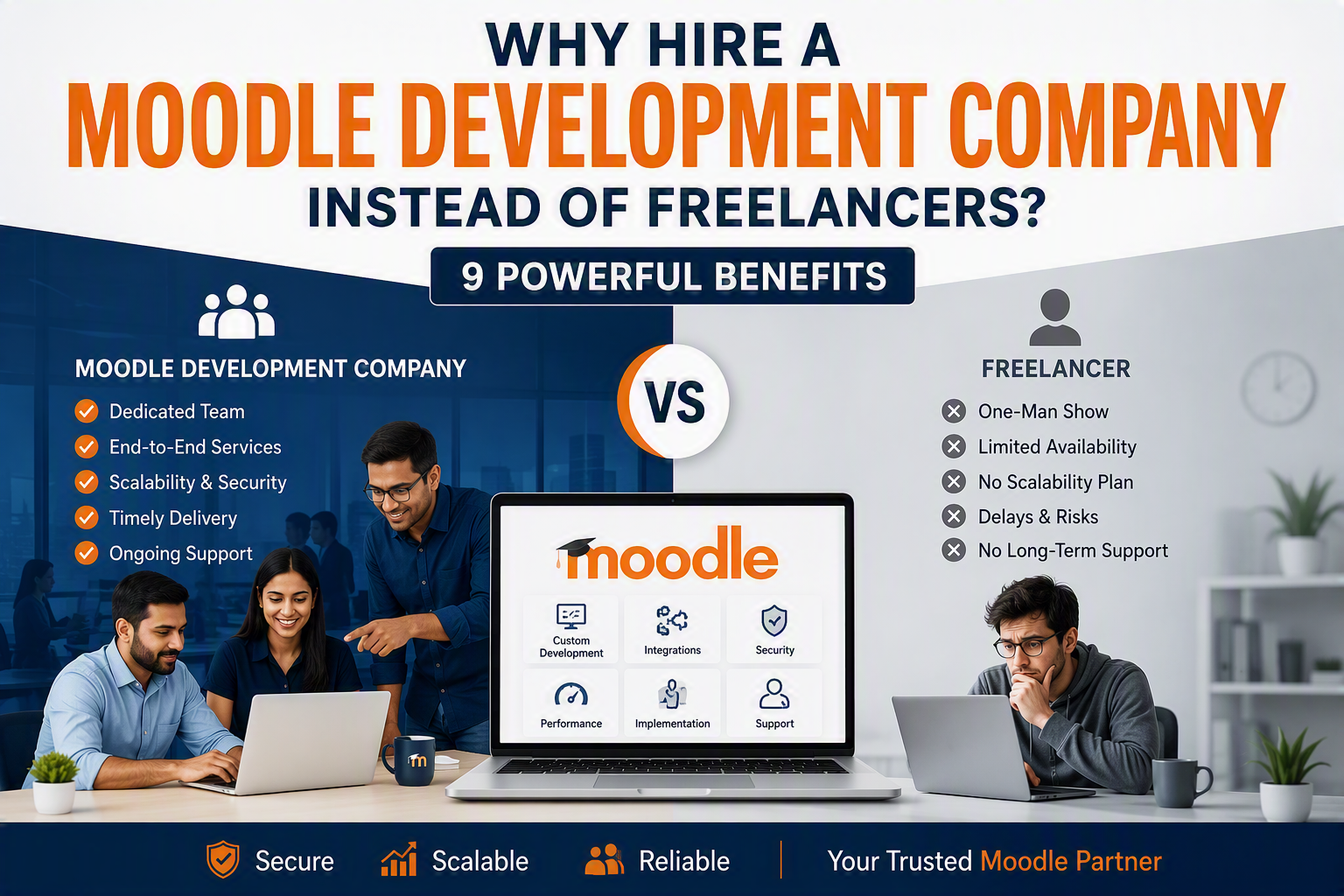
If you’re evaluating options to build, customize, or scale your Learning Management System, you’ve probably weighed the two obvious paths: hire a freelancer, or hire a Moodle Development Company. On paper, a freelancer looks cheaper and faster to onboard. In practice, most universities, training companies, and corporate L&D teams that go this route end up back at square one — chasing a developer who’s gone quiet, patching security gaps, or paying twice to redo work that wasn’t built to scale.
This isn’t a knock on individual developers. It’s a question of what your Moodle project actually needs: continuity, accountability, security, and a team that’s done this dozens of times before — not once.
Below are 9 reasons organizations increasingly choose a dedicated Moodle Development Services provider over freelance talent, and how to tell which one is right for your project.
1. End-to-End Moodle Development Services, Not Piecemeal Work
A freelancer typically handles one slice of a project — a plugin here, a theme tweak there. A Moodle development company delivers the full lifecycle: requirements analysis, architecture, custom plugin development, third-party integrations (SIS, HR, CRM, payment gateways), QA testing, deployment, and post-launch support. When one team owns the whole build, nothing falls into the gap between “that wasn’t part of my scope” and “I assumed someone else handled it.”
2. A Dedicated Team, Not a Single Point of Failure
Hire a freelancer and you’re betting your entire LMS roadmap on one person’s availability, health, and continued interest in your project. If they go dark mid-sprint, get pulled onto a higher-paying gig, or simply move on, you inherit undocumented code and a stalled timeline. A company structure means backend developers, front-end specialists, QA engineers, and project managers are all accountable to each other — and to you.
3. Real Moodle Support and Maintenance Agreements
Freelancers rarely offer formal Moodle Support and Maintenance contracts. Once the invoice is paid, response times slow down fast. A Moodle development company typically offers SLAs — defined response and resolution windows for bugs, security patches, version upgrades, and performance issues. For institutions running Moodle as mission-critical infrastructure, that SLA is the difference between a two-hour fix and a two-week outage.
4. Stronger Security and Compliance Posture
LMS platforms hold sensitive data: student records, employee training history, payment details, sometimes health or certification data tied to compliance frameworks like GDPR, FERPA, or HIPAA. A professional Moodle partner follows secure coding practices, conducts code reviews, and stays current on Moodle security advisories. A solo freelancer, understandably, often doesn’t have the bandwidth to audit every release for vulnerabilities — and one overlooked patch can expose your entire user base.
5. Deeper Moodle Customization Services
Off-the-shelf Moodle rarely matches a growing institution’s exact workflow. Whether it’s custom gradebook logic, white-labeled branding, tailored reporting dashboards, or a bespoke enrollment workflow, Moodle Customization Services from an experienced team draw on patterns tested across dozens of prior implementations — not trial and error on your dime.
6. Built to Scale With You
A freelancer optimizes for “get it working now.” A development company optimizes for “keep working at 10x the users.” That distinction matters enormously once your course catalog, user base, or concurrent exam traffic grows. Proper Moodle LMS Development accounts for caching strategy, database optimization, and server architecture from day one — so scaling later doesn’t mean rebuilding from scratch.
7. Structured Processes Mean Faster, More Predictable Delivery
Agencies work within defined project management frameworks — sprints, milestones, staging environments, documented QA cycles. This structure surfaces problems early, when they’re cheap to fix, rather than at launch, when they’re expensive. Freelance engagements, by contrast, often run on ad hoc timelines with minimal documentation, which creates risk every time a handoff happens.
8. Proven Moodle Implementation Services and Methodology
A company that has delivered dozens of Moodle Implementation Services projects brings a repeatable methodology: discovery, data migration planning, integration mapping, user acceptance testing, and phased rollout. That experience shows up in fewer surprises — and a shorter path from kickoff to go-live.
9. A Long-Term Moodle Partner, Not a One-Off Vendor
Your LMS isn’t a one-time project; it’s infrastructure you’ll depend on for years. Working with an established Moodle Partner means you have a single point of contact for every future need — new integrations, version upgrades, added functionality — instead of re-explaining your entire setup to a new freelancer every time something breaks.
Freelancer vs. Moodle Development Company: A Quick Comparison
| Factor | Freelancer | Moodle Development Company |
|---|---|---|
| Availability | Single person, limited hours | Full team, business continuity |
| Support after launch | Informal, often slow | Structured SLA-based support |
| Security practices | Varies by individual | Standardized code review & audits |
| Scalability planning | Rarely built in upfront | Architected from the start |
| Documentation | Often minimal | Standard project deliverable |
| Long-term partnership | Project-by-project | Ongoing relationship |
| Risk if unavailable | High — project stalls | Low — team covers gaps |
Who Actually Needs This?
This decision matters most for:
- Universities and colleges managing thousands of concurrent learners, integrations with student information systems, and strict data compliance requirements.
- Corporate L&D teams rolling out compliance training, onboarding, or certification programs across large, distributed workforces.
- Training and certification companies whose entire revenue model depends on LMS uptime and a polished learner experience.
If your Moodle instance is a side project with a handful of users, a freelancer might genuinely be enough. If it’s core to how your organization delivers education or trains people, the calculus changes.
Why Organizations Choose Rannlab as Their Moodle Development Company
Rannlab works exclusively in the Moodle ecosystem — development, customization, integration, migration, and enterprise-grade support — for educational institutions, training companies, and corporate learning departments. That focus means our team isn’t learning Moodle on your project; we’re applying patterns already proven across prior implementations to get your platform live faster, more securely, and built to scale.
Ready to move beyond freelance guesswork? Talk to Rannlab’s Moodle experts for a free consultation on your project — whether you’re starting fresh, migrating from another LMS, or need ongoing support for an existing Moodle instance.
Frequently Asked Questions
Is it more expensive to hire a Moodle development company than a freelancer?
Upfront hourly rates can be higher, but total cost of ownership is often lower once you factor in rework, downtime, security incidents, and the cost of re-onboarding a new freelancer mid-project.
Can a Moodle development company help if I already have an existing site built by a freelancer?
Yes. Auditing and stabilizing an existing Moodle instance — including cleaning up undocumented custom code — is a common starting point for many clients.
How long does a typical Moodle implementation take?
Timelines vary by scope, but a structured Moodle Implementation Services engagement typically includes discovery, build, testing, and phased rollout, with clear milestones at each stage rather than an open-ended timeline.
Do you offer ongoing support after launch?
Yes — ongoing Moodle Support and Maintenance is typically set up as a defined SLA covering updates, security patches, and issue resolution, rather than ad hoc, pay-as-you-go
