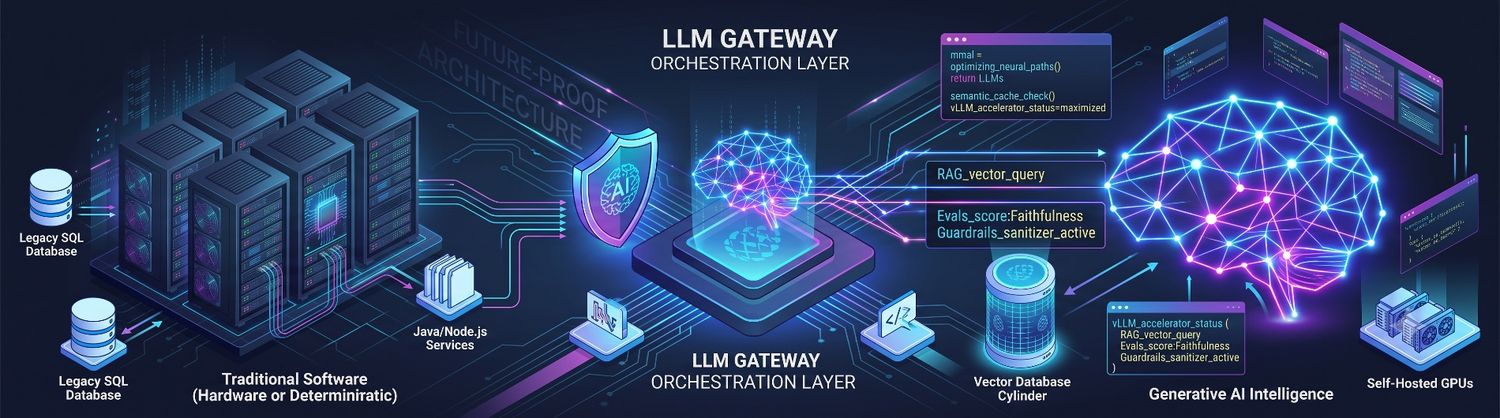
Integrating high-performance AI into traditional enterprise infrastructure requires a fundamental shift in architecture.
Artificial Intelligence is no longer just a futuristic concept relegated to research labs; it is an active, mandatory layer in modern production systems. However, adding AI capabilities to an enterprise application is vastly different from building a simple wrapper around a third-party API.
If you are looking for exactly how to integrate Large Language Models into existing software architectures, you must navigate a complex shift. You are introducing a non-deterministic, highly latent, and computationally expensive component into a system that was historically built to be deterministic, fast, and highly predictable.
To seamlessly blend generative AI into your current technology stack, you must do so without compromising system reliability, increasing latency exponentially, blowing past your cloud budget, or introducing severe security vulnerabilities.
This comprehensive guide breaks down the core architectural patterns, operational trade-offs, and engineering best practices required to successfully bring LLMs into enterprise production environments.
The Paradigm Shift: Deterministic vs. Probabilistic Systems
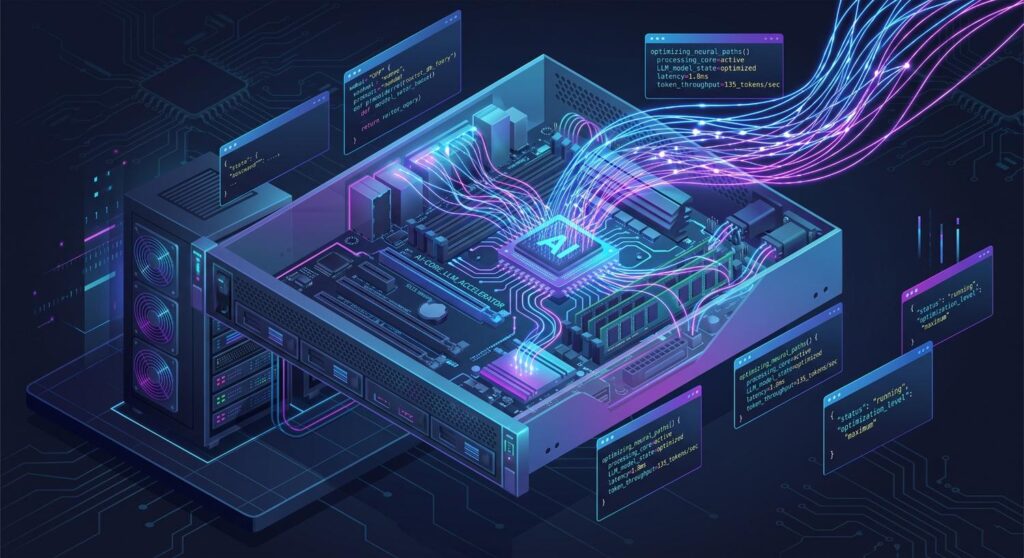
Before looking at infrastructure, software architects must first understand the fundamental shift in system behavior.
Traditional software architecture is deterministic. For a given set of inputs, the database or API will return the exact same output every single time. You write a SQL query; you get specific rows back.
LLMs introduce a probabilistic layer. If you send the same prompt to an LLM ten times, you might get ten slightly different variations of an answer. This non-determinism forces a complete rethink of how we handle caching, testing, error handling, and user experience.
You can no longer rely on rigid assertions in your unit tests, and your user interfaces must be designed to handle asynchronous, streaming data generation rather than instant JSON payloads.
1. Choosing the Right Integration Pattern: API vs. Self-Hosted vs. Hybrid
The foundational architectural decision you must make is determining where the model lives and executes. This choice impacts your security boundary, latency profile, and maintenance overhead for years to come.
Option A: Cloud-Based API Integration (Third-Party)
Utilizing external APIs (such as OpenAI’s GPT-4, Anthropic’s Claude 3, or Google Vertex AI) is the fastest path to production. In this model, your existing application treats the LLM provider as an external microservice.
- Pros:
- Zero Infrastructure Management: No need to provision GPUs or manage Kubernetes clusters for model inference.
- Cutting-Edge Models: Immediate access to the most capable frontier models on the market.
- Elastic Scalability: Pay-per-token pricing means you only pay for what you use, scaling instantly to handle traffic spikes.
- Cons:
- Vendor Lock-in: Tying your prompt engineering to one specific model’s quirks makes switching difficult.
- Data Privacy Risks: Sending proprietary customer data to external servers can violate strict compliance frameworks (HIPAA, SOC2, GDPR).
Option B: Self-Hosted / Private Cloud Deployment
For enterprises with strict compliance constraints, deploying open-source models (like Meta’s Llama 3) inside your own Virtual Private Cloud is the preferred path. This is typically managed via inference frameworks like vLLM or Ollama.
- Pros: Absolute Data Privacy and deterministic costs at scale.
- Cons: High engineering overhead and exceptionally expensive GPU provisioning.
Option C: The Hybrid Router Approach
The most advanced architectures utilize a hybrid model. A lightweight, locally hosted open-source model acts as a “router.” When a user submits a request, the local model classifies the intent. Simple tasks stay local; complex reasoning is routed to an expensive, external frontier model.
2. Introducing the LLM Gateway (The Orchestration Layer)
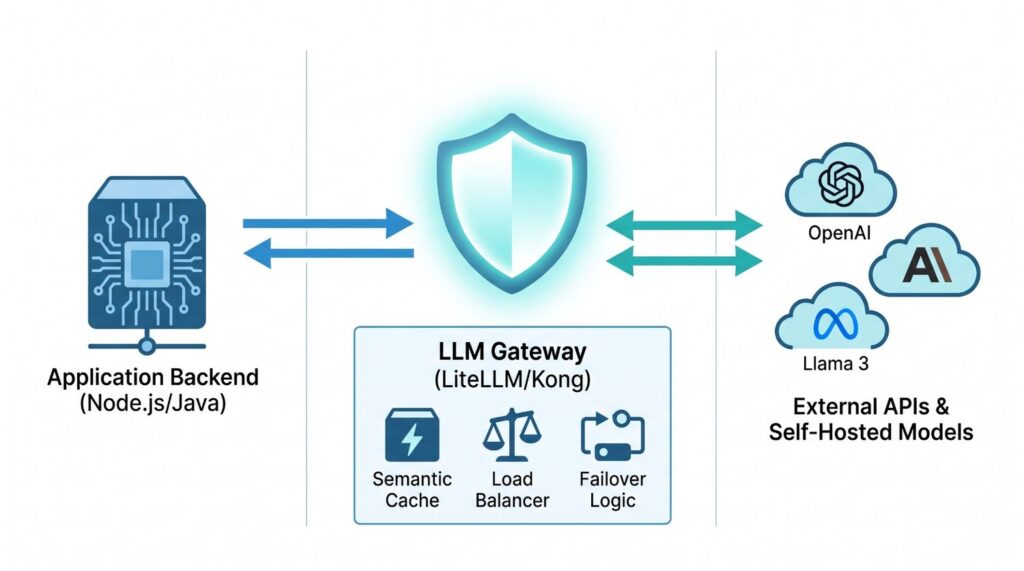
One of the most dangerous anti-patterns in AI engineering is allowing your core business logic (e.g., your Node.js or Java backend) to communicate directly with an external LLM provider.
Instead, you must introduce an LLM Gateway (or orchestration layer).
The LLM Gateway acts as a protective, cost-saving shield between your backend and external AI providers.
This is a dedicated microservice that sits between your application backend and the LLM providers. Its key responsibilities include:
- Fallback & High Availability: LLM APIs are notoriously prone to latency spikes. An LLM gateway implements automatic failovers. If OpenAI times out, the gateway silently routes the exact same prompt to Anthropic, ensuring the end-user never sees an error screen.
- Semantic Caching: Standard caching relies on exact string matching. An LLM gateway uses a Semantic Cache. It converts the incoming prompt into a mathematical vector and compares it to previous prompts. If the intent is identical, it returns the cached response instantly, saving money and time.
- Standardized Observability: The gateway logs every prompt, response, and token count in a standardized format, allowing your platform engineering team to build centralized dashboards to monitor AI spend.
3. Context is King: Retrieval-Augmented Generation (RAG)
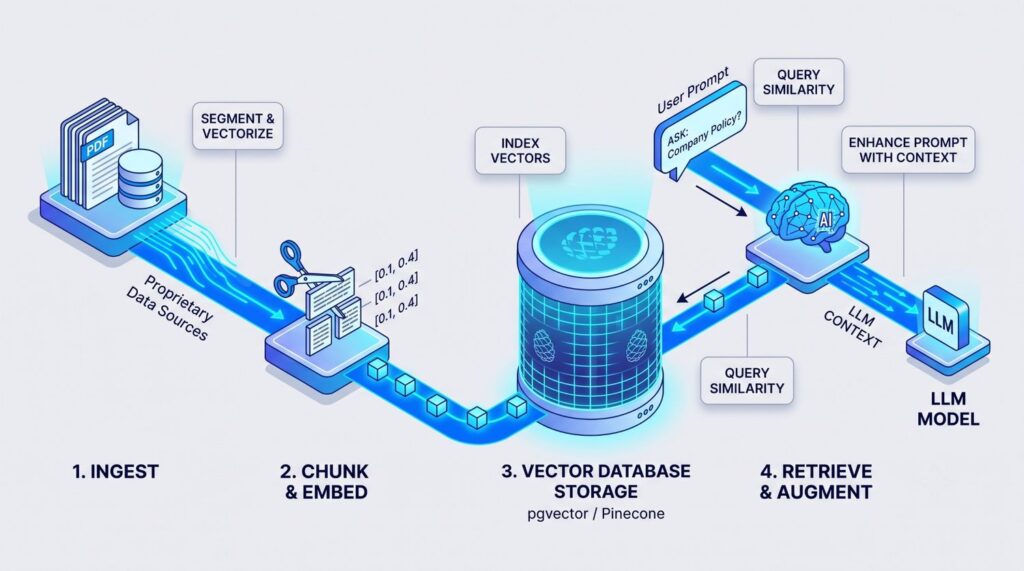
An LLM out of the box is frozen in time. It knows nothing about your proprietary user data, your company’s internal wikis, or your live database inventory.
While fine-tuning is an option, it is expensive and cannot handle real-time data updates. Retrieval-Augmented Generation (RAG) has emerged as the definitive architectural standard for connecting real-time, proprietary data to an LLM safely.
A standard RAG pipeline ingests document chunks, vectorizes them, and retrieves them to augment user prompts.
The Mechanics of RAG
RAG works by intercepting the user’s prompt, searching your internal databases for relevant information, appending that information to the prompt, and then asking the LLM to generate an answer based only on the provided context.
To achieve this, text must be converted into numerical arrays called embeddings. The system compares the user’s embedding vector against the database’s embedding vectors using distance metrics like Cosine Similarity:
$$ \text{Cosine Similarity} = \frac{\mathbf{A} \cdot \mathbf{B}}{|\mathbf{A}| |\mathbf{B}|} = \frac{\sum_{i=1}^{n} A_i B_i}{\sqrt{\sum_{i=1}^{n} A_i^2} \sqrt{\sum_{i=1}^{n} B_i^2}} $$
Values closer to 1 indicate high semantic similarity, meaning the retrieved document is highly relevant to the user’s query.
4. Agents and Tool Calling (Function Calling)
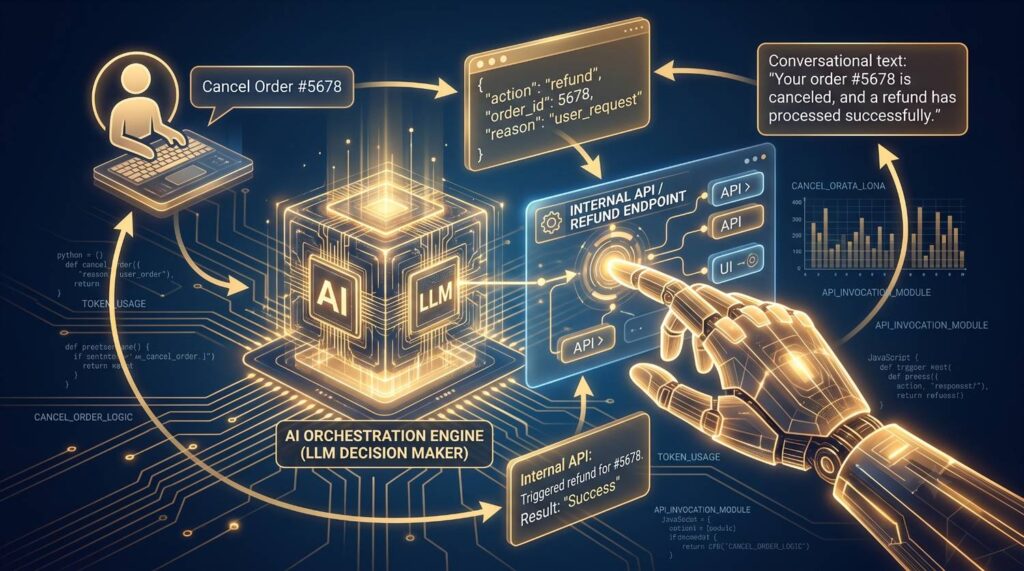
Generating text is useful, but the true power of AI comes when you allow the LLM to take action. This is known as Tool Calling or building Agentic Workflows.
Instead of just returning a string of text, modern LLMs can be instructed to return structured JSON that triggers your existing internal APIs.
By leveraging Tool Calling, the LLM acts as an orchestration engine, deciding which internal APIs to trigger based on user intent.
How Tool Calling Architecture Works:
- Define the Tools: You provide the LLM with a schema of available functions (e.g.,
issue_refund(order_id)). - The LLM Decides: The user says, “Cancel my last order.” The LLM pauses generation and returns a JSON payload:
{"function": "issue_refund", "arguments": {"order_id": "12345"}}. - Execution: Your backend application receives this JSON, executes the real internal API, and sends a “success” message back to the LLM.
- Final Response: The LLM reads the success message and generates a human-readable response for the user.
5. Overcoming Latency: The Streaming Imperative
The most jarring change for traditional software engineers adopting AI is the latency profile. A complex SQL query might take 50 milliseconds. A complex LLM prompt can take 5 to 15 seconds.
If you use standard HTTP REST paradigms, the user’s screen will freeze with a loading spinner for 10 seconds, leading to a terrible user experience.
Implementing Server-Sent Events (SSE)
Your architecture must transition to support streaming. Instead of waiting for the full payload, you must stream the response from the LLM provider, through your gateway, and to the frontend UI character-by-character.
Server-Sent Events (SSE) is the industry standard for LLM streaming. SSE is a unidirectional stream over standard HTTP, making it much easier to load balance through corporate firewalls than heavy WebSockets.
6. LLMOps: Testing, Evaluation, and CI/CD
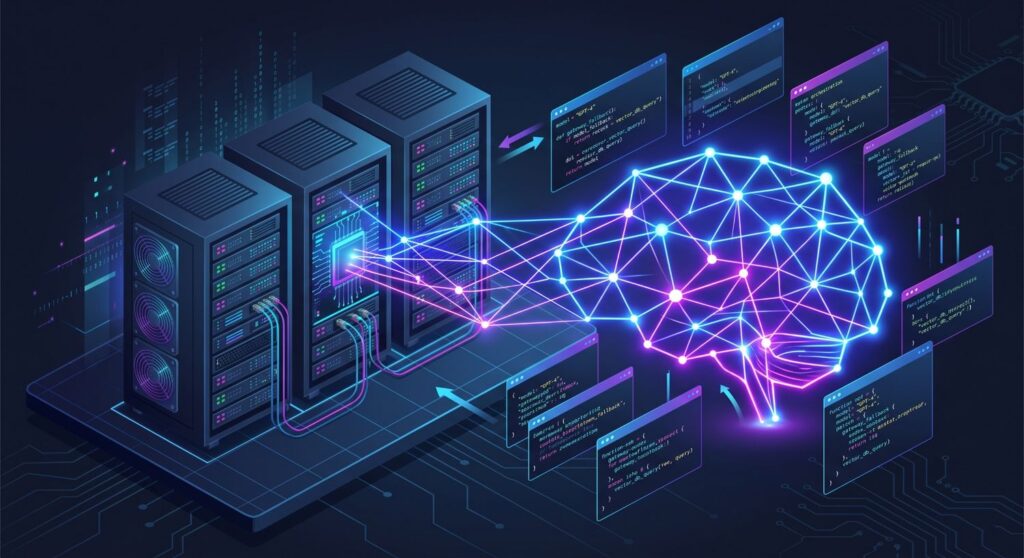
You cannot unit test an LLM the way you test a standard function, because the output changes. “LLMOps” is the discipline of managing the lifecycle of AI models in production.
Continuous Evaluation (Evals)
Instead of binary pass/fail tests, you must implement Evals. Evals are automated tests that score LLM outputs against a rubric to check for:
- Faithfulness: Did the LLM invent information (hallucinate), or is its answer strictly derived from the provided RAG context?
- Answer Relevance: Did the model actually answer the user’s question, or did it go on a tangent?
Furthermore, treat prompts as code. Prompts should live in a centralized registry and go through a strict CI/CD pipeline before being deployed to production.
7. Security Architecture and Guardrails
Integrating an LLM expands your threat landscape significantly. Traditional firewalls and WAFs cannot parse conversational AI attacks like Prompt Injection, where attackers feed the model adversarial inputs to bypass system instructions.
The Guardrail Layer
Architects must implement an AI-specific security layer, often called Guardrails, between the user input and the LLM.
- Input Validation: Scans the user’s prompt for injection attempts and blocks them before they cost you API tokens.
- PII Masking: Detects Social Security Numbers or internal IP addresses in the user’s prompt and replaces them with dummy tokens (e.g.,
[REDACTED_PHONE]) before sending the data to an external API.
Conclusion: Designing for the Future
When you successfully integrate Large Language Models into existing software architectures, it is an exercise in managing abstraction, non-determinism, and data flow.
Do not fall into the trap of tightly coupling your legacy backend to a single model provider. By implementing a dedicated LLM Gateway, establishing robust RAG pipelines, embracing UI streaming, and enforcing strict security guardrails, you can future-proof your system.
Ready to Future-Proof Your Architecture?
Integrating Large Language Models into enterprise systems requires specialized expertise in AI orchestration, cloud infrastructure, and data security. You don’t have to navigate these complex architectural shifts alone.
At Rannlab Technologies, we specialize in designing and deploying scalable, secure, and cost-effective AI solutions tailored to your unique business needs. Whether you need to implement an advanced RAG pipeline, deploy a self-hosted LLM, or build custom agentic workflows into your existing legacy software, our elite team of software architects and engineers is ready to help.
👉 Contact Rannlab Technologies today to schedule a technical consultation and accelerate your AI transformation!
