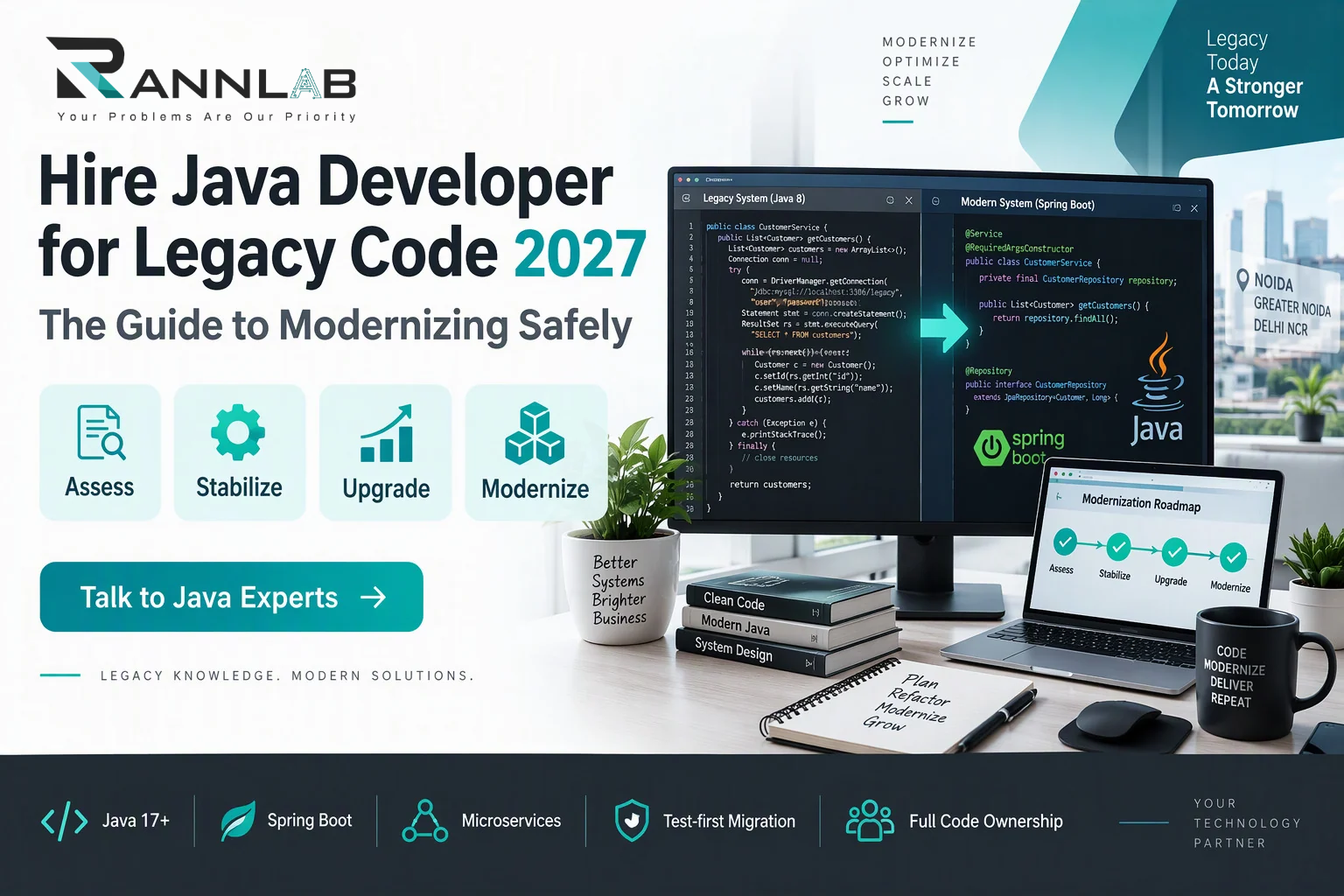
To hire Java developer for legacy code work, look for engineers who can read, test and safely change old Java systems, not just write new Spring Boot apps. The best candidates combine Java upgrade skills, refactoring discipline and good judgement about what to leave alone.
Timing matters this year. Oracle’s Java SE Support Roadmap lists Java 8, 11, 17, 21 and 25 as long-term-support releases, and Oracle has said that Oracle JDK 21 updates from the October 2026 patch update onward come under the Java SE OTN licence, which is free only for personal and development use. If your core systems still run on older Java, this hire Java developer for legacy code 2027 guide shows you who to look for, what to test, and how to modernize without stopping the business. Java legacy code modernization is mostly about reducing risk, so the people you hire matter more than the tools.
Whether you hire Java developers for legacy system modernization as an in-house team or hire dedicated Java developers in India, the same rules apply. For budget planning across other project types, see our software development cost in India guide.
At a glance
- Who to hire: when you hire Java developer for legacy code, choose engineers with proven Java upgrade, refactoring and testing experience, not only new-build skills
- First step: a short assessment of your systems before you commit to a big programme
- Safest approach: modernize in small slices instead of one big rewrite
- Hiring model: dedicated team for long programmes, fixed scope for a defined upgrade, time and material for support
- Always confirm: you own the source code, and the team writes tests before changing critical logic
- Java version: check which JDK vendor you run and plan your move to a supported LTS release
What Counts as Legacy Java Code?
Legacy Java code is software that still does important business work but is hard to change safely. “Legacy” is less about age and more about risk. Typical signs include:
- Old Java versions and outdated frameworks, such as Struts, EJB 2 or JSP-heavy pages
- SOAP services, Ant builds and hand-written database access
- Little or no automated test coverage
- Missing documentation and knowledge held by one or two people
- Libraries that no longer receive security fixes
- Hard-coded settings and manual deployments
If your team avoids touching a module because nobody is sure what will break, that module is legacy, whatever its age. That is the kind of system you are asking someone to take on when you hire Java developer for legacy code.
Why Java Legacy Code Modernization Matters in 2027
Waiting has a cost, and it is rarely visible until something breaks. These are the main pressures:
- Support and licence changes. Oracle’s blog on the JDK 21 licence change says updates to JDK 21 begin moving to the OTN licence from the October 2026 update, the same licence already used for Java 8, 11 and 17. Many teams run other OpenJDK builds, so first confirm which vendor you actually use.
- Security. Old libraries and old Java versions stop receiving fixes, which leaves known weaknesses in production.
- Integration. Modern APIs, cloud services and AI tools are harder to connect to a tangled monolith.
- People. It is harder to hire and retain engineers for very old stacks, and the few people who know the system become a single point of failure.
- Speed. Every change takes longer when there are no tests and nobody trusts the code.
These pressures are why it pays to hire Java developer for legacy code before a deadline forces the issue.
Java Legacy Code Modernization: Five Paths and When to Use Each
Before you hire anyone, decide what kind of modernization you need. Each system may need a different path.
| Path | What changes | Best when | Main risk |
|---|---|---|---|
| Retain or retire | Nothing, or the system is switched off | Low business value, or replaced elsewhere | Hidden users or reports still depend on it |
| Rehost | Move to new servers or cloud with no code change | You need breathing room quickly | Technical debt moves with the system |
| Replatform | Upgrade the JDK, app server, database or build, with limited code change | The code is sound but the runtime is outdated | Library and framework incompatibilities |
| Refactor or rearchitect | Restructure code, split modules or services | Business logic is valuable but slow to change | Needs strong tests and domain knowledge |
| Rebuild or replace | New system or an off-the-shelf product | The system no longer fits the business | Highest cost, adoption and data-migration risk |
Why small slices beat a big rewrite
If you hire Java developer for legacy code, ask early whether they plan to rewrite or to modernize in slices. Martin Fowler describes the Strangler Fig approach as gradual modernization: you build new capabilities beside the old system and move behaviour across piece by piece. He notes that a full replacement often fails, because it takes a long time, users can’t wait for new features, and the old system’s real behaviour is hard to pin down.
Microsoft’s Strangler Fig pattern guide explains the mechanics: a façade sits in front of the legacy system and routes some requests to the new system and the rest to the old one, until the old system can be retired. A good Java legacy code modernization team will usually propose this or something close to it.
Hire Java Developers for Legacy System Modernization: Which Roles Do You Need?
When you hire Java developers for legacy system modernization, most projects need a small mix of roles, not one hero developer.
| Role | What they do | When you need them |
|---|---|---|
| Java modernization engineer | Upgrades the JDK and frameworks, refactors code, fixes dependencies | Almost always |
| Architect or tech lead | Chooses the modernization path, defines service boundaries and the plan | At the start, and for any large system |
| QA automation engineer | Builds regression and behaviour tests around current functionality | Whenever test coverage is low |
| DevOps engineer | Sets up CI/CD, environments, containers and monitoring | When deployments are manual |
| Database engineer | Handles schema changes, data migration and query performance | When the database is part of the change |
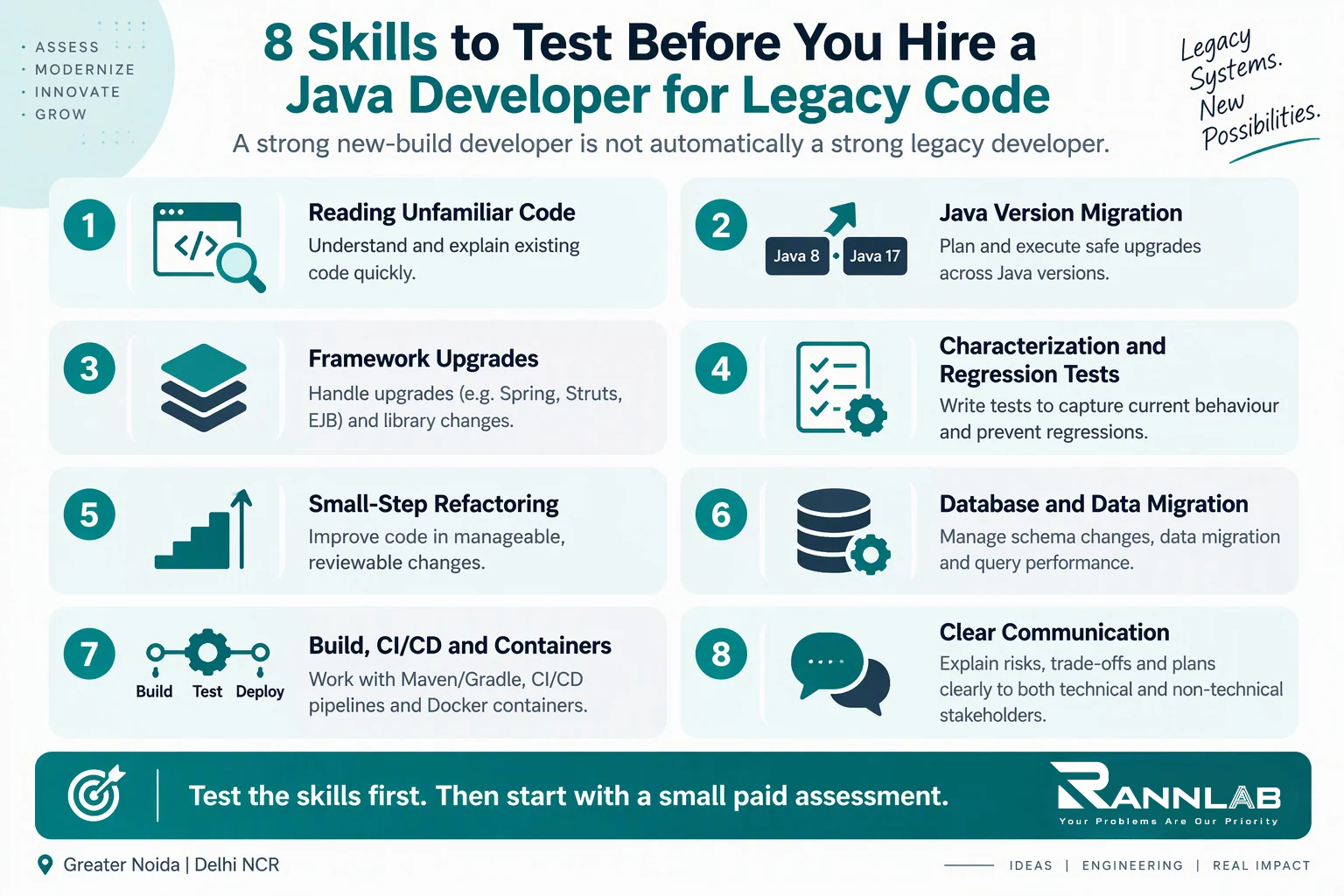
8 Skills to Test Before You Hire Java Developer for Legacy Code
A strong greenfield developer is not automatically a strong legacy developer. When you hire Java developer for legacy code, test these eight skills:
- Reading unfamiliar code. Give a real, anonymised class and ask what it does and what could break if it changes.
- Java version migration. Ask how they move a system from Java 8 or 11 to a current LTS release, including build changes, removed or restricted APIs and library updates.
- Framework upgrades. Spring Boot 3 needs Java 17 or newer and uses the jakarta.* namespace instead of javax.*, so ask how they handle that change in a large codebase.
- Characterization and regression tests. They should capture current behaviour in tests before changing anything critical.
- Small-step refactoring. Look for reviewable commits, not a giant rewrite on a branch for six months.
- Database and data migration. Ask about schema versioning, data validation and query tuning.
- Build, CI/CD and containers. Maven or Gradle, pipelines and Docker should be routine for them.
- Communication. They should explain risks and trade-offs clearly to non-engineers and write decisions down.
Hire Java Developer for Legacy Code: A Simple Screening Process
Use the same steps for every candidate or vendor, so you can compare them fairly.
- Write a one-page brief. List the systems, the Java and framework versions, the database, integrations, known pain points and your goal.
- Screen for evidence. Ask for past modernization or migration work, not only a list of technologies.
- Run a code-reading exercise. Share a safe, anonymised sample and ask them to explain it, find risks and propose tests.
- Ask for a short plan. A good candidate proposes how they would start, what they would test first and what they would leave alone.
- Check references. Speak to a past client about a legacy project, not a new build.
- Start with an assessment. Begin with a small, paid assessment or pilot before committing to the full programme.
Hire Dedicated Java Developers in India: Which Hiring Model Fits?
If you plan to hire dedicated Java developers in India, choose the engagement model that matches how clear your scope is.
| Model | Best for | Watch out for |
|---|---|---|
| Dedicated developers or squad | Long modernization programmes and ongoing platform work | Needs a clear owner on your side to set priorities |
| Fixed scope | A defined job, such as an assessment or a specific Java version upgrade | Changes to scope can add cost |
| Hourly or time and material | Support, bug fixing and evolving requirements | Needs regular budget tracking |
Any of these models can work when you hire Java developer for legacy code, as long as scope, ownership and testing responsibilities are clear.
What drives the cost
The cost to hire Java developer for legacy code varies with scope and seniority. Published rate guides for Indian Java developers vary widely, so don’t compare hourly numbers alone. Ask for a monthly quote with named roles and compare these factors:
- Seniority of the engineers, and whether an architect is included
- Domain knowledge, such as banking, insurance or healthcare
- Team size and how long the programme will run
- How much test automation you need to build first
- Support and on-call expectations
- Time-zone overlap with your team
A Safe Roadmap for Java Legacy Code Modernization
Whoever you hire, the work should follow a clear order. A good partner will walk you through these steps before you commit to a large programme:
- Assess. Inventory applications, Java versions, dependencies, vulnerabilities, integrations and data flows. Mark each system as retain, retire, rehost, replatform, refactor or replace.
- Stabilize. Add tests around the most important flows, set up CI, logging, monitoring and backups, and document what you learn.
- Upgrade the platform. Move to a supported LTS Java release, update the build and replace vulnerable libraries.
- Decompose gradually. Put a façade in front of the old system and move one capability at a time, with a rollback plan for each slice.
- Retire and clean up. Switch off the old parts, remove duplicates and update the documentation.
Which Java version should you target?
Oracle says it offers Oracle JDK 25, released in September 2025, as the current LTS release, and its roadmap lists 8, 11, 17, 21 and 25 as LTS versions. Before you hire Java developer for legacy code, decide whether the brief should name a target version. A sensible target is the newest LTS release your frameworks and vendors support. Your developer should check library compatibility, licence terms for your JDK vendor and the cost of staying on an older release before you decide.
Hire Java Developer for Legacy Code 2027: What to Plan For
Here is a hire Java developer for legacy code 2027 checklist: practical points to build into your brief. They are planning judgments, so validate them against your own systems:
- Licence and support dates. Check your JDK vendor and Java version now, not when an update stops arriving.
- Tests first. Budget time to build a safety net before large changes.
- An assessment before a programme. A short, scoped assessment is cheaper than discovering problems mid-project.
- Modular hiring. Start with a small core team and add specialists, such as QA automation or DevOps, as the work needs them.
- AI-assisted analysis, with human checks. Martin Fowler’s team has written about using generative AI to understand legacy code, and stresses that human validation stays central. Treat AI output as a starting point for your engineers, not a replacement for them.
Red Flags When You Hire Java Developer for Legacy Code
Pause the process if you see any of these:
- Proposes a full rewrite before reading the code
- No plan for tests before changes
- Cannot explain how they would keep the system running during the change
- Only shows new-build projects
- Promises a fixed price and date with no assessment
- Vague answers on code ownership and access to repositories
- No mention of rollback or monitoring
10 Questions to Ask Before You Hire Java Developer for Legacy Code
- Have you modernized a Java system like ours? What changed and what went wrong?
- How would you assess our system before proposing a plan?
- How do you add tests to code that has none?
- Which Java version would you target, and why?
- How do you handle the javax to jakarta change?
- How would we keep the system live while you modernize it?
- How do you handle database changes and data validation?
- Who owns the source code, build scripts and environments?
- What does your handover and documentation look like?
- Can we speak to a client whose legacy system you modernized?
How RANNLAB Fits
RANNLAB Technologies is a Greater Noida company building software since 2013. If you want to hire Java developer for legacy code projects and add engineers to your own team, you can hire Java developers with experience in Java 17+, Spring Boot, Spring Cloud, microservices, Docker, Kubernetes and database migrations. You can also browse our wider dedicated developers options, including dedicated engineers and managed squads, with full source code ownership.
If you need a team to plan and run the work, our custom software development services include legacy modernization and monolith-to-microservices migration. You can also read our guide on how to choose a software development company in Noida before you shortlist vendors.
Put the same questions to us that you’d put to anyone: who will work on our system, how will you test it, and who owns the code?
Frequently Asked Questions
How do I hire Java developer for legacy code?
Write a one-page brief of your systems, screen for past modernization work, run a code-reading exercise, check references and start with a small paid assessment before committing to a full programme.
What skills should a Java developer for legacy code have?
They should read unfamiliar code, upgrade Java versions and frameworks, write characterization tests, refactor in small steps, handle database migration and work comfortably with build tools, CI/CD and containers.
Should I rewrite or modernize my legacy Java application?
Modernize in slices unless the system no longer fits the business. Full rewrites carry high risk because the old system’s real behaviour is hard to capture, so most teams do better with an incremental approach.
What should I know to hire Java developer for legacy code 2027?
Check which JDK vendor you run, the support and licence dates for your Java version, and whether your frameworks work on a current LTS release. Oracle lists Java 8, 11, 17, 21 and 25 as LTS releases.
How do I hire Java developers for legacy system modernization?
Look for engineers or a team with proven migration experience, ask for a short plan before you sign, and make sure the contract covers tests, documentation, code ownership and handover.
Which Java version should we move to?
Usually the newest LTS release that your frameworks and libraries support. Your developers should confirm compatibility and licensing for your JDK vendor first.
Is it better to hire dedicated Java developers in India or use a fixed-price project?
Use dedicated developers for long programmes where scope evolves, and fixed scope for a defined job such as an assessment or one version upgrade.
How much does it cost to hire a Java developer in India?
Rates vary widely with seniority, domain knowledge and engagement model. Ask for a monthly quote with named roles, and compare scope rather than hourly rates alone.
What is the strangler fig pattern?
It is a gradual modernization approach where a façade routes requests between the old and new systems, and functionality moves to the new system piece by piece until the old one can be retired.
Do we need tests before modernizing legacy Java code?
Yes, for the most important flows. Tests that capture current behaviour let developers change the code and prove nothing important broke.
How long does Java legacy code modernization take?
It depends on system size, test coverage, integrations and the path you choose. Get an assessment first, then plan the work in phases.
Talk to Us About Your Legacy Java System
Ready to hire Java developer for legacy code? Tell us what you run today, which Java version, and what keeps you up at night. We’ll suggest a safe first step and share a phase-wise estimate, with no obligation.
Share your legacy system details →
Prefer a quick chat? Message us on WhatsApp, or hire Java developers directly if you already have a plan.
