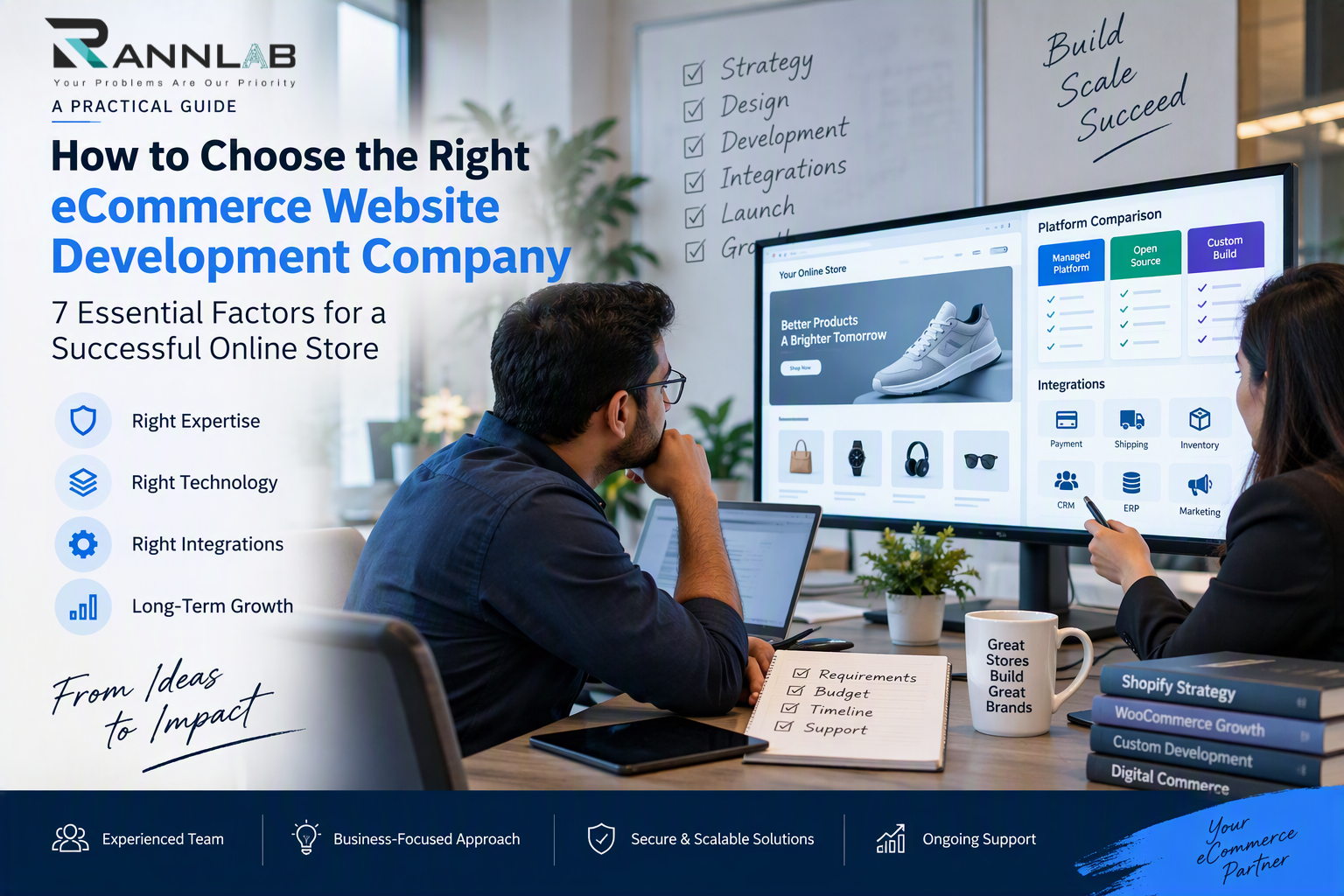
A polished storefront can still fail if orders do not reach the right system, inventory is inaccurate, mobile checkout is frustrating, or nobody owns technical issues after launch. That is why choosing an eCommerce website development company should begin with your operating model, not a gallery of attractive homepages.
For a founder or retail team, the real risk is not only development cost. It is paying twice because the first build cannot support product variants, shipping rules, catalogue growth, integrations, campaigns, returns, or future improvements.
This guide gives you a practical way to compare vendors without requiring deep technical knowledge.
What does an eCommerce website development company actually do?
An eCommerce website development company plans and builds the technical system through which customers discover products, place orders and receive post-purchase communication. Its work may cover store architecture, UI/UX, catalogue structure, payment and shipping setup, integrations, analytics, testing, deployment, maintenance and future enhancements.
The exact scope varies between vendors. One agency may handle only theme installation. Another may provide complete eCommerce website development services, including custom workflows, migration, cloud deployment and ongoing support.
Before comparing proposals, establish whether you need:
- A new online store
- A redesign of an existing store
- Migration from another platform
- Integration with inventory, ERP or CRM software
- A custom B2B or D2C buying workflow
- Continuous technical support after launch
This distinction prevents an apparently affordable quotation from becoming an incomplete solution.
Why does choosing the right eCommerce website development company matter?
The right eCommerce website development company protects more than your website. It helps protect customer journeys, operational continuity, data flows and future development investment. A weak technical foundation can create manual work for sales, fulfilment, finance and customer-support teams.
The wrong fit often becomes visible after development starts. Common symptoms include unclear scope, repeated change requests, unfinished integrations, inconsistent mobile screens and uncertainty about post-launch ownership.
A reliable eCommerce development partner should therefore connect design decisions with commercial and operational requirements. It should be able to explain what is being built, why it is needed, what is excluded and how future changes will be managed.
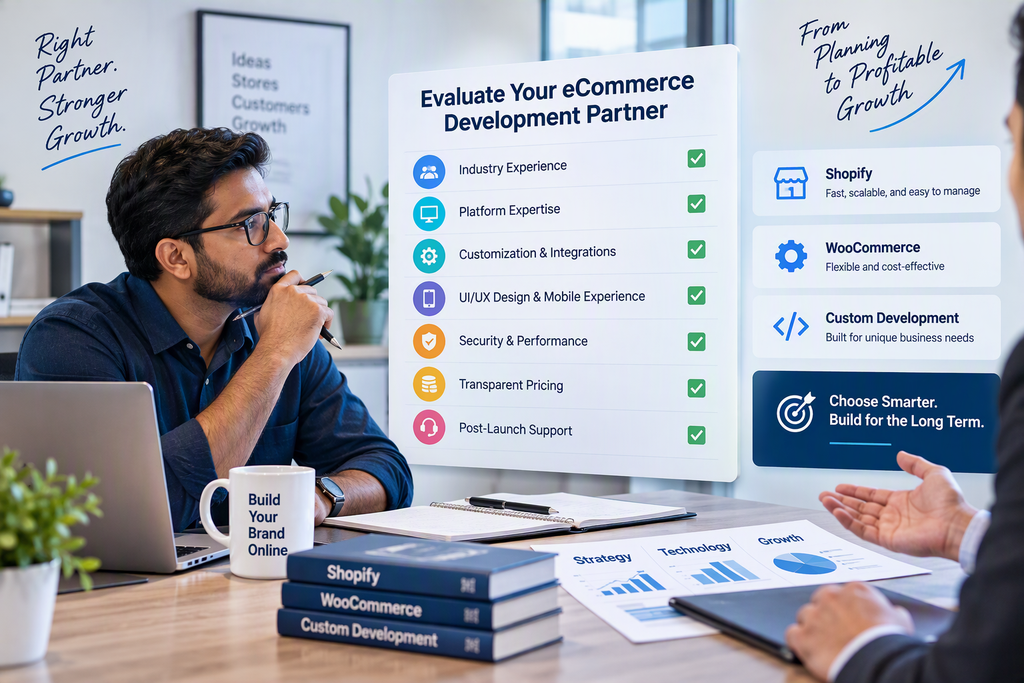
Which seven factors should you evaluate before hiring?
The best eCommerce development company for your business is not necessarily the largest agency or the lowest bidder. It is the team whose experience, technical approach and delivery model match your commercial priorities.
1. Does the company have relevant industry experience?
Ask for examples that are relevant to your business model, catalogue or workflow. A clothing store may need size and colour variants. A jewellery business may need detailed product specifications. A B2B seller may require enquiries, negotiated pricing, account roles or quotation workflows.
Do not accept a portfolio link as the complete answer. Ask the eCommerce development agency to explain:
- What problem the store needed to solve
- Which parts the agency delivered
- Which platform was used
- What integrations were required
- What constraints affected the solution
- Whether the example can be discussed publicly
A design screenshot shows appearance. It does not prove that the team handled catalogue migration, checkout configuration, security, order flows or post-launch changes.
2. Can the agency justify its technology recommendation?
A competent eCommerce website development company should recommend technology after understanding your requirements. Be cautious when every prospect receives the same platform recommendation.
The discussion should cover catalogue size, expected customisation, internal skills, content requirements, integrations, ownership expectations, hosting responsibility and maintenance capacity.
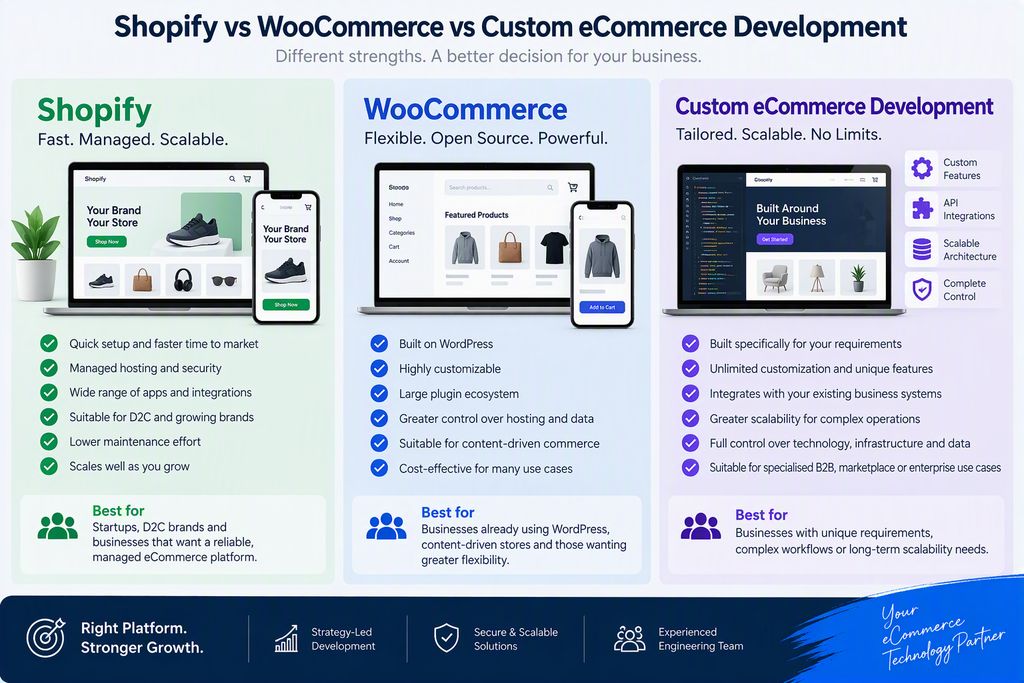
| Requirement | Shopify may suit | WooCommerce may suit | Custom development may suit |
|---|---|---|---|
| Faster standard-store launch | Strong fit | Possible | Usually unnecessary |
| Existing WordPress content operation | Limited relevance | Strong fit | Depends on architecture |
| Managed platform preference | Strong fit | Requires separate management | Requires an agreed operating model |
| Extensive workflow customisation | App or custom-code dependent | Flexible with careful engineering | Strongest control |
| Highly specialised B2B logic | Evaluate carefully | Possible with customisation | Often worth assessing |
| Maintenance responsibility | More platform-managed | Shared with site owner or agency | Defined by architecture and contract |
This table is a starting point, not a universal recommendation. Final selection should follow documented discovery.
3. Can the team handle customisation and integrations?
An online store rarely operates alone. It may need to exchange information with payment providers, logistics partners, inventory tools, accounting software, a CRM, an ERP, email platforms or customer-support systems.
Ask the agency to map each integration in plain language:
- Which system sends the data?
- Which system receives it?
- What event starts the exchange?
- What happens if the request fails?
- Who monitors failures?
- Which party owns the external account and recurring fee?
This conversation separates general website builders from teams capable of custom eCommerce development.
Need a Technical Second Opinion?
Share your proposed platform, catalogue size and required integrations. RannLab can return a requirement map showing the important store modules, integration dependencies and items that need discovery.
E-Commerce DevelopmentGet My Requirement Map
4. Does the UI/UX support real mobile shopping?
A mobile-responsive page is not automatically a usable mobile store. Check search, filters, product options, image galleries, cart changes, address entry, payment selection and order confirmation on a real phone.
When reviewing an eCommerce development agency, ask to see complete journeys rather than isolated homepage sections.
Use this practical review:
| Customer journey | What to inspect |
|---|---|
| Product discovery | Search quality, categories, filters and navigation |
| Product evaluation | Images, variants, availability and delivery information |
| Cart | Quantity updates, coupon behaviour and cost visibility |
| Checkout | Form length, errors, payment flow and mobile usability |
| Post-purchase | Confirmation, order information and support access |
Design should reduce uncertainty. It should not hide essential information behind decorative effects.
5. How does the company approach security and performance?
Security should be part of architecture, development and release checks, not an optional task added before launch. Ask about authentication, access control, software updates, input validation, dependency review, backups, logging, payment-data handling and incident response.
Shopify’s developer guidance says external input should be treated as untrusted, secrets should remain outside submitted code, dependencies should be controlled, and authentication must not be confused with authorisation. Following security best practices
For WooCommerce, clarify who will manage hosting, WordPress updates, extension compatibility, backups and security monitoring. The official WooCommerce documentation maintains a dedicated security section for store administration. WooCommerce Security Documentation
The agency should also explain how it tests performance on product, collection, search, cart and checkout-related pages. Do not assess speed from the homepage alone.
6. Is the project scope and cost transparent?
A useful proposal explains deliverables, assumptions, exclusions, responsibilities and third-party costs. It should not rely on a single total with no scope detail.
Ask the eCommerce development partner to separate:
- Discovery and planning
- UI/UX design
- Theme or storefront development
- Product and content migration
- Payment and shipping setup
- Third-party integrations
- Analytics and conversion tracking
- Quality assurance and UAT
- Deployment
- Warranty and maintenance
- Themes, apps, hosting and external subscriptions
7. What happens after the store goes live?
Launch is the beginning of store operations. Products change, campaigns introduce new landing pages, platforms evolve, extensions require updates and customers reveal usability problems that were not obvious during development.
Ask whether support includes:
- Bug resolution
- Platform and extension updates
- Performance monitoring
- Security review
- Catalogue assistance
- New sections or features
- Integration troubleshooting
- Analytics validation
- Response and escalation expectations
Post-launch support should have a defined scope. “We will support you” is not enough.
How should you compare Shopify, WooCommerce and custom development?
Platform selection should follow requirements rather than popularity. Shopify offers a managed commerce platform and supports extensions through apps, themes and storefront technologies. Shopify Developer Documentation WooCommerce builds commerce functionality into WordPress, while a custom solution offers greater architectural control with greater ownership responsibility.
The honest question is not “Which platform is best?” It is “Which platform creates the best balance of speed, control, operating effort and future flexibility for this business?”
A practical eCommerce development partner should document the trade-offs and explain where its recommendation may stop being suitable.
What questions should you ask before signing?
Use these questions during vendor discussions:
- Which similar projects can you discuss with approval?
- Why are you recommending this platform?
- Which requirements need custom development?
- Which third-party services will create recurring costs?
- How will products, customers and URLs be migrated?
- How will integrations and failure cases be tested?
- What are our responsibilities during the project?
- What is excluded from the quotation?
- How are change requests estimated and approved?
- What warranty and support apply after launch?
- Who owns the store accounts, domain, code and data?
- What documentation and training are included?
Clear answers usually indicate a mature delivery process. Vague answers expose areas that need written clarification.
What warning signs indicate an unsuitable agency?
Be careful when an agency:
- Promises guaranteed rankings or sales
- Recommends a platform before understanding requirements
- Cannot separate included work from optional work
- Avoids discussing security or integrations
- Uses inaccessible or unapproved projects as proof
- Treats mobile responsiveness as the complete mobile strategy
- Cannot explain account and data ownership
- Offers no testing or acceptance process
- Has no defined post-launch support model
- Provides an unusually low quotation with major items omitted
The best eCommerce development company will not pretend every risk has disappeared. It will identify assumptions, dependencies and limitations before development starts.
How can you score an eCommerce development company?
Use this RannLab vendor-readiness self-audit. Award two points for “yes”, one for “partly” and zero for “no”.
- Has the company explained a relevant project in detail?
- Has it justified the platform against your requirements?
- Are integrations and third-party dependencies documented?
- Are scope, exclusions and ownership responsibilities clear?
- Are testing, security and post-launch support defined?
8 to 10 points: Strong basis for commercial and technical evaluation.
5 to 7 points: Promising, but clarify the incomplete areas in writing.
0 to 4 points: High risk of scope, ownership or delivery problems.
This framework evaluates proposal quality. It does not certify an agency or guarantee project results.
How does RannLab approach eCommerce development?
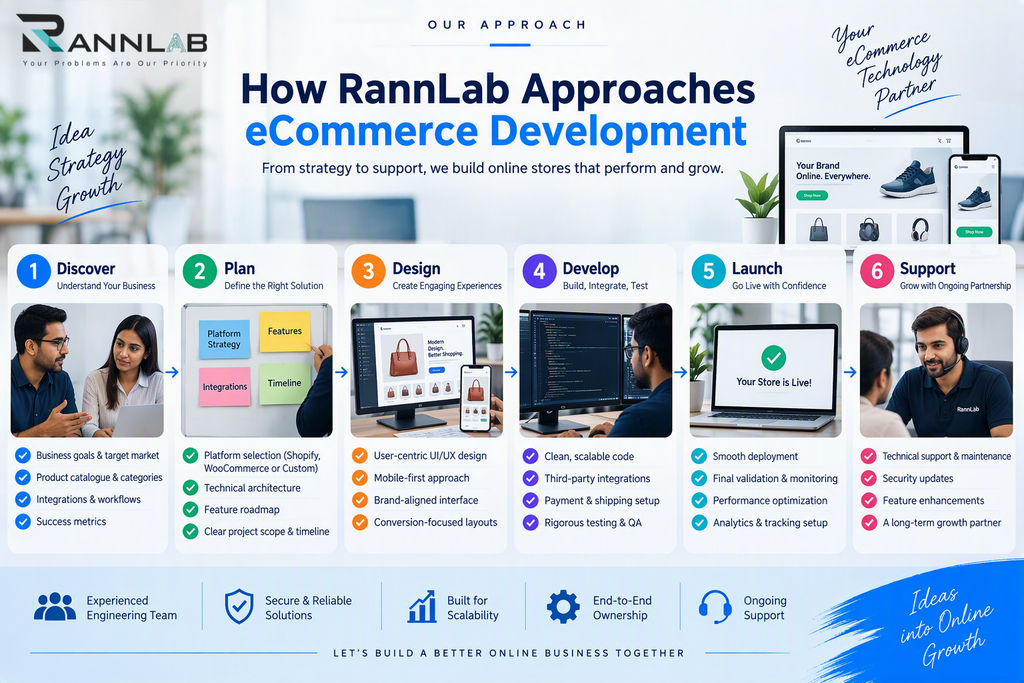
RannLab plans eCommerce work around business requirements, store architecture, UI/UX, platform selection, catalogue and order flows, integrations, testing, deployment and support. Internal capability material specifically covers Shopify, WooCommerce and custom stores, together with payment, catalogue, cloud and maintenance work.
The working approach is:
- Discover: Define customers, catalogue, workflows, integrations and commercial priorities.
- Design: Map the customer journey and produce store screens or prototypes.
- Develop: Configure or build the agreed storefront, backend and integrations.
- Test: Review functions, devices, security, performance and business scenarios.
- Launch: Deploy the approved release and validate production settings.
- Support: Resolve agreed issues and plan controlled improvements.
RannLab has dedicated online pages for eCommerce development, Shopify store launches and broader website development. Those are the recommended service destinations for this article.
Frequently asked questions
How do I choose an eCommerce website development company?
Choose an eCommerce website development company by evaluating relevant project experience, platform reasoning, integration skills, security practices, scope transparency and ongoing support. Ask the shortlisted team to explain how your products, customers, payments, fulfilment and systems will work together. Record assumptions and exclusions in the final proposal.
What services should an eCommerce development agency provide?
An eCommerce development agency may provide discovery, UI/UX design, storefront development, product migration, payment and shipping configuration, integrations, analytics, testing, deployment and maintenance. Not every agency includes every service, so compare the written scope rather than relying on the service name.
How much does it cost to hire an eCommerce development partner?
Cost depends on design complexity, catalogue size, platform, migration, integrations, custom workflows, testing and support. Request an itemised proposal that separates development fees from themes, apps, subscriptions and external services. Any RannLab price must be verified against the live proposal before publishing or quoting.
Should I choose Shopify or WooCommerce?
Shopify may suit businesses seeking a managed commerce platform and structured app ecosystem. WooCommerce may suit organisations already using WordPress or wanting more control over hosting and extensions. The choice should reflect operations, customisation, ownership, maintenance capacity and integration requirements.
When is custom eCommerce development appropriate?
Custom eCommerce development is worth assessing when standard platforms cannot support essential workflows, permissions, pricing logic, integrations or ownership requirements without excessive workarounds. It normally requires a stronger plan for hosting, security, upgrades, documentation and long-term technical support.
Can an agency migrate my existing online store?
Yes, many agencies provide migration services. Confirm which products, customers, orders, content, images, metadata and URLs can be transferred. The final migration scope depends on the source platform, available data, API access and data quality. Test redirects and critical customer journeys before launch.
Do I need maintenance after launch?
Most stores need ongoing maintenance or improvement. Responsibility depends on the platform and agreement. Support may include bug fixes, updates, compatibility checks, performance work, monitoring, integration support and new features. Define response expectations, exclusions and commercial terms before launch.
Conclusion: Which eCommerce website development company should you hire?
Hire the eCommerce website development company that understands your operating model, explains technology clearly and documents its responsibilities. Relevant evidence, secure engineering, transparent scope and dependable support matter more than a low starting quotation.
If you are comparing Shopify, WooCommerce and custom development, RannLab can review your catalogue, integrations and growth requirements before recommending a delivery path.
