
Choosing the right technology stack is unequivocally the most consequential decision you will make at the start of any digital project. It is the foundation upon which your entire business logic, user experience, and future scalability will rest.
If you choose correctly, your engineering team will build faster, scale effortlessly, and attract top-tier talent who want to work with modern tools. If you choose poorly, you will drown in technical debt, constantly battle performance bottlenecks, struggle to integrate with modern APIs, and ultimately inflate your website development cost.
In 2026, the landscape of the best web development frameworks 2026 has matured significantly. The wild, fragmented experimentation of the early 2020s has settled into clear, battle-tested standards. We are witnessing a massive shift toward “meta-frameworks” that handle both the frontend and backend simultaneously, as well as a strong emphasis on how well a framework plays with AI-assisted coding tools.
Summary:
- The React Ecosystem: Next.js remains the undisputed king of full-stack React development, offering unparalleled SEO and Server-Side Rendering (SSR) capabilities.
- The Performance Winner: Svelte and SvelteKit lead in raw performance by compiling code to vanilla JavaScript, completely eliminating heavy runtime overhead.
- Enterprise Backend Reliability: Laravel (PHP) and Django (Python) remain the absolute gold standards for secure, scalable, and data-heavy backend architectures.
- AI-Coding Compatibility: Frameworks with strict, opinionated conventions (like Django, Laravel, and emerging tools like Wasp) are currently proving much easier for AI agents to write coherent code for, compared to highly fragmented, unopinionated stacks.
What is a Web Development Framework?
A web development framework is a standardized set of pre-written code, libraries, and tools that provides a foundational structure for building web applications and websites. Frameworks prevent developers from having to “reinvent the wheel” for common tasks like routing, database management, security protocols, and session authentication. By providing this scaffolding, frameworks allow engineers to focus strictly on unique business logic and bespoke user interface design.
Understanding the Split: Frontend vs. Backend
Before diving into specific frameworks, it is crucial to understand the architectural divide in modern web development.
1. Top Frontend Frameworks in 2026: The Battle for the Browser
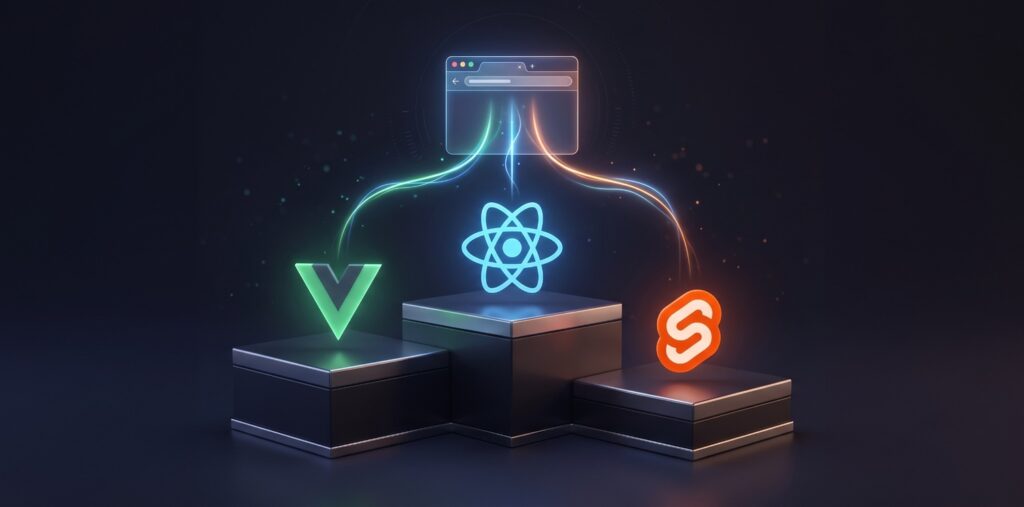
Frontend frameworks manage what the user actually sees, clicks, and interacts with. In 2026, the focus is entirely on component-based architecture, highly reactive state management, and aggressively minimizing the amount of JavaScript sent to the user’s browser to meet strict Core Web Vitals benchmarks.
A. React.js: The Unshakable Foundation
Backed by Meta, React is technically a UI library rather than a full framework, but it undeniably forms the foundation of the modern web. With the maturity of React 18 and 19 features like concurrent rendering, automatic batching, and Server Components, it remains the safest, most robust bet for enterprise projects.
- The Pros: The largest ecosystem in the world, massive talent pool, and unmatched flexibility.
- The Cons: High learning curve, requires extensive third-party libraries for routing and state management (which leads to fragmentation).
- Best For: Massive ecosystems, highly interactive SaaS dashboards, and teams planning to scale quickly.
B. Vue 3: The Balanced Underdog
Vue.js has always offered a gentler learning curve than React while remaining incredibly powerful. Vue 3’s Composition API has matured beautifully in 2026, making it an excellent choice for teams that want clean, readable code without the steep architectural debates common in the React ecosystem.
- The Pros: Excellent documentation, highly approachable, incrementally adoptable.
- The Cons: Smaller talent pool in Western markets compared to React (though incredibly dominant in Asian markets).
- Best For: Integrating reactive components into existing legacy systems and rapid Minimum Viable Product (MVP) development.
C. Svelte: The Compiler-First Speed Demon
Unlike React and Vue, which do the bulk of their work in the browser (using a “virtual DOM”), Svelte shifts that heavy lifting to a compile step that happens when you build your app. The result is highly optimized, surgically precise vanilla JavaScript with zero runtime overhead.
- The Pros: Blazing-fast load speeds, incredibly concise syntax, no virtual DOM overhead.
- The Cons: Smaller ecosystem and fewer third-party libraries than React.
- Best For: Projects where mobile performance, Core Web Vitals, and absolute raw speed are the highest priorities.
D. HTMX: The Radical Simplifier
A rising star in 2026, HTMX allows you to access AJAX, CSS Transitions, WebSockets, and Server Sent Events directly in HTML, using attributes. It represents a pushback against the complexity of heavy JavaScript frameworks.
- Best For: Internal tools, simple CRUD applications, and teams heavily favored toward backend languages who don’t want to learn complex JS frontends.
2. Top Backend Frameworks in 2026: The Server-Side Heavyweights
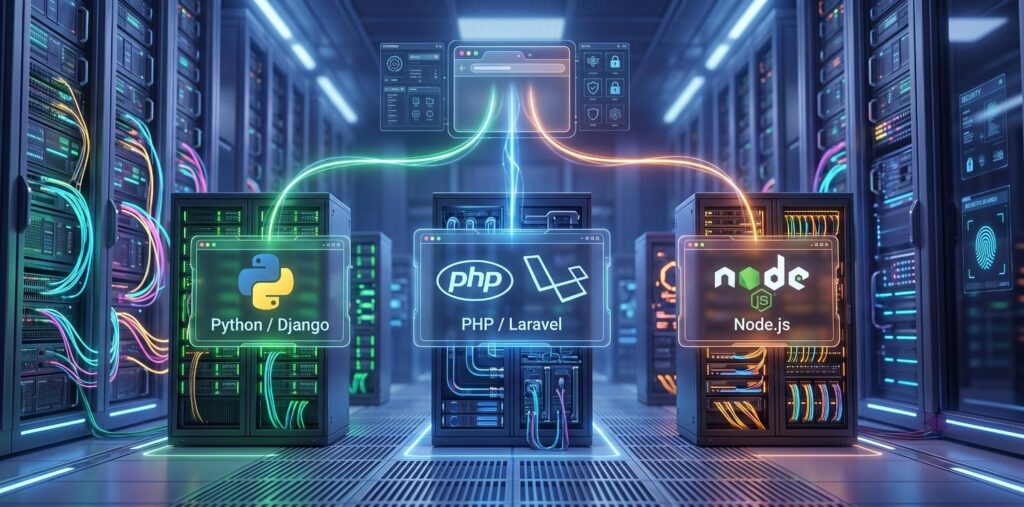
If your custom web application requires heavy data processing, machine learning integration, or complex financial transactions, a dedicated backend framework is essential.
A. Django (Python): The Data Powerhouse
Django operates on a “batteries-included” philosophy. It ships with a powerful ORM (Object-Relational Mapper), robust authentication, and a ready-to-use admin panel right out of the box. Because Python is the undisputed language of AI and Machine Learning, Django is the top choice for apps that need to process complex algorithms.
- The Pros: Highly secure, rapid development, immense Python ecosystem.
- The Cons: Can be monolithic and slightly heavy for simple microservices.
- Best For: FinTech, machine learning apps, healthcare portals, and highly secure enterprise data systems.
B. Laravel (PHP): The Enterprise Standard
Despite jokes about PHP’s age, Laravel is its modern crown jewel and powers a massive percentage of the profitable web. Laravel provides an elegant syntax and an incredibly rich ecosystem (Forge, Vapor, Nova) for easy server deployment and administration.
- The Pros: Unmatched developer experience, massive community, highly scalable.
- The Cons: PHP’s syntax isn’t as trendy as modern TypeScript.
- Best For: Custom B2B SaaS platforms, complex API development, and e-commerce backends.
C. Express.js / NestJS (Node.js): The JavaScript Backend
Node.js allows teams to use JavaScript (or TypeScript) on both the frontend and the backend. Express.js is the minimalist standard, while NestJS provides a more rigid, Angular-like architecture for enterprise scaling.
- The Pros: Code sharing between frontend and backend, highly performant for I/O operations.
- The Cons: Express can become disorganized without strict team conventions.
- Best For: Real-time applications (chat apps, live tracking, streaming) and teams that want a unified full-stack TypeScript codebase.
D. Spring Boot (Java): The Corporate Giant
In the enterprise world of banking, insurance, and legacy systems, Java remains king. Spring Boot makes Java development faster and more production-ready.
- Best For: Massive, distributed enterprise systems where security, multi-threading, and long-term stability are paramount.
3. The Rise of Full-Stack Meta-Frameworks
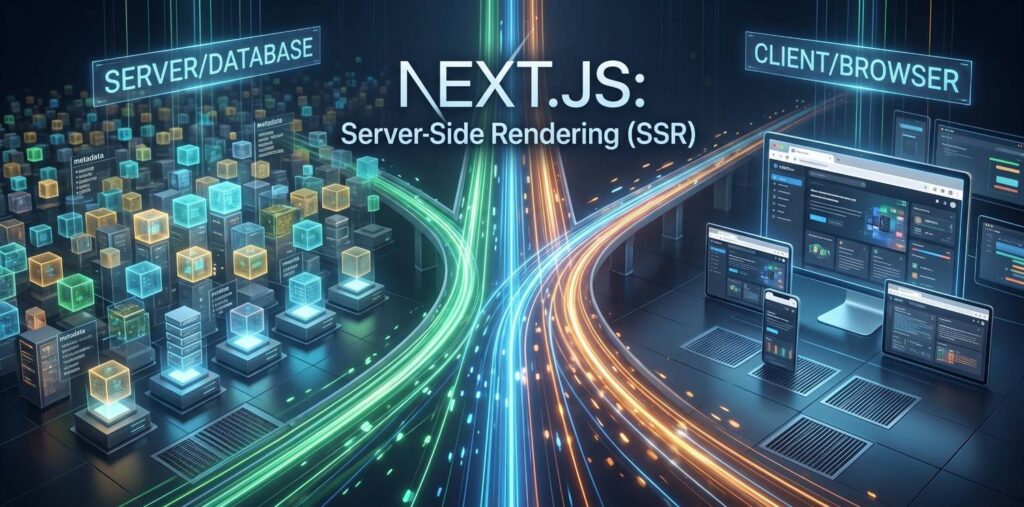
Instead of manually wiring a React frontend to an Express backend and fighting with API routing, 2026 is dominated by “meta-frameworks” that handle everything end-to-end.
A. Next.js: The React Ecosystem King
We use Next.js for a vast majority of modern web projects because it solves React’s biggest historical flaw: SEO-friendly website architecture. By offering built-in Server-Side Rendering (SSR) and Static Site Generation (SSG), Next.js ensures that search engine crawlers can read your content perfectly. It handles file-based routing and automatic image optimization effortlessly.
- Best For: High-traffic e-commerce, content-heavy marketing sites, and dynamic SaaS products.
B. Nuxt.js (The Vue Alternative)
If you prefer Vue’s syntax over React’s, Nuxt.js is the Next.js equivalent for the Vue ecosystem. It provides the same robust SSR, routing, and SEO benefits with an incredibly clean developer experience.
C. The AI-First Innovators: Wasp and Reflex
As AI coding assistants (like GitHub Copilot and Codeium) write more code, frameworks with strict conventions are winning out because AI systems can predict them better.
- Wasp: A declarative full-stack JS framework that gives React, Node.js, and Prisma a “batteries-included” treatment, making it incredibly easy for AI to understand and generate accurate full-stack code.
- Reflex: Allows developers to build full-stack web apps entirely in Python—zero JavaScript required—compiling the frontend dynamically.
4. How to Choose the Right Framework for Your Project

To avoid over-engineering your platform and inflating your budget, you must ruthlessly evaluate your actual business needs. Ask your engineering team these four critical questions:
- What is the primary function?
- If it is a content-heavy or ecommerce site requiring flawless SEO, use Next.js.
- If it requires heavy, complex database logic and AI data processing, use Django.
- If you need to ship a B2B SaaS product quickly with robust auth and billing, use Laravel.
- Are you building for mobile eventually?
- If your ultimate goal includes launching a native iOS/Android app, starting with a React-based web framework (like Next.js) makes transitioning to React Native significantly easier, allowing you to share code and logic.
- What are the security implications?
- Review our guide on Website Security Best Practices. Highly opinionated frameworks like Django and Laravel have built-in protections against SQL injection and CSRF out of the box, whereas unopinionated setups (like raw Express) require you to build those defenses manually.
Frequently Asked Questions (FAQ)
Which web framework is fastest in 2026? For raw frontend loading speed and Time to First Byte (TTFB), Svelte (and SvelteKit) consistently outperforms others due to its lack of a virtual DOM and zero-runtime overhead. For server-rendered speed and large-scale application performance, Rust-based backends or heavily optimized Next.js environments are highly competitive.
Is PHP dead for web development? Not even close. Thanks to the continuous, massive updates to the Laravel framework, PHP remains one of the most stable, lucrative, and widely used backend ecosystems for building secure enterprise applications in 2026. It handles rapid SaaS development better than almost any other ecosystem.
What is the MERN stack and is it still relevant? The MERN stack (MongoDB, Express.js, React, Node.js) is still relevant for learning and building specific types of real-time applications. However, in professional 2026 enterprise environments, teams often prefer relational databases (PostgreSQL over MongoDB) and meta-frameworks (Next.js over raw Express) for better structure and SEO.
Ready to Build Your Next Digital Platform?
Choosing between React, Django, Laravel, and Next.js shouldn’t be based on developer hype or Twitter trends; it should be based on your specific business logic, scalability needs, and financial budget.
If you are unsure which technology stack will properly support your custom web application or ecommerce platform, our technical architects are here to help you map out the perfect infrastructure.
👉 Request a Free Tech Stack Consultation Today and get a personalized architecture roadmap tailored to your 2026 business goals.
