
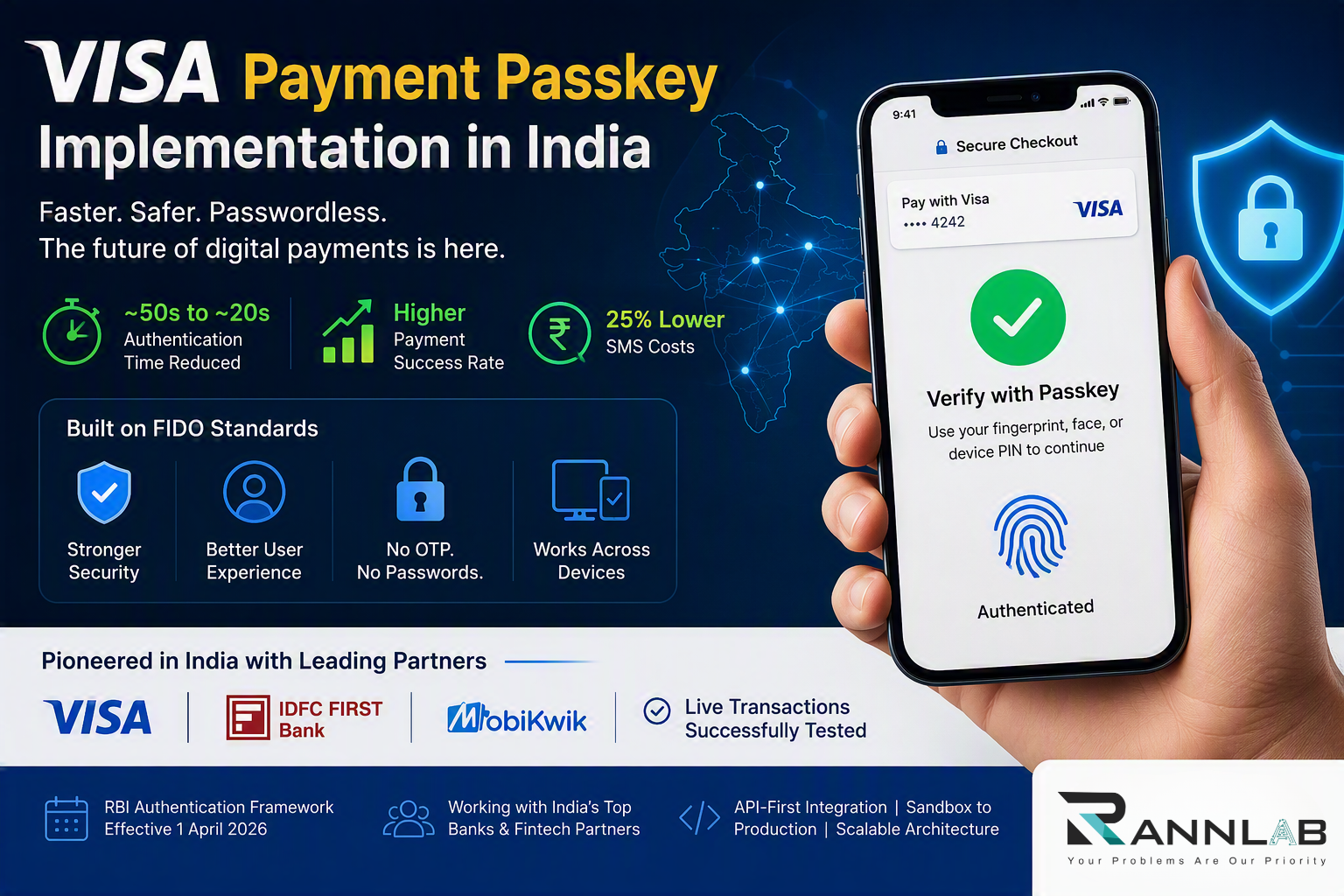
Visa Payment Passkey implementation is not a theoretical capability at RannLab. We have taken a passkey integration through build, certification support and live transaction validation with an issuing bank on India’s Visa network — working alongside the client’s internal engineering team, the network’s technical team and the issuer.
That matters because most vendors currently pitching passkey work have read the same press release you have. Very few have watched an issuer test environment behave differently from production at 11pm before a certification window closes.
What we actually delivered
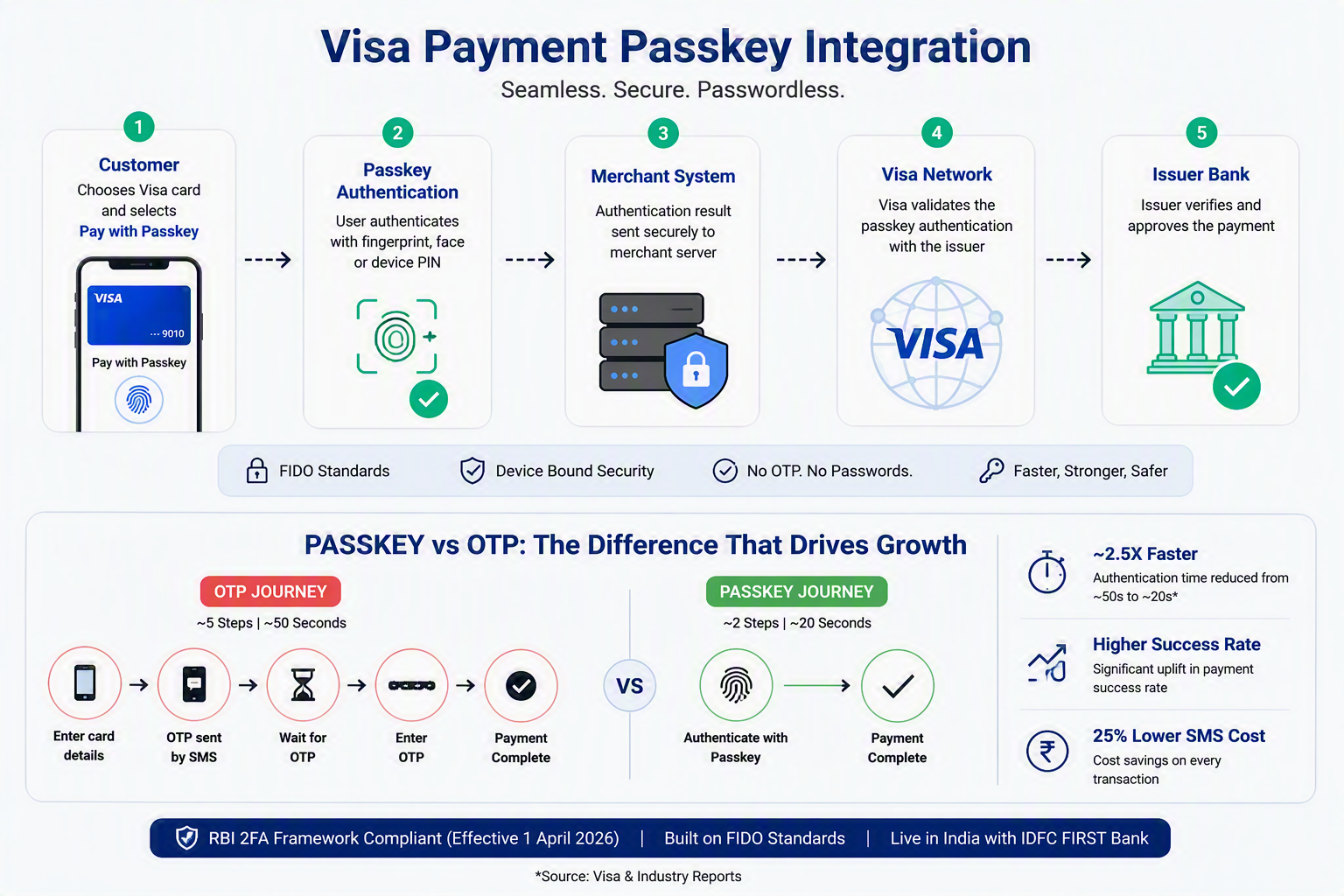
The engagement covered the full path from architecture to a validated live transaction:
Integration architecture. Mapping the passkey flow across the merchant application, the backend, the network’s passkey service and the issuing bank — and identifying where the client’s existing checkout had to change versus where it could stay untouched.
Enrolment flow design. Deciding when to ask a cardholder to create a passkey. This single product decision determines your adoption curve, and it is the one most teams get wrong by interrupting a first checkout.
Backend implementation. Authentication request handling, session and device binding, response validation, and the state machine covering every branch a real transaction can take.
Fallback to OTP. Graceful degradation for unsupported devices and browsers, with no dead ends. A stranded customer is worse than never offering a passkey.
Certification support. Coordinating test cases across four parties — client, network, aggregator and issuer. This is where timelines slip, because you are dependent on four calendars rather than one.
Live transaction validation. Successful authenticated transactions against a live issuing bank, which is the only real proof that an integration works.
Why Visa Payment Passkey implementation is harder than it looks
Teams budget for an SDK drop-in and discover a certification programme. Six things consistently consume more time than planned:
1. Device binding lifecycle. Passkeys bind to a device. New phone, desktop browser, shared family device, cleared browser data — each needs a defined path. Handle this poorly and support volume swamps the conversion gain.
2. The enrolment moment. Ask too early and you lose the sale. Ask too late and adoption never builds. There is no SDK setting for this; it is a product judgement informed by your own funnel data.
3. Test environment drift. Issuer sandboxes do not always mirror production behaviour. Discovering this during certification rather than after go-live is the difference between a delay and an incident.
4. Four-party coordination. Merchant, network, aggregator and issuer all have to align on test windows. Nobody controls the critical path.
5. Measurement instrumentation. If you cannot separate passkey and OTP cohorts on authentication success rate, time-to-authenticate and payment success rate, you cannot defend the programme at the next budget review.
6. Regulatory alignment. The RBI Authentication Directions, 2025 require two independent factors with at least one dynamically generated, effective 1 April 2026. Your implementation has to satisfy that, not merely function.
The business case, in your numbers
Visa Payment Passkey went live in India in July 2026 with IDFC FIRST Bank as first issuer, available to select users at merchants including Myntra, Paytm, MakeMyTrip, Tata Starbucks, Reliance Digital and EatSure.
The reported outcomes are specific:
| Metric | Reported result |
|---|---|
| Checkout authentication time | ~50 seconds down to ~20 seconds |
| Passkey adoption, repeat users | 61% (MakeMyTrip, first rollout) |
| SMS cost | 25% reduction in the same rollout |
| Payment success rate | Significant uplift expected versus OTP |
Apply it to your own volume. At 100,000 card transactions a month with a 12% OTP-related failure rate, a five-point payment success rate improvement recovers 5,000 transactions monthly. At ₹1,500 average order value that is ₹75 lakh in monthly GMV — before the SMS spend you stop paying.
Who should be moving now
High-volume D2C and marketplace merchants where a one-point payment success rate change is measured in crores annually.
Fintech platforms and payment aggregators whose merchants will start asking, and who need the capability in their own stack rather than referring it out.
Banks and issuers building cardholder-side enrolment journeys.
Any merchant whose OTP failure rate exceeds 10% — you are funding a problem with a known solution.
Why RannLab for your Visa Payment Passkey implementation
We build payment and digital trust infrastructure — PKI, eSign, eKYC and authentication systems — for regulated environments. Passkeys sit naturally in that stack rather than being an unrelated new service line.
What that means practically:
- We have completed a live passkey integration, including certification support and validated transactions with an issuing bank
- We work across .NET, Java, Node.js, PHP and Python, so we integrate into your stack rather than asking you to change it
- We have PKI depth, not just SDK familiarity — cryptographic authentication is our existing domain
- We instrument measurement from day one, so you can prove the uplift internally
- Our engineering team is in Greater Noida, in your timezone, available during your certification windows
Talk to our payments team
Tell us your monthly card transaction volume, current payment aggregator and where OTP failures cost you most. We will return a realistic integration route, effort estimate and timeline — from engineers who have already been through this.
Talk to our payments team
Not a discovery call about whether passkeys work. A technical conversation with engineers who have already taken an integration through certification.
- Monthly card transaction volume
- Your current payment aggregator
- Where OTP failures cost you most
You get back a realistic integration route, effort estimate and timeline — not a sales deck.
RannLab Technologies Pvt. Ltd. — Greater Noida, Delhi NCR. Payments · PKI · eSign · Digital Trust Infrastructure.
Frequently asked questions
Have you actually implemented Visa Payment Passkey?
Yes. We have delivered a passkey integration for an Indian fintech platform through build, certification support and live transaction validation with an issuing bank.
How long does a Visa Payment Passkey implementation take?
It depends primarily on route. Integrating through an already-certified payment aggregator is materially faster than direct network integration, which requires full certification against network and issuer test environments.
Do we need to change our payment aggregator?
Usually not. Several major Indian aggregators are already enabled, and we assess your existing relationship before recommending any change.
What happens to customers whose devices do not support passkeys?
Your checkout falls back to OTP. Graceful degradation is mandatory in the implementation, not optional.
Does biometric data reach our servers?
No. Authentication happens on the customer’s device using its native unlock. The biometric never leaves the device, which is what your privacy notice should state.
Is this only for Visa cards?
Our work covers passkey authentication architecture broadly. Mastercard launched its Payment Passkey Service in India in August 2024 on EMVCo, W3C and FIDO Alliance standards, and most merchants need to plan for both networks.
Can you work alongside our internal engineering team?
Yes — that is how we prefer to work. Our last passkey engagement ran jointly with the client’s internal team and the network’s technical staff.
