Quick answer: ABDM compliance is not yet mandatory for every standalone private lab in Delhi, but it is effectively mandatory for any lab connected to PM-JAY empanelled facilities or covered by state digital health directives. With 84.79 crore ABHA IDs created and the Delhi High Court now ordering NIC audits of digital hospital systems, labs without ABDM-ready LIMS software are losing referrals, incentives and empanelment access.
ABDM compliant lab software has moved from a nice-to-have to a business-critical decision for every diagnostic lab in Delhi NCR. In July 2026 the Delhi High Court ordered surprise NIC audits of digital hospital systems across the capital, and the National Health Authority has already communicated 2026 compliance timelines to empanelled facilities and their software vendors. If your laboratory still runs on billing-first software, you are now the weakest link in a referral chain that is going fully digital.
Why ABDM compliant lab software suddenly matters in Delhi?
In July 2026, a Division Bench of Justice Prathiba M. Singh and Justice Manmeet Pritam Singh Arora directed the National Informatics Centre to conduct surprise inspections and audits across all 38 Delhi government hospitals by 31 July 2026, to verify whether the NextGen e-Hospital Management Information System (e-HMIS) is being implemented consistently and uniformly.
The Court’s words were direct: there “needs to be consistency and uniformity in using the NextGen e-Hospital Management Information System.”
The case — Court on its Own Motion v. Union of India — was triggered by a 70-year-old patient from Seelampur who was turned away from LNJP Hospital despite the portal showing ICU beds available. The Court also recorded that no UHID had been generated for her at the first hospital she visited, breaking her digital record trail before treatment began.
The audit report was ordered to state three things: whether ICU bed availability is correctly reflected online, whether emergency calls are properly attended, and whether NextGen e-HMIS is uniformly implemented.
The principle underneath is the part every lab owner should read twice: where a health system is represented as digitally operational, the digital interface and the ground reality must match in real time. Deployment alone is no defence.
That single detail is why ABDM compliant lab software is now a boardroom topic rather than an IT line item. Patient identity and record continuity, which is precisely what a Laboratory Information System produces at sample registration and report release, have become audit-grade metrics rather than back-office housekeeping.
Does this order apply to private diagnostic labs?
No — not directly. The Delhi High Court’s directions target 38 Delhi government hospitals and the NextGen e-HMIS platform. There is no blanket judicial mandate requiring every standalone private pathology lab to adopt ABDM compliant lab software.
But treating that as “we’re safe” is a misread of where enforcement actually comes from. ABDM adoption for private labs is being driven by executive and commercial pressure, not courts:
- A missing UHID became a court-noticed failure. Patient identity and record continuity — precisely what a Laboratory Information System produces at sample registration and report release — are now audit-grade metrics.
- NextGen e-HMIS carries laboratory and radiology modules. Labs feeding into or attached to these facilities must exchange structured digital reports, not PDFs on WhatsApp.
- Judicial scrutiny raises the floor for everyone. Once government facilities are audited on digital consistency, empanelment bodies, insurers and referring clinicians apply the same expectation downstream to their private partners.
- Referral economics shift quietly. A hospital running a digital record system will route work to a lab whose ABDM compliant lab software can publish results straight into it.
Is ABDM compliant lab software mandatory for labs in India?
It depends entirely on your empanelment status. Here is the honest breakdown — no vendor scaremongering:
| Facility type | ABDM status in 2026 | What delay actually costs you |
|---|---|---|
| AB-PMJAY empanelled hospitals & attached labs | Mandatory. The NHA has communicated 2026 timelines to empanelled private hospitals and their software vendors | Suspension of PM-JAY empanelment, inability to submit scheme claims, NHA penalties |
| Facilities under state digital health directives | Mandatory as per individual state deadlines | Licence renewal friction, removal from state panels |
| Private standalone diagnostic labs | Voluntary, but strongly encouraged by the NHA | Lost referrals, no delivery into patient health lockers, ineligible for DHIS incentives |
Now look at the adoption curve, because this is what actually decides your revenue:
- 84.79 crore ABHA IDs created across India as of early 2026
- 2.26 lakh+ health facilities and 2.6 lakh+ healthcare professionals registered on ABDM
- 56,000+ hospitals already running ABDM-enabled solutions
- 5 crore+ OPD tokens processed through ABDM Scan & Share, cutting average wait times from an hour to thirty minutes
Every one of those records was created by ABDM compliant lab software or a comparable hospital system.
When more than half the country carries an ABHA ID, “voluntary” stops being a technical status and becomes a competitive disadvantage.
What ABDM compliant lab software must actually do: M1, M2 and M3
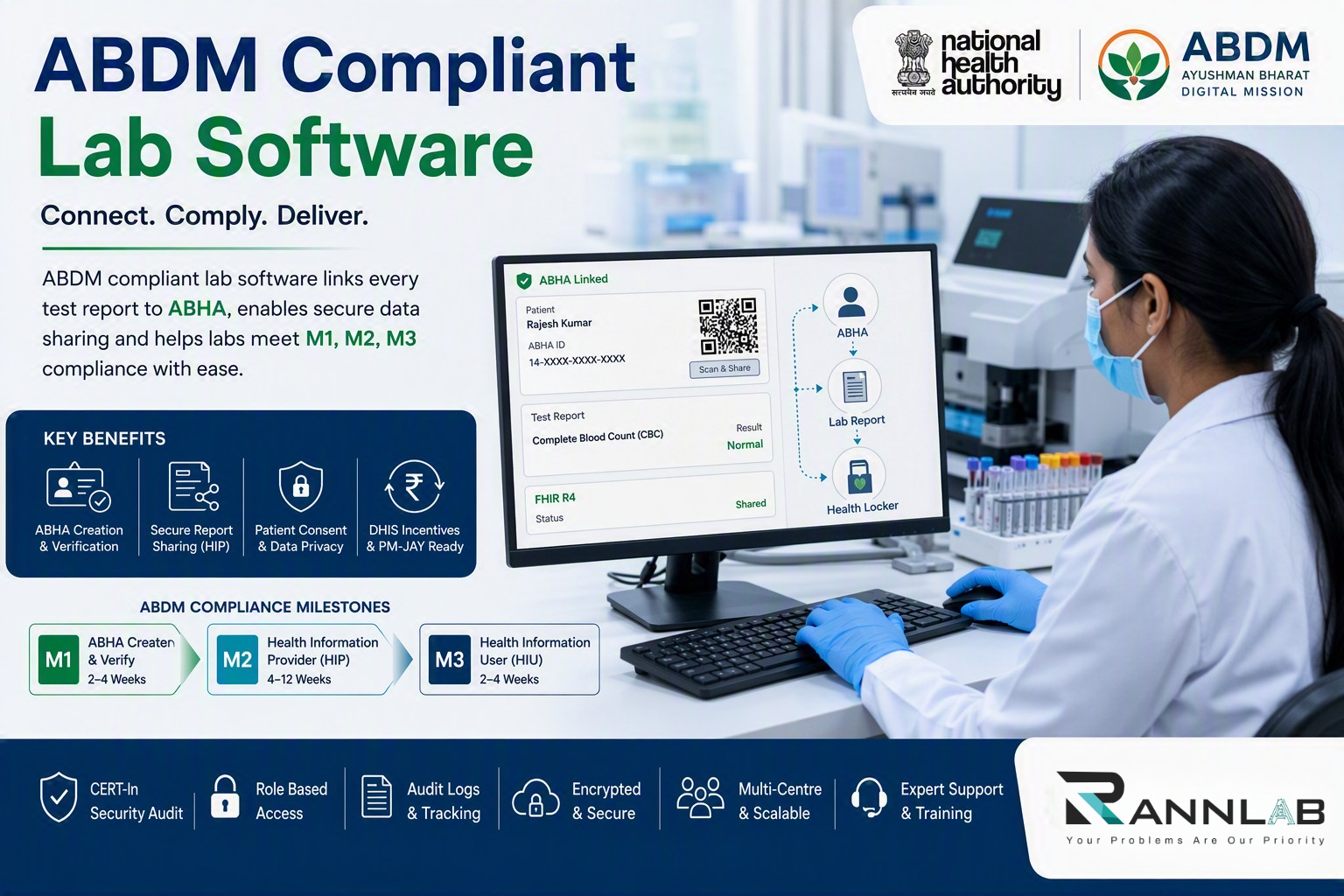
ABDM certification is structured around three milestones — M1, M2 and M3 — plus facility and professional registrations and a security audit. For a diagnostic lab, M2 is the milestone that matters most, because that is where your reports enter the national health record.
| Milestone | What it means for your lab | Typical effort |
|---|---|---|
| M1 — ABHA Create & Verify | Your front desk creates or verifies a patient’s 14-digit ABHA at registration and supports Scan & Share QR check-in | 2–4 weeks |
| M2 — Health Information Provider (HIP) | Every lab report, prescription and OP record is linked to the patient’s ABHA as a care context and shared, with consent, in FHIR R4 format | 4–12 weeks — the demanding one |
| M3 — Health Information User (HIU) | You fetch prior records from other ABDM facilities with patient consent — better clinical context, fewer repeat tests | 2–4 weeks on top of M2 |
Alongside the milestones, genuinely ABDM compliant lab software requires:
- Facility registration on the Health Facility Registry (HFR) at facility.abdm.gov.in
- Pathologist and clinician registration on the Healthcare Professionals Registry (HPR)
- ABDM Sandbox access, then production credentials
- A CERT-In empanelled security audit
- HTTPS with valid TLS, role-based access control, audit logging of every record access, strict multi-tenant data isolation, documented consent and retention policy, encrypted storage of ABHA identifiers and patient PII
Official programme details are published by the National Health Authority.
What does ABDM compliant lab software cost, and how long does it take?
Sandbox access and both government registries (HFR and HPR) are free. The two real costs are the CERT-In empanelled security audit — typically ₹40,000 to ₹1,50,000 depending on scope — and software integration.
And software integration is where the entire economics of this decision sit:
If your software vendor is already ABDM-certified, your integration cost approaches zero and your timeline compresses from months to weeks. You inherit their milestones instead of rebuilding them.
That single fact should drive your vendor conversation this week. Ask your current LIMS or HMS provider one question:“What is your ABDM certification status — M1, M2 or M3?” If they cannot answer immediately with a certificate, you are the one carrying the risk, not them.
The 6-question ABDM readiness self-audit for your lab
Answer these honestly. Each “no” is a gap that will cost you money or a licence.
- Can your receptionist create and verify an ABHA inside your existing software — or do they open a separate government portal and retype the patient’s details?
- Are your reports FHIR R4 structured — or are they PDFs with a signature image pasted on top?
- Is every report auto-linked to the patient’s ABHA as a care context, with consent captured and logged?
- If an assessor asked who accessed a specific patient’s report last Tuesday at 4 PM, could you answer in under a minute from an audit log?
- Is your facility registered on HFR and your pathologists on HPR — with the registrations current, not lapsed?
- Have you cleared a CERT-In empanelled security audit in a form you could produce on demand?
Scoring: 5–6 yes — you are ahead of most of Delhi NCR. 3–4 yes — you have a 6–10 week remediation path. 0–2 yes — your software was built for billing, not for a connected health ecosystem, and you should be evaluating replacement rather than patching.
How RannLab builds ABDM compliant lab software
RannLab Technologies Pvt. Ltd. is an official System Integrator under the NHA and ABDM SIDH (System Integrators in Digital Health) Program, appointed through the programme driven by Ernst & Young with Access Health India, supported by the Bill & Melinda Gates Foundation and the National Health Authority. The SIDH programme exists specifically to drive EMR adoption in hospitals with 10 to 200 beds across urban and semi-urban India.
That matters for one practical reason: we have already walked the sandbox-to-production path for ABDM compliant lab software, so you do not have to fund the learning curve.
What we deliver for laboratories and diagnostic chains:
- ABHA at the counter — create, verify and link inside the same registration screen your staff already uses, with Scan & Share QR at reception
- ABDM Connector API — HPR, HFR and HIU integration with OAuth 2.0 secure access, consent request and status management, and record linkage to ABHA IDs
- FHIR R4 report linkage — pathology, biochemistry and radiology results auto-published as care contexts with full consent handling
- Complete lab workflow — order entry, barcoded sample tracking, analyser interfacing, quality control, TAT dashboards, pathologist digital sign-off
- NABL-aligned documentation — audit trails, QC records and report formats that survive assessment
- Multi-centre and franchise architecture — collection centres, home collection, B2B rate lists, centralised reporting across locations
- Audit-ready security — role-based access control, tenant isolation, encryption of ABHA identifiers and PII, complete access logging, and third-party VAPT by certified external auditors
- Patient and doctor delivery — WhatsApp, SMS, portal and health-locker delivery replacing manual dispatch
We also help you claim what you are owed: the Digital Health Incentive Scheme (DHIS) pays healthcare providers for eligible digital records. Most labs never claim it because their software cannot evidence the records.
Because we build the underlying platforms in-house through our /services/software-development/, moving from a legacy LIMS to ABDM compliant lab software does not mean rebuilding your workflows from zero.
We also help you claim what you are owed. The Digital Health Incentive Scheme pays healthcare providers for eligible digital records, and most labs never claim it because their existing system cannot evidence those records.
Why the next two quarters are the window
Delhi’s public health system is being digitally audited under judicial supervision. PM-JAY empanelment is tied to ABDM readiness on 2026 timelines. Patients already carry ABHA IDs and are beginning to ask for them at your counter.
Labs that install ABDM compliant lab software this quarter become the default referral partners for the next five years. Labs that wait will integrate under deadline pressure, at a worse price, on somebody else’s schedule.
Deploying ABDM compliant lab software takes weeks rather than months, provided your partner already carries the certification.
Integration takes weeks, not months — when your partner already carries the certification.
Get a free ABDM readiness assessment for your lab
Tell us your facility type, number of centres and current software. We will send you a written gap report covering HFR and HPR registration status, the milestone scope you actually need, security audit requirements, DHIS incentive eligibility, and a realistic go-live timeline.
No sales deck. A written assessment you can act on.

RannLab Technologies Pvt. Ltd. — Greater Noida, Delhi NCR NHA & ABDM Official SIDH Partner · Healthcare IT · Digital Trust Infrastructure
Frequently Asked Questions
Is ABDM compliance mandatory for diagnostic labs in Delhi?
Not universally. ABDM compliance is mandatory in practice for facilities empanelled under AB-PMJAY and for those covered by state-level digital health directives. For private standalone labs with no government scheme affiliation it remains voluntary, though the National Health Authority strongly encourages adoption to enable digital report delivery to patients’ health lockers.
Did the Delhi High Court order all labs to use digital software?
No. The July 2026 directions concerned implementation of the NextGen e-Hospital Management Information System and surprise NIC audits across 38 Delhi government hospitals, ordered by a bench of Justice Prathiba M. Singh and Justice Manmeet Pritam Singh Arora. Private standalone labs were not covered by that order.
How long does ABDM integration take for a lab?
M1 (ABHA create and verify) typically takes 2–4 weeks. M2 (Health Information Provider — the milestone that carries your lab reports) takes 4–12 weeks. M3 (Health Information User) adds a further 2–4 weeks. These timelines compress substantially if your software vendor is already ABDM-certified.
What does ABDM compliance cost?
The ABDM sandbox and the HFR and HPR registries are free government portals. A CERT-In empanelled security audit typically costs ₹40,000 to ₹1,50,000 depending on scope. Software integration cost drops to near zero when your existing vendor already supports ABDM.
What is ABHA?
ABHA (Ayushman Bharat Health Account) is a 14-digit unique health identifier for every Indian citizen, created using Aadhaar OTP or mobile OTP. It links prescriptions, lab reports and discharge summaries across hospitals, labs and pharmacies, accessible to authorised providers only with the patient’s explicit consent.
What happens if a PM-JAY empanelled facility misses the ABDM deadline?
Facilities risk suspension of PM-JAY empanelment, inability to submit scheme claims, potential penalties from the NHA, and loss of a significant revenue stream.
What is the Digital Health Incentive Scheme (DHIS)?
DHIS is a National Health Authority scheme that pays financial incentives to healthcare providers for eligible digital health records created under ABDM. It is designed to offset the cost of digitisation for hospitals, labs and clinics.
