When a Canadian digital-health company needed to unify clinical and wearable data into one trusted intelligence layer, they partnered with Rannlab. Here’s how we engineered it — end to end.
The Project at a Glance
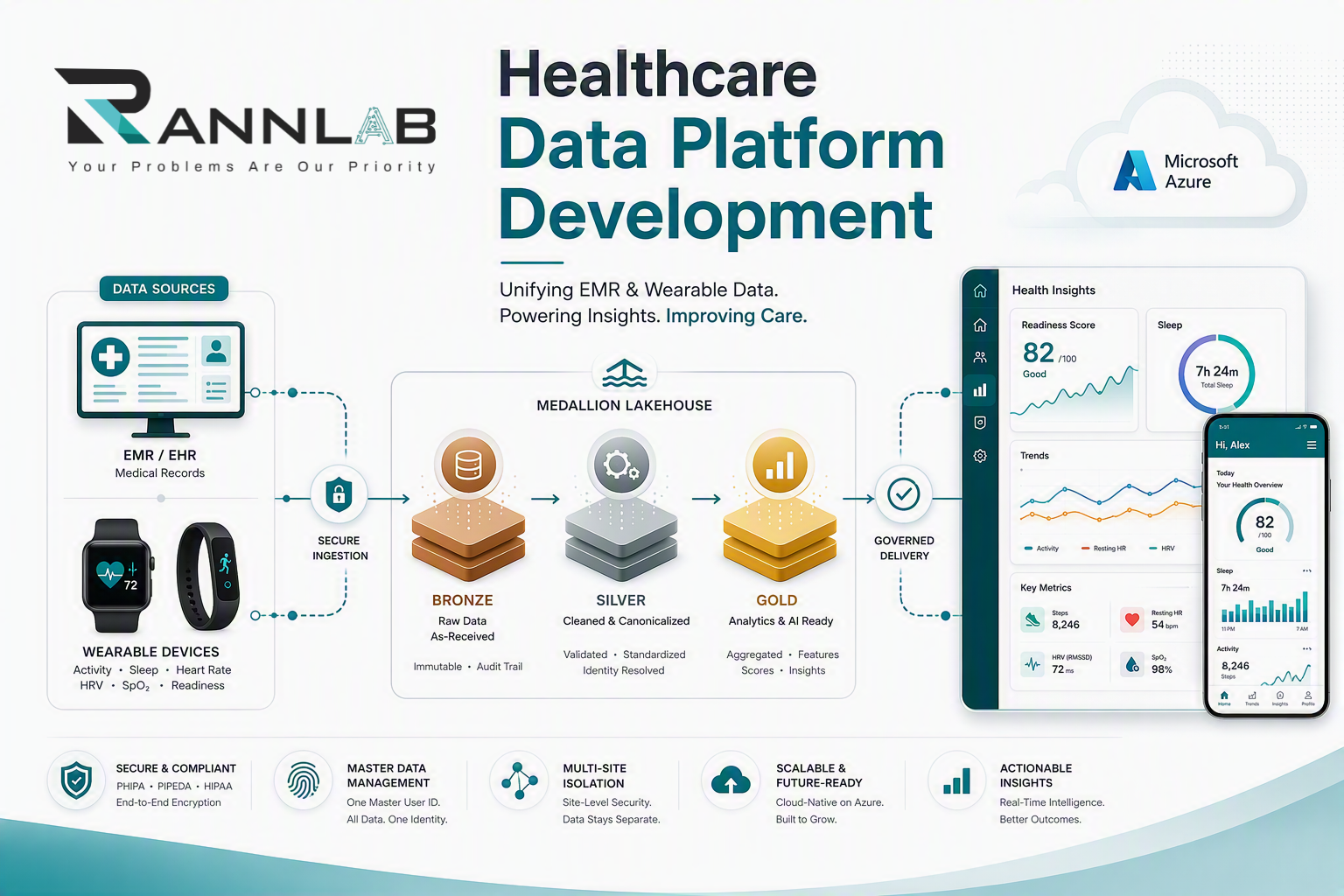
Healthcare data platform development is one of the hardest engineering challenges in digital health — and it’s exactly what a Canadian company, Ubika, hired Rannlab to solve. Ubika needed to unify Electronic Medical Record (EMR) data and wearable health data into one secure, governed intelligence layer, then surface insights to patients and clinicians through a clean web and mobile experience.
The app you see is the easy part. The real work lives underneath: connecting to live EMRs and wearables, standardizing fragmented health data, and doing it all under Canada’s strict privacy laws (PHIPA, PIPEDA) and HIPAA. Here’s how we engineered it on Microsoft Azure.
The Challenge
Healthcare data is unforgiving. A patient must only ever see their own records — complete, accurate, and current. That meant building a platform that could:
- Ingest from many sources — EMRs (Accuro, OSCAR), wearables (Fitbit, Oura), and future IoT, imaging, and billing systems — without rebuilding integrations each time.
- Standardize messy data — turn vendor-specific formats into one clean, consistent model.
- Prove one identity — tie every single data point back to one reliable user.
- Isolate every organization — keep each clinic’s patient data strictly separate on shared infrastructure.
- Bake in compliance — governance, encryption, and audit trails as a foundation, not an afterthought.
The Architecture — Built on Azure, Compliance-First
Our Approach to Healthcare Data Platform Development
Our healthcare data platform development approach rests on four engineered layers. Rannlab delivered a private-by-default cloud platform. The only public surface is the patient-facing web app, protected by Azure Front Door with a Web Application Firewall (WAF). Everything else — APIs, functions, databases, storage, and the data engine — lives privately inside Azure’s network, reachable only through private endpoints, VPN with Entra ID, MFA, and least-privilege access.
The platform rests on four engineered layers:
1. Unified Data Ingestion — The Ubika Data Connector
A proprietary connector automates onboarding and securely pulls data from EMRs and wearables — in real time and on demand. It handles OAuth, rate limits, retries, and standardization, so Ubika can scale across new clinics and devices without custom manual integration every time.
2. The Medallion Lakehouse — Raw to Refined
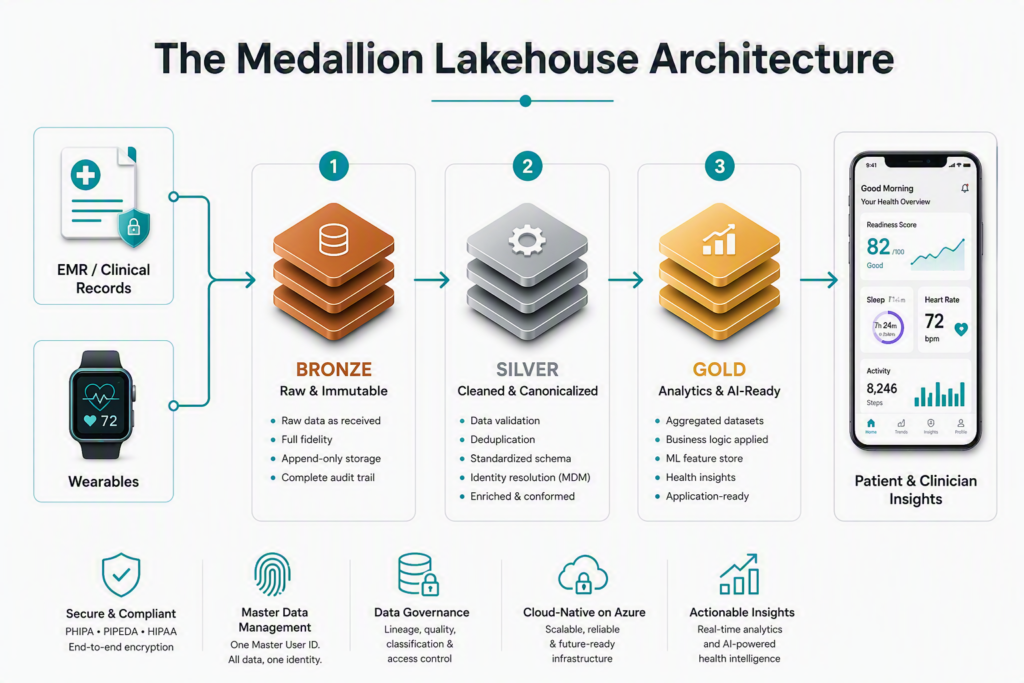
All data flows through a three-tier Bronze → Silver → Gold architecture on Azure Data Lake:
- Bronze stores every raw payload immutably, so data can always be reprocessed.
- Silver cleans, deduplicates, converts units, and resolves identity to one master user.
- Gold produces analytics-ready, application-ready datasets and health intelligence.
3. Master Data Management — One Identity Thread
A hub-and-spoke identity model gives every user a single, application-owned Master User ID. Wearables and EMRs keep their own identifiers, but everything downstream references Ubika’s master ID — so a patient’s Fitbit data, Oura data, and clinical records all align under one person, with no fragile cross-system joins and no external identifiers leaking into health data.
4. Multi-Site Isolation — Safe on Shared Infrastructure
A Site ID acts as the primary isolation boundary across storage, processing, governance, and application layers. Data from one clinic or provider network cannot be accessed by another, even on shared infrastructure — the principle that makes secure, multi-tenant healthcare scale possible.
Security & Compliance — Engineered In, Not Bolted On
Security & Compliance in Healthcare Data Platform Development
- Encryption everywhere — TLS in transit, AES-256 at rest, customer-managed keys, and hashing of sensitive identifiers (like health card numbers) as data moves downstream.
- Governance by default — full Bronze→Gold data lineage via Azure Purview, automated PII/PHI classification, and complete audit trails.
- Enterprise monitoring — Microsoft Defender for Cloud, Azure Sentinel (SIEM), and Azure Monitor for continuous threat detection and observability.
- Resilience — geo-zone-redundant storage and zone-redundant PostgreSQL high availability, protecting against zone and regional failures.
How We Validated It — Patient-Safe by Design
Successful healthcare data platform development doesn’t stop at build — it demands rigorous end-to-end testing. Beyond building the pipeline, Rannlab hardened it against the real world through rigorous end-to-end testing: verifying first-time onboarding, ensuring the app shows an honest “your data is being prepared” state rather than partial data, confirming that live EMR updates and automatic background sync flow through correctly, and proving that invalid identities, duplicate sign-ups, and mid-pipeline failures never expose the wrong data or crash the app.
The Result
Ubika now runs on a secure, compliant, scalable healthcare data platform — multi-site ready, wearable- and EMR-connected, and engineered for long-term growth across the Canadian market and beyond.
Why This Matters for Canadian Health Innovators
In digital health, trust is the product — and trust is won or lost in the data layer. Rannlab specializes in exactly this: compliant, cloud-native, EMR- and wearable-integrated platforms that patients and clinicians can rely on. Successful healthcare data platform development demands compliance, resilience, and clean identity from day one.
Building a healthcare data platform in Canada? Rannlab handles the hard part — secure ingestion, EMR/wearable integration, compliance, and scale. https://www.rannlab.com/contact
Frequently Asked Questions
What is healthcare data platform development?
A healthcare data platform unifies clinical records, wearable data, and other health sources into one secure, governed system that powers analytics, insights, and applications for patients and providers.
Is the platform compliant with Canadian privacy laws?
Yes. The platform is engineered to meet PHIPA (Ontario), PIPEDA (Canada), and HIPAA (US) requirements, with encryption, audit trails, and strict data isolation built in.
Can it integrate with existing EMR systems?
Yes. The platform connects to EMRs like Accuro and OSCAR, plus wearables like Fitbit and Oura, through a proprietary data connector — with room to add new sources.
How long does it take to build a platform like this?
Timelines depend on data sources, compliance scope, and features. Contact Rannlab for a scoped estimate for your project.
