How much does Moodle cost?” is a trick question, and it’s usually the wrong one. Moodle itself is free and open-source — there’s no license fee. What you’re actually paying for is the development, customization, hosting, and support that turns a bare Moodle install into a platform your learners and administrators actually want to use.
That distinction is where most budgets go wrong. Organizations request quotes expecting a flat number and get a range instead, because the real cost depends on scope, not the software. This guide breaks down what drives Moodle development cost in 2026, with realistic pricing ranges by project type, so you can budget accurately and spot a lowball quote before it becomes a mid-project surprise.
Why “Moodle Is Free” Doesn’t Mean Your Project Is
Moodle’s core software costs nothing to download and run. But a production-ready LMS involves layers Moodle doesn’t ship with out of the box:
- Hosting and infrastructure — servers, CDN, backups, uptime monitoring
- Theme and UX customization — matching your brand, not the default interface
- Custom plugin development — features specific to your workflow
- Third-party integrations — SIS, HRMS, CRM, payment gateways, video conferencing
- Data migration — moving existing courses, users, and grade history from a legacy system
- Security hardening and compliance — GDPR, FERPA, or HIPAA-aligned configurations
- Ongoing support and maintenance — updates, bug fixes, version upgrades
Each of these is a separate cost center, and the total varies enormously depending on how many of them your project touches.
Typical Moodle Development Cost Ranges by Project Type
These are general industry ranges for 2026 — actual quotes will vary by vendor, region, and project complexity. Treat this as a planning benchmark, not a fixed price list.
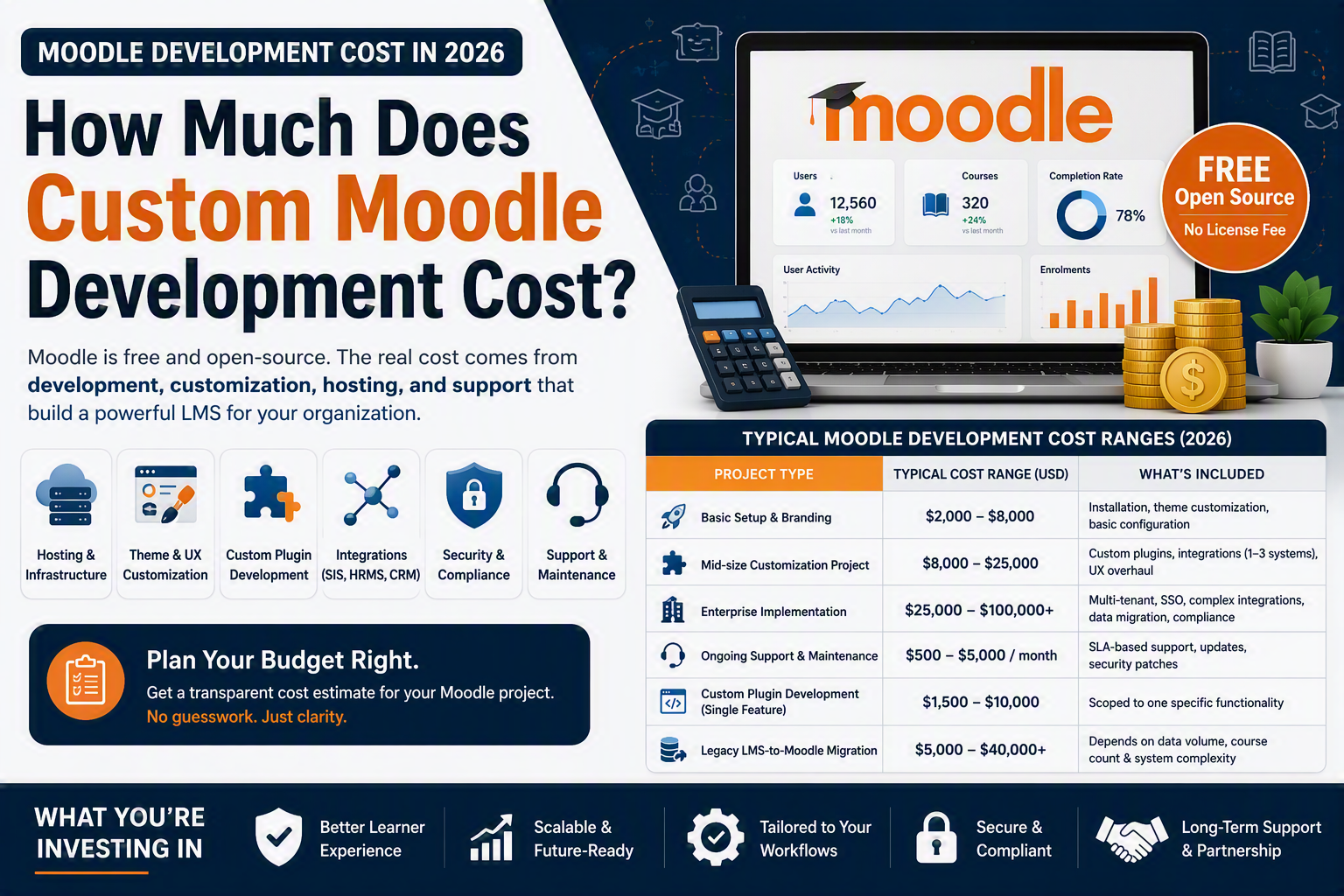
| Project Type | Typical Cost Range | What’s Included |
|---|---|---|
| Basic Moodle setup & branding | $2,000 – $8,000 | Installation, theme customization, basic configuration |
| Mid-size customization project | $8,000 – $25,000 | Custom plugins, integrations (1–3 systems), UX overhaul |
| Enterprise Moodle implementation | $25,000 – $100,000+ | Multi-tenant architecture, SSO, complex integrations, data migration, compliance work |
| Ongoing support & maintenance | $500 – $5,000/month | SLA-based bug fixes, security patches, version upgrades |
| Custom plugin development (single feature) | $1,500 – $10,000 | Scoped to one specific functionality |
| Legacy LMS-to-Moodle migration | $5,000 – $40,000+ | Depends on data volume, course count, and system complexity |
What Actually Drives the Price Up or Down
1. Scope of Customization
A themed install with default functionality costs a fraction of a platform with custom gradebooks, bespoke reporting dashboards, or a purpose-built enrollment workflow. The more your workflow diverges from Moodle’s defaults, the more development hours it takes.
2. Number and Complexity of Integrations
Connecting Moodle to a single sign-on provider is a different job than syncing bidirectional data with an HRMS, a payment gateway, and a video conferencing tool simultaneously. Each integration point adds development time, testing, and long-term maintenance surface area.
3. User Scale and Concurrency
A platform serving 200 users has very different infrastructure and caching needs than one serving 50,000 concurrent learners during exam season. Performance architecture — following Moodle’s own scaling guidance — becomes a real line item at enterprise scale.
4. Data Migration Volume
Migrating from an existing LMS means mapping and transferring users, course content, grade history, and completion records. The cost scales with how much historical data needs to move and how messy that data is.
5. Compliance Requirements
If your Moodle instance handles data governed by GDPR, FERPA, or HIPAA, expect additional cost for security audits, access controls, and documentation — this isn’t optional scope, it’s risk mitigation.
6. Freelancer vs. Development Company
Freelance rates often look cheaper hourly, but freelancers typically don’t include project management, QA, documentation, or post-launch support in that rate — costs that resurface later as rework or emergency fixes. A development company’s quote usually reflects the full lifecycle, which is why direct hourly comparisons can be misleading. (We covered this trade-off in more depth in Why Hire a Moodle Development Company Instead of Freelancers?)
7. Team Location
Hourly rates vary significantly by region — development teams in North America and Western Europe generally charge more per hour than teams in South Asia or Eastern Europe. That doesn’t automatically mean lower total cost, though: a lower hourly rate with more hours billed can land at the same total as a higher rate delivered more efficiently.
Hidden Costs to Ask About Upfront
A quote that looks lean often has costs pushed outside the scope document. Before signing, confirm whether these are included:
- Post-launch bug fixes during a warranty period
- Version upgrade support (Moodle releases major updates regularly)
- Server and hosting costs, or whether that’s billed separately
- Training for administrators and instructors
- Documentation handover
- Source code and plugin ownership rights
A Simple Way to Budget Your Project
Rather than asking “what does Moodle cost,” bring a vendor three things instead:
- Your user count and growth projection — current and expected in 12–24 months
- A list of systems you need Moodle to talk to — HRMS, SIS, CRM, SSO provider, payment processor
- Any compliance requirements — GDPR, FERPA, HIPAA, or industry-specific standards
A vendor who can turn those three inputs into a scoped estimate — rather than a single flat number — is giving you a quote you can actually plan around.
Get an Accurate Quote for Your Project
Generic pricing ranges are a starting point, not a substitute for a real scope conversation. Request a free Moodle development quote from Rannlab — tell us your user count, integration needs, and timeline, and we’ll give you a scoped estimate instead of a guess.
Frequently Asked Questions
Is Moodle really free to use?
Yes — Moodle’s core software is free and open-source under the GPL license. The costs come from hosting, customization, integrations, and support, not the software itself.
Why do Moodle development quotes vary so much between vendors?
Quotes vary because scope definitions vary. Two vendors quoting the “same” project may differ in what they include — QA, documentation, post-launch support, and hosting are often the line items that separate a low quote from a complete one.
Is it cheaper to hire a freelancer for Moodle customization?
Hourly rates can look lower, but freelancers often exclude project management, QA, and post-launch support from that rate. Total project cost — including rework — can end up comparable to or higher than a structured agency engagement.
How much does ongoing Moodle support cost after launch?
Ongoing Moodle Support and Maintenance typically runs $500–$5,000/month depending on platform size and SLA response times, covering security patches, bug fixes, and version upgrades.
Does migrating from another LMS to Moodle cost more than starting fresh?
Usually, yes — migration adds data mapping, content conversion, and validation work on top of standard implementation, though the exact premium depends on how much historical data needs to move.
