
There comes a definitive moment in the lifecycle of many growing digital businesses when a standard website—no matter how optimized or finely tuned—simply stops being sufficient. The limitation isn’t just about appearance; it’s about core capability. You might require complex user portals, real-time data processing, unique proprietary algorithmic logic, or seamless, bidirectional integration with deeply embedded internal ERP systems.
If you are currently trying to force a content management system (CMS) like WordPress, Shopify, or Webflow to handle complex procedural logic, heavy transactional databases, or highly dynamic, user-specific states, you aren’t just fighting the platform; you are aggressively accumulating massive technical debt that will eventually break the budget.
In 2026, the distinction between content and capability is paramount. While simple sites show content, true web applications perform actions. Custom web application development is the specialized engineering required to bridge that gap.
Summary:
- The Defining Shift: Standard websites focus on content delivery; web applications process complex data, manage personalized user states, and facilitate transactional actions.
- The Scaling Trigger: You must move beyond CMS builds when platform-specific limitations—specifically rigid data models, security vulnerabilities from plugin bloat, and poor performance under heavy concurrent user load—become severe business bottlenecks.
- 2026 Technology: Engineering leaders are prioritizing JavaScript/TypeScript (React, Vue) frontend frameworks coupled with scalable, secure microservices or serverless backends (Node.js, AWS Lambda).
- Architecture Mandatory: Superior custom web application development relies on robust architectural design, ensuring high availability, modularity, and comprehensive technical documentation.
What is Custom Web Application Development?
Custom web application development is the expert practice of conceptualizing, designing, engineering, deploying, and maintaining bespoke software that is accessed globally via a standard web browser. Unlike informational websites, these applications are procedural and user-centric, focusing on highly dynamic interactivity, complex state management, and proprietary data processing tailored exactly to specific business goals. They rely on decoupled architectures, leveraging frontend frameworks for smooth UI and robust API backends for core software-as-a-service (SaaS) utility.
1. Web Application vs. Website: Mapping the Crucial Interactivity Gap
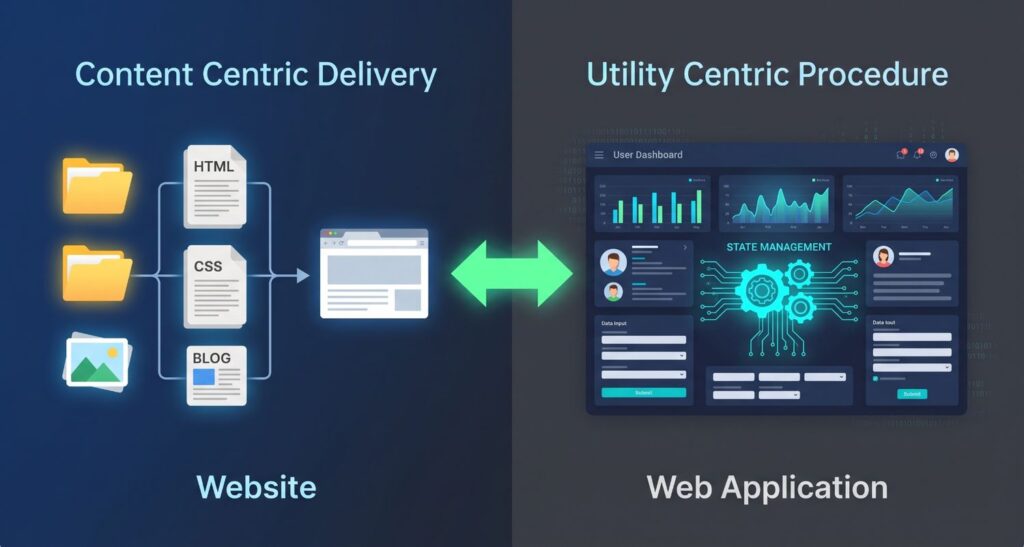
The distinction between a website and a web application has become blurred to the casual user, but from a strategic engineering perspective, the difference is absolute. It directly impacts your development roadmap, your security posture, and your long-term website development cost.
A. The Website: Content-Centric Delivery
A traditional website is designed fundamentally for content consumption. It delivers informational text, static images, and embedded video to the user with minimal expectation of active input. Success here is measured by core usability: readability, intuitive navigation, fast load speeds (optimizing Core Web Vitals), and strong information architecture.
Examples: A corporate brochure site, a portfolio, a standard news blog, or an informational restaurant menu.
B. The Web Application: Utility-Centric Procedure
A modern web application is utility-centric. It requires active user interaction and procedural input to perform its function. It does not just display content; it processes transactional data in real-time. Crucially, a web application maintains user state—it must securely manage authentication (logins), handle personalization, and remember dynamic user decisions across a session.
Examples: Digital banking portals, Customer Relationship Management (CRM) tools , project management software , complex online booking systems, and any modern Software-as-a-Service (SaaS) product.
2. Knowing the Critical Signals: When to Scale Beyond CMS
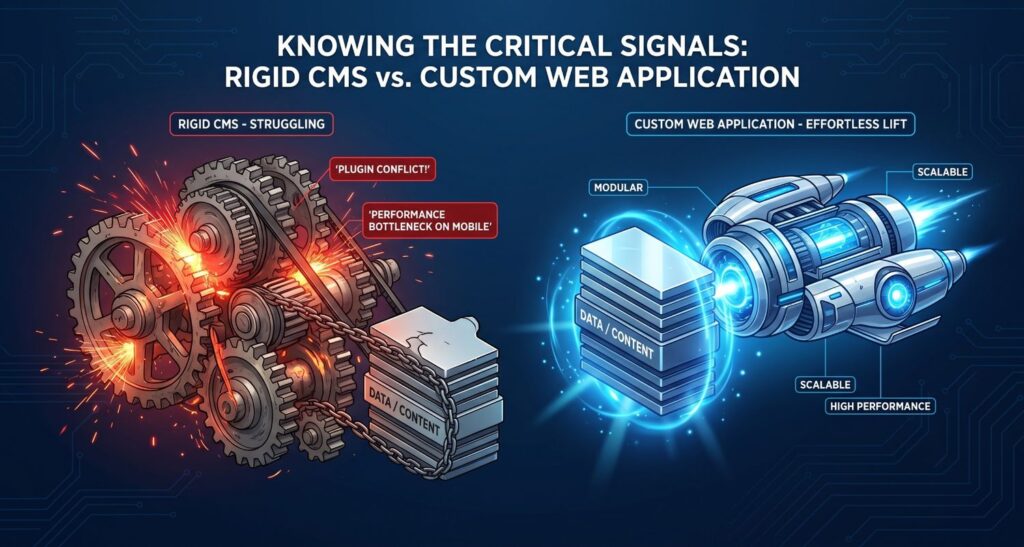
Standard CMS platforms are magnificent for content; they are terrible for procedural logic. If your growing business is experiencing the following bottlenecks, you are hacking a CMS, not engineering a solution. You are ready for true custom software development.
A. The Performance Bottleneck: Core Web Vitals on Mobile cellular networks
Wait, didn’t we say CMSs are good at content? Yes, but they are heavy. To provide flexibility, CMSs load substantial, unused JavaScript and CSS files on every page request. While they pass on desktop, they often fail Google’s strict mobile Core Web Vitals on real-world cellular connections.
If your core utility cannot meet the 2.5s Larger Contentful Paint (LCP) benchmark on a standard mobile network because the CMS engine is too bloated, you need a custom, lightweight SPA (Single Page Application) that only loads the code needed for that specific action. For more on this, read our dedicated guide: Mobile-First Web Design: Why Responsive Website Development is Now Non-Negotiable.
B. “Plugin Dependency Hell” and Security Risk
When you rely on ten, fifteen, or twenty-plus third-party plugins just to handle basic interactivity (e.g., custom forms, basic member portals, advanced filtering), you are operating a platform that is unstable, slow (heavy TTFB), and insecure. Each plugin introduces an external code dependency, massive technical debt, and increases the attack surface for automated hacking attempts. When you spend more time fixing plugin conflicts than building business features, you must scale.
C. Rigid Data Structures and Poor Procedural Logic
Standard CMS databases have rigid, non-standard schemas optimized for blog posts (wp_posts). Forcing deeply nested data, complex relational models (like a healthcare patient record or a financial portfolio), or multi-step procedural logic (like a dynamic loan application flow) into this structure is inefficient, prone to errors, and severely limits your ability to scale.
3. The Architecture of Scalable, Bespoke Web Apps (2026)
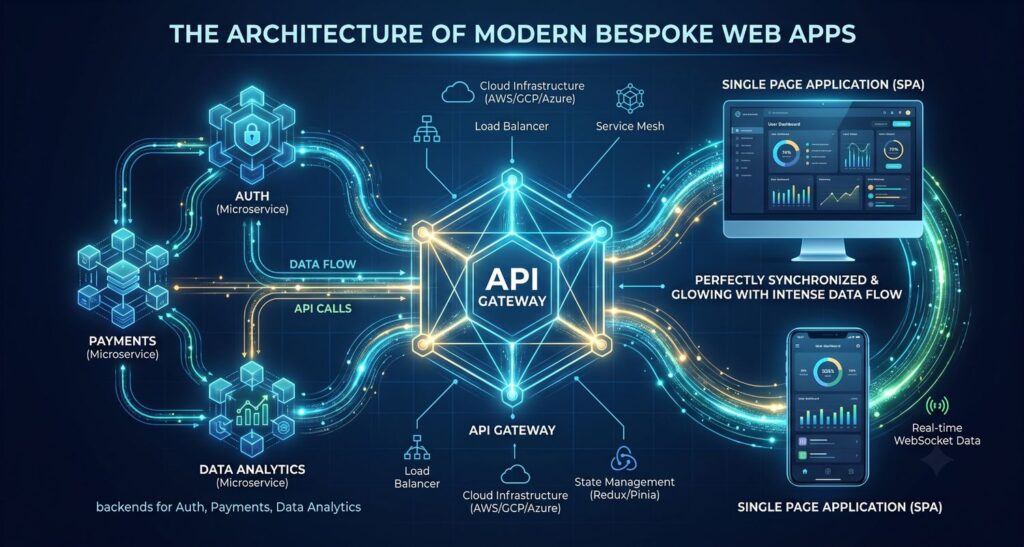
When you decide to invest in expert custom web application development for 2026 and beyond, your engineering team is likely moving toward a fully decoupled, headless, or single-page application (SPA) architecture.
Decoupled (Headless) Setup: Separating Concerns
Following modern technical SEO architecture principles, you strictly separate concerns. This decoupling ensures that the backend and frontend can scale independently.
- The Backend (The Engine): A high-performance, stateless API (REST or GraphQL) engineered using technologies like Node.js, Python (Django), or Go, managing data logic and security.
- The Frontend (The Glass): A blazing-fast, immersive user interface built with JavaScript/TypeScript frameworks that consumes the backend APIs.
The Domination of React and Vue via Next.js and Nuxt.js
A Single Page Application (SPA) is a powerful web application type that only loads the initial HTML, CSS, and JavaScript once. As the user interacts with the app, it fetches data dynamically via APIs and updates the interface instantly without a full browser refresh. This mimics the experience of a native mobile app.
- The SEO Imperative: Mastering Server-Side Rendering (SSR) Historically, SPAs had devastating SEO issues because search engine crawlers struggled to render JavaScript. In 2026, this problem has been expertly resolved. Engineering leaders leverage modern frameworks like Next.js (for React) or Nuxt.js (for Vue) to implement true Server-Side Rendering (SSR). These tools pre-render the JavaScript on the server into clean, semantic HTML before it reaches the client, merging near-instant user speed with 100% search engine visibility and accessibility.
4. Prioritizing the Engineering Disciplines: Security by Design and QA
When you opt for bespoke development, you assume 100% responsibility for stability and protection. This is where expertise separates simple coders from qualified engineers. In 2026, a “functional” web app is useless if it is vulnerable or fragile.
Essential Security by Design (2026)
Standard CMSs have a global community quickly patching vulnerabilities. In your enterprise web application, security is your mandatory cost.
- Input Sanitization and Validation: Guarding against SQL injection (data corruption) and Cross-Site Scripting (XSS – data theft).
- Authentication & Authorization: Secure user authentication (like MFA) and strict Role-Based Access Control (RBAC).
- WAF and DDoS Protection: Implementing dynamic security at the edge (like Cloudflare, Fastly, or AWS WAF).
Rigorous QA and Stress Testing
Because every piece of your procedurallogic is proprietary, Quality Assurance (QA) is not optional. You must assume nothing works until it is rigorously tested.
- Automated Testing: Unit tests for individual functions and End-to-End (E2E) tests for critical user journeys.
- Stress and Load Testing: Pushing the custom architecture to its breaking point to simulate flash traffic and identify memory leaks before deployment.
Frequently Asked Questions (FAQ)
What is the core difference between a custom web application and a standard website? The core difference is purpose and capability. A website’s primary function is delivering static content efficiently. A custom web application’s primary function is performing specific procedural actions, processing user data dynamically, and managing user state (personalization) seamlessly.
How do I choose the optimal technology stack for a custom build in 2026? There is no “best” stack, only the rightstack for your goals. JavaScript/TypeScript (React with Next.js/Node.js) is excellent for real-time reactivity, speed, and cross-platform synergy; Python (Django) is powerful for AI integration, machine learning, and rigorous data handling; and PHP (Laravel) remains robust for massive enterprise applications.
Are custom web applications always more expensive than standard CMS builds? In almost all cases, yes. The initial website development cost in India for a custom web application is higher because you are not just customizing a pre-built platform; you are engineering bespoke software logic from scratch. However, you often achieve significantly higher long-term cost-effectiveness and scalability, as you are not limited by platform-specific technical debt or expensive paid plugin ecosystems.
Ready to Elevate Your Digital Ecosystem into a Scalable, Bespoke Solution?
Is your CMS actively hindering your procedural capabilities, security posture, and business growth? If you are struggling with “plugin hell,” severe performance bottlenecks under concurrent load, or rigid architectures, you aren’t just “running a site”; you are running software without the necessary engineering foundation. Don’t continue to hack a CMS to perform complex tasks; build the scalable, custom web application your digital business demands for 2026.
👉Request a Custom Web Application Scalability Consultation
(Click here to connect directly with our senior software engineers and receive a tailored technical roadmap and feasibility study for scaling your digital platform.)
