The Elephant in the Room: Your LMS is a Digital File Cabinet
Let’s be honest for a second. Most enterprise Learning Management Systems built over the last decade aren’t actually interactive learning environments—they’re expensive digital file cabinets.
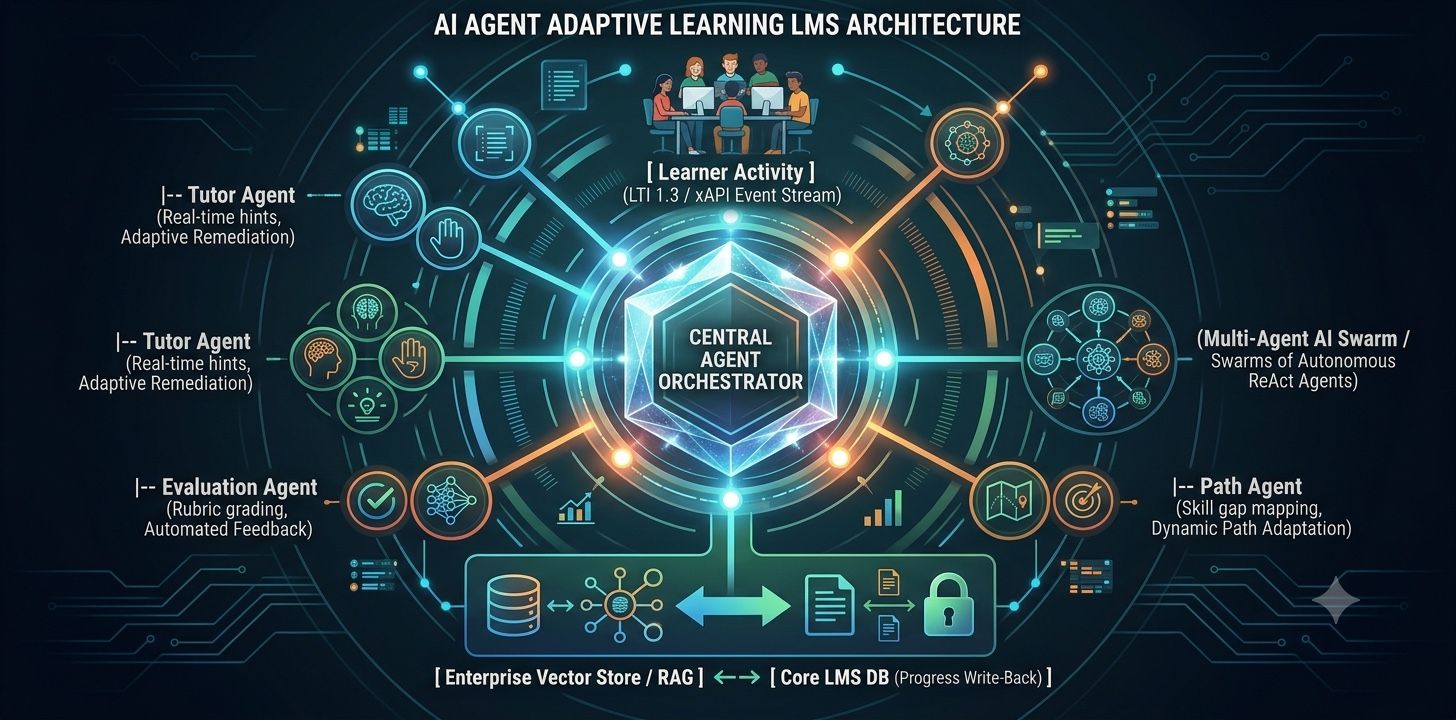
The good news? You don’t need to burn your existing codebase to the ground. You can retrofit an AI agent adaptive learning LMS architecture on top of your legacy database using lightweight, modern microservices.
Whether you’re running a massive corporate Moodle setup, a legacy Canvas instance, or a custom monolith written years ago, the core pattern is the same: dump static video files, force users through linear SCORM slides, throw a 10-question multiple-choice quiz at the end, and check a compliance box.
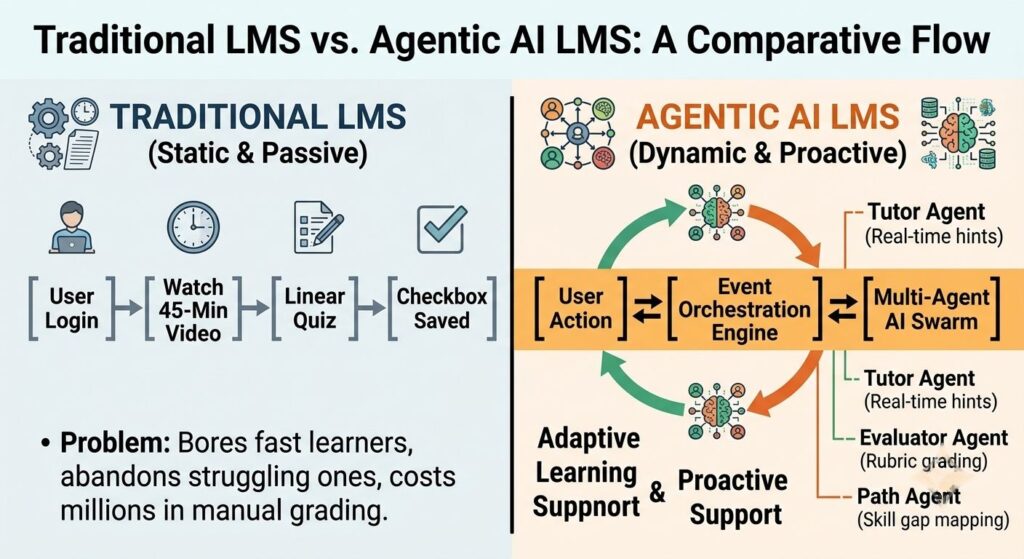
For EdTech founders and Enterprise L&D leaders, this outdated setup hurts where it matters most:
- Sinking Completion Rates: Forced linear modules alienate senior hires who already know the material and overwhelm junior hires who need extra context.
- Grading Bottlenecks: Human instructors spend days manually grading essay assignments and open-ended submissions, killing real-time learning momentum.
- Exploding Content Authoring Costs: L&D teams burn hundreds of hours manually building separate variations of the same course for different seniority levels.
The Blueprint Shift: Monolithic vs. Agentic LMS Architecture
Plugging a generic ChatGPT widget into your sidebar isn’t “AI modernization.” That’s just an interface distraction.
True modernization requires moving from passive, reactive scripts to an Agentic AI Architecture—a network of autonomous software agents that monitor user behavior, reason through pedagogical goals, and intervene before a learner gives up.
| Dimension | Monolithic Legacy LMS | Sidebar AI Chatbot | Agentic AI LMS Architecture |
|---|---|---|---|
| Logic Core | Rigid SQL queries & if/else rules | Basic prompt/response window | Event-driven LLM orchestration |
| Awareness | Knows if a module was clicked | Knows only what the user types | Ingests real-time quiz latency & hint counts |
| Intervention | Passive (Wait for click) | Reactive (Wait for prompt) | Proactive (Detects friction instantly) |
| Integration | Hardcoded monolithic views | Standalone popup modal | Native LTI 1.3 & REST middleware APIs |
The Engine Room: 4 Technical Pillars of Adaptive AI Systems
To turn your platform into an intelligent learning assistant, four distinct technical components must work together under the hood:
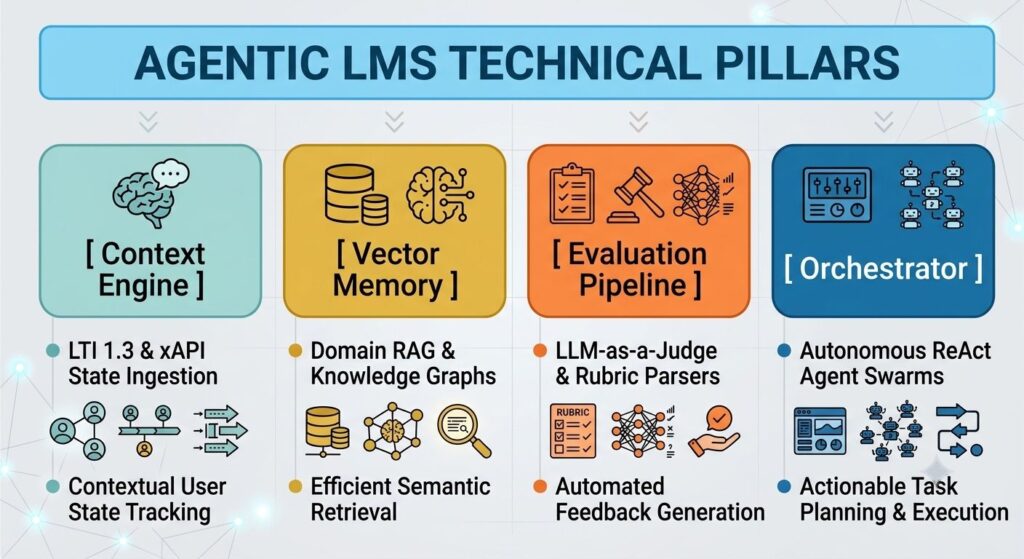
1. The Context Ingestion Engine (xAPI + LTI 1.3)
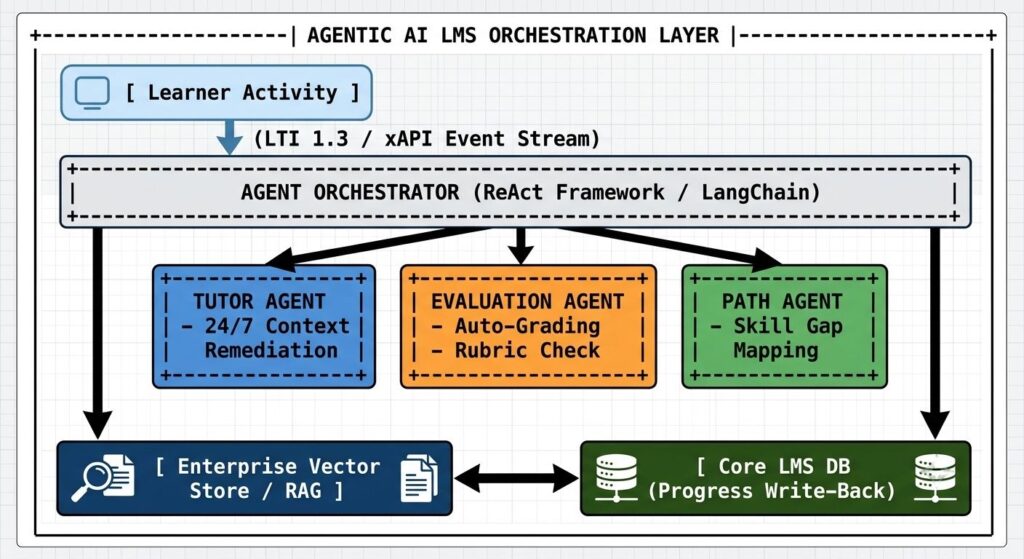
Your AI is only as smart as its context. By streaming real-time xAPI telemetry (video pause rates, assessment attempt times, hint triggers), the system feeds real-world user behavior directly to the agent layer.
2. Domain-Grounded RAG (Vector Memory)
Generic AI models make things up when pushed on complex corporate topics. Using Retrieval-Augmented Generation (RAG) paired with vector stores (Pinecone, Qdrant, pgvector), the system forces AI agents to pull answers only from your validated company documents, manuals, and course transcripts.
3. Multi-Agent Orchestration
Instead of relying on one massive, slow prompt, modern architectures deploy specialized sub-agents:
- The Tutor Agent: Delivers instant, contextual hints without giving away final answers.
- The Evaluator Agent: Analyzes open-ended text or code submissions against strict rubric criteria.
- The Path Agent: Re-maps upcoming course modules based on real-time skill gap analysis.
4. Deterministic Evaluation Engine
A structured multi-pass pipeline that scores complex assignments using an LLM-as-a-Judge approach—delivering granular feedback in seconds while routing edge cases to human review queues.
The Workaround: Retrofitting AI into Legacy Stacks (No Rebuild Needed)
Worried about breaking your legacy database or migrating millions of user records? Don’t be. You don’t need to rewrite your application from scratch.
Instead, build a lightweight middleware microservice (Python FastAPI or Node.js) that communicates with your legacy platform through LTI 1.3 standards and secure webhooks.
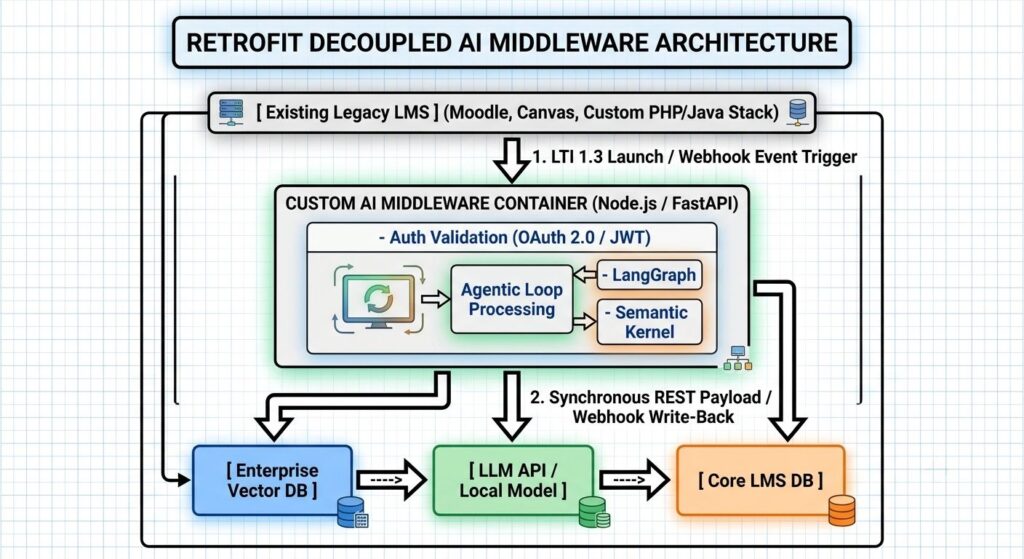
The 4-Step Retrofit Process
- Hook the Events: Configure legacy backend webhooks for key triggers like
user.assessment_failedormodule.timeout_exceeded. - Wrap in LTI 1.3: Package the AI agent UI as an LTI tool container so it renders natively inside your existing course pages.
- Send Structured JSON: Pass user context safely using schema-validated API payloads.
- Write Back Results: Post competency updates, scores, and new path assignments directly back to your main database via REST.
Auto-Grading That Doesn’t Hallucinate: Building the Evaluation Pipeline
Manual grading is the single biggest operational bottleneck in L&D. But trusting an AI to grade subjective, open-ended assignments sounds terrifying—until you build a Multi-Pass Evaluation Pipeline.
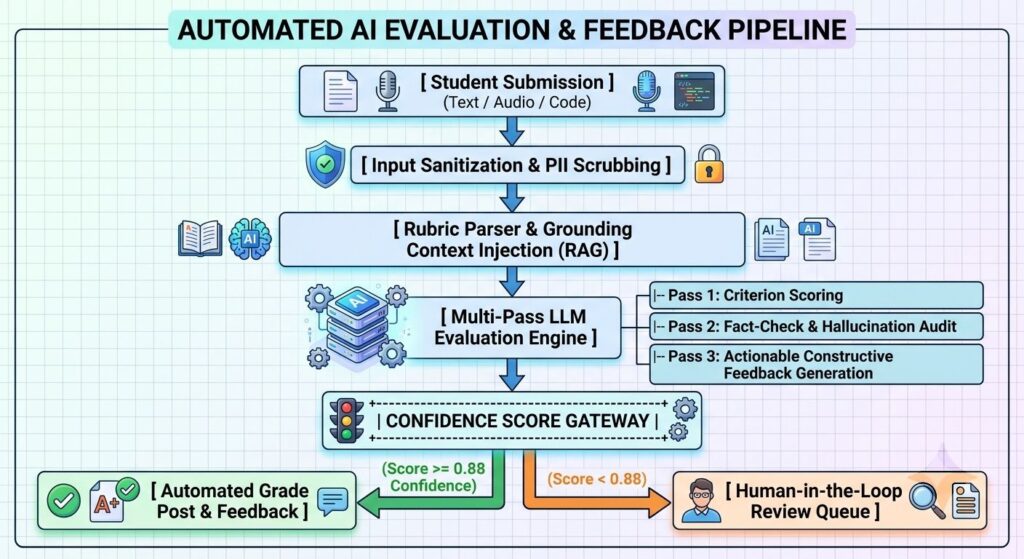
The Secret: Multi-Pass Logic & Confidence Gateways
- Pass 1 (Draft Score): Evaluates submission text strictly against JSON-formatted rubric points.
- Pass 2 (Fact-Check Audit): Cross-references proposed feedback against verified reference answers to catch hallucinations.
- Pass 3 (Tone Adjustment): Converts technical scores into encouraging, actionable student feedback.
- Confidence Gate: If the model’s internal confidence falls below 88%, the submission is automatically routed to an instructor’s review queue with pre-filled AI suggestions.
Dynamic Learning Paths: Killing the “Skip or Suffer” SCORM Loop
Traditional course branching is rigid and binary (Passed? Go to Module 2. Failed? Repeat Module 1).
Adaptive AI architecture replaces binary rules with Knowledge-Graph Sequencing. The system breaks courses into atomic skill nodes (e.g., Docker_Basics, Kubernetes_Ingress, Helm_Charts) and updates a real-time mastery score for each node as the user interacts with the platform.
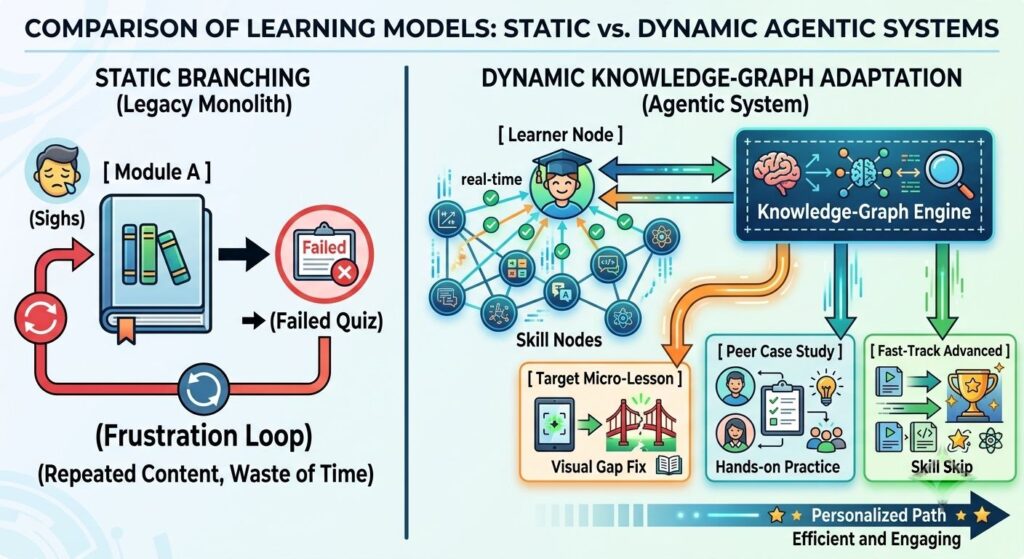
If a learner struggles with Kubernetes_Ingress, the system doesn’t make them rewatch an entire hour-long lecture. The Path Agent dynamically generates a targeted 3-minute micro-lesson specifically addressing the ingress routing logic, fixes the gap, and moves them forward.
Ironclad Security: PII Scrubbing, FERPA, and Human Guardrails
Shipping AI features in enterprise or academic environments means taking security and data privacy seriously.
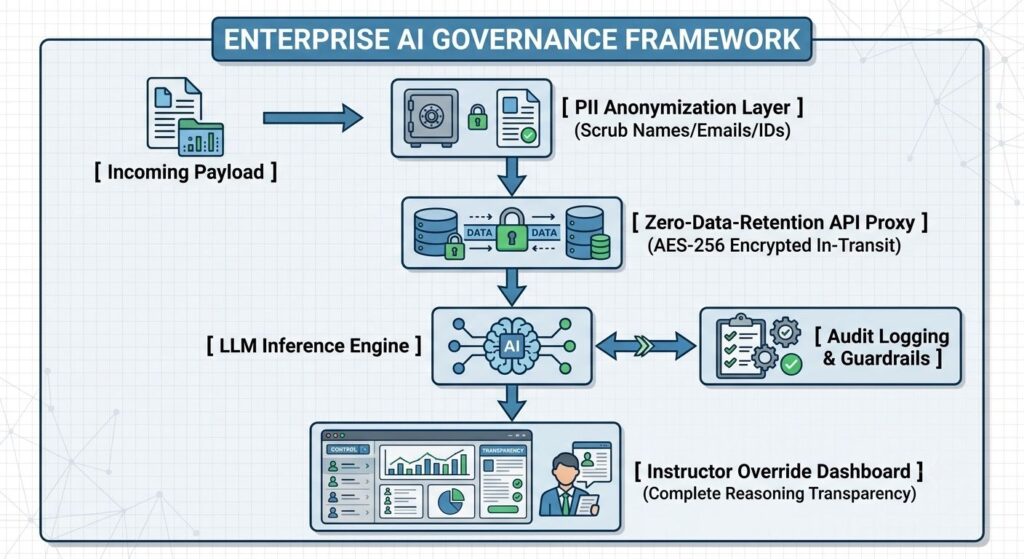
The Golden Rule: Student submissions and employee assessment data must never be used to train public LLMs. Zero Data Retention (ZDR) endpoints are mandatory.
Essential Compliance Controls
- PII Scrubbing: Strip names, emails, and student ID numbers using Regex/NER pipelines before payloads leave your servers.
- Zero Data Retention Contracts: Ensure your enterprise API agreements mandate immediate memory purges post-inference.
- Explainable AI (XAI) Logs: Record full reasoning chains for every auto-graded score so instructors can audit and override any AI decision with a single click.
The 5-Stage AI Retrofit Roadmap
Transforming your learning software doesn’t happen overnight, but a staged approach minimizes risk and delivers early wins:
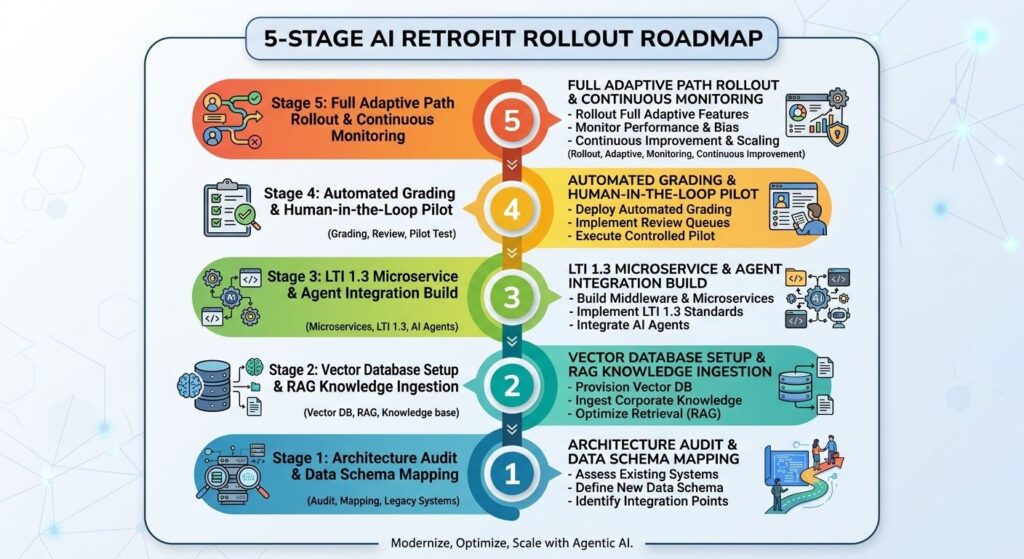
- Stage 1: Audit & Mapping (Weeks 1–2): Identify high-friction areas (like grading bottlenecks) and map API hooks.
- Stage 2: RAG Pipeline Setup (Weeks 3–4): Ingest verified documentation and course material into a secure vector store.
- Stage 3: LTI Microservice Build (Weeks 5–8): Deploy a containerized agent middleware service connected via OAuth 2.0 / LTI 1.3.
- Stage 4: Auto-Grading Pilot (Weeks 9–12): Launch auto-grading on selected courses using human-in-the-loop validation.
- Stage 5: Full Adaptive Rollout (Weeks 13+): Enable dynamic knowledge-graph paths and monitor performance via real-time APM dashboards.
Frequently Asked Questions (FAQ)
What is an AI agent adaptive learning LMS architecture?
An AI agent adaptive learning LMS architecture combines autonomous software agents, vector databases, and real-time event telemetry within a Learning Management System. Instead of serving static, one-size-fits-all content, it auto-grades subjective submissions, delivers personalized hints, and adapts learning paths in real time.
Can we add AI agents without replacing our existing LMS?
Yes! By deploying an external microservice layer connected via LTI 1.3 protocols, REST APIs, and event webhooks, you can add custom AI tutors and auto-grading engines to systems like Canvas, Moodle, or custom legacy monoliths without a full platform rebuild.
How does the system handle AI grading hallucinations?
By using a Multi-Pass Evaluation Pipeline grounded in explicit JSON rubrics and RAG context. The AI evaluates submissions against specific criteria, verifies its own logic in a second pass, and routes low-confidence evaluations directly to human instructors.
Is student data safe when processed by LLMs?
Yes—provided you enforce Zero Data Retention (ZDR) API pipelines, anonymize Personally Identifiable Information (PII) before sending requests, and maintain audit logs to remain fully compliant with FERPA, GDPR, and SOC 2 standards.
Turn Your Legacy LMS into an AI-Powered Competitive Advantage
Static content, manual grading, and rigid course structures are holding your learning platform back. By building or retrofitting a modern AI agent adaptive learning LMS architecture, you can automate routine tasks, deliver personalized learning at scale, and drive measurable completion metrics.
Ready to bring your LMS into the AI era?
Book a technical architecture review with our engineering team today to explore how custom AI agents can integrate seamlessly into your current software stack.
