You just launched a high-budget Instagram Reels influencer campaign or spent thousands of rupees on Meta Ads targeting buyers in Tier 1, Tier 2, and Tier 3 Indian cities. You open your Google Analytics or Shopify dashboard, and the graphs look incredible: a massive surge in website sessions with thousands of visitors from Mumbai, Delhi, Bengaluru, Pune, and Ahmedabad.
Yet, when you open your payment gateway or order management dashboard, the result is disheartening: almost zero sales.
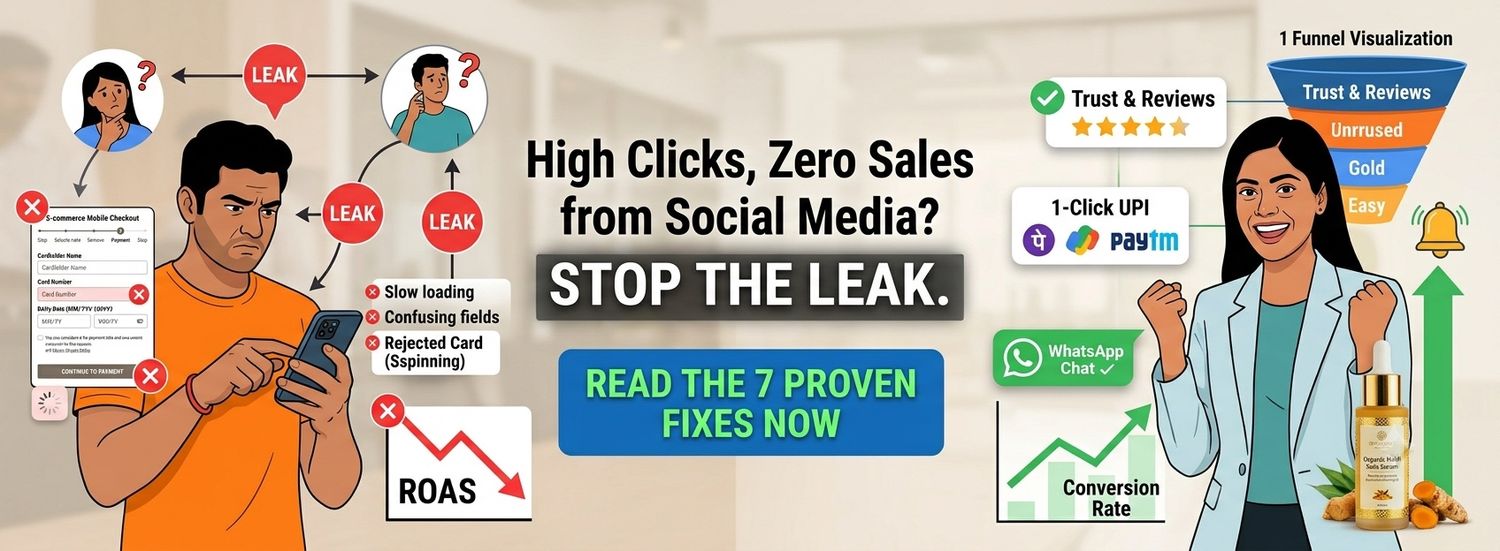
It is one of the single most frustrating and costly challenges faced by modern Indian D2C brands and e-commerce entrepreneurs: high clicks, high engagement, zero conversions.
If you are struggling to understand why your social media traffic is not converting into paying customers once visitors hit your online store, you are not alone. In this comprehensive masterclass, we will deconstruct the unique psychology of the Indian social media shopper, identify the hidden conversion leaks killing your mobile checkout, and provide a field-tested 7-step blueprint to double your sales.
Why Your Traffic Fails to Convert
Social media traffic is not converting on your website primarily due to payment friction, acute trust deficit, and intent mismatch. Unlike Google Search visitors who actively search with high commercial intent, social media users are passively browsing for entertainment. When these casual browsers land on an unfamiliar website requiring multi-step form fills, lacking instant 1-click UPI payments (PhonePe/Paytm), or missing hyper-local trust markers like WhatsApp support, they bounce immediately without buying.
The Benchmark Reality: Search vs. Social Media Traffic in India
Before overhauling your website layout or blaming your ad creative, it is critical to ground your expectations in industry data.
Traffic originating from social media platforms inherently converts at a vastly lower rate than search engines or direct messaging channels. Comparing Instagram traffic to Google Search traffic is like comparing apples to oranges.
Conversion Rate Benchmarks Across Indian Channels
Acquisition Channel
Average Conversion Rate (India)
Primary Visitor Mindset
WhatsApp Business Broadcasts
4.5% – 8.2%
High trust, direct brand relationship, high intent
Google Search (Organic SEO)
2.8% – 4.2%
High commercial intent; actively searching for a solution
Google Shopping / Performance Max
2.0% – 3.1%
Active product comparison & ready-to-buy mindset
Paid Meta Ads (Instagram / Facebook)
0.8% – 1.5%
Passive discovery; high initial suspicion
Organic Social (Reels / Shorts / TikTok)
0.4% – 0.9%
Pure entertainment mode; extreme impulse sensitivity
If your current social media conversion rate in India sits below 0.5%, your store suffers from critical friction points in its conversion funnel. However, if your traffic converts between 1.2% and 2.0%, you are performing within healthy parameters for cold social media discovery.
7 Deep-Rooted Reasons Why Social Media Traffic Is Not Converting
To diagnose why your website fails to convert Instagram, Facebook, and YouTube traffic, let us examine the psychological, technical, and operational failure points in detail.
1. The “Scroll State” Intent Mismatch
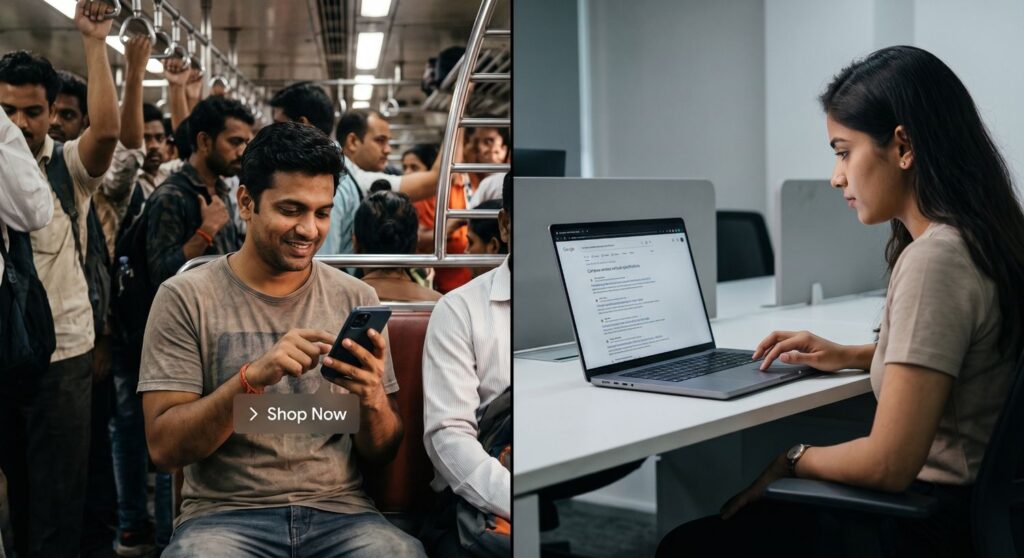
The primary reason social media traffic is not converting comes down to consumer psychology: Passive Browsing vs. Active Searching.
Search Engine Psychology: When a user types “buy Ayurvedic anti-dandruff shampoo online” into Google, they are experiencing an active pain point. They have their credit card or UPI app ready, and their commercial intent is at its peak.
Social Media Psychology: When a user clicks a link while scrolling through Instagram Reels at 11:00 PM, they were in the middle of consuming short-form video entertainment. They opened the app for a quick dopamine hit, not to make a purchase.
When this user lands on your website, they are in a fragile, highly distracted “scroll state.” If your website immediately demands heavy commitments—such as forcing account creation, displaying aggressive full-screen popups, or demanding a multi-step checkout—the visitor snaps out of impulse mode and hits the back button.
2. Mobile Checkout & UPI Payment Friction
India is a mobile-first digital economy. Unified Payments Interface (UPI) accounts for over 75% of all digital retail transactions nationwide, driven by platforms like PhonePe, Google Pay, Paytm, and CRED.
When a social media user in India clicks an ad on Instagram, the website opens inside Instagram’s In-App Browser(IAB). This in-app environment creates severe technical hurdles if your store is not optimized for it:
OTP Redirection Failure: Standard debit/credit card checkouts force two-factor authentication (3D Secure OTPs). In-app browsers often crash, freeze, or drop session cookies during OTP SMS switching.
Manual Form Typing: Requiring mobile users to type out their full name, address, pin code, state, city, and card details on a small touch screen introduces massive friction.
Missing Deep-Linking: If clicking “Pay via PhonePe” fails to trigger a direct app-switch intent protocol to the installed PhonePe or Google Pay app on their smartphone, the transaction fails automatically.
If your payment gateway forces users to manually type payment details instead of providing 1-click UPI intent, you are losing up to 60% of potential buyers at the final step.
3. Severe Trust Deficit & “Fake Store” Paranoia
The Indian e-commerce landscape has experienced a massive influx of low-quality drop-shipping operations, fraudulent social ads, and fake storefronts that collect money and never deliver products. Consequently, Indian consumers are hyper-cautious when visiting an unfamiliar brand for the first time via social media.
When a first-time visitor lands on your site from an ad, they immediately look for reasons not to trust you.
Red Flags That Trigger Trust Deficit:
No Registered Company Information: Absence of a clear corporate address, GSTIN (Goods and Services Tax Identification Number), or registered business name in the website footer.
No Direct Support Channels: Absence of a visible WhatsApp contact option or Indian phone helpline (forcing users to rely solely on an unmonitored support@ email address).
Fake or Stock Social Proof: Generic text reviews without real photos, or imported reviews translated poorly from foreign platforms.
Hidden Pricing & Taxes: Displaying prices that suddenly increase at the final checkout screen due to hidden shipping fees or unstated GST additions.
If your store fails to establish instant legitimacy within the first 3 seconds, cold social visitors will back out without browsing further.
4. Cash on Delivery (COD) Drop-Off & RTO Anxiety
Cash on Delivery (COD) remains a fundamental pillar of Indian e-commerce, driving anywhere from 40% to 70% of total order volume, particularly across Tier 2, Tier 3, and rural markets.
However, offering COD to cold social media traffic is a double-edged sword:
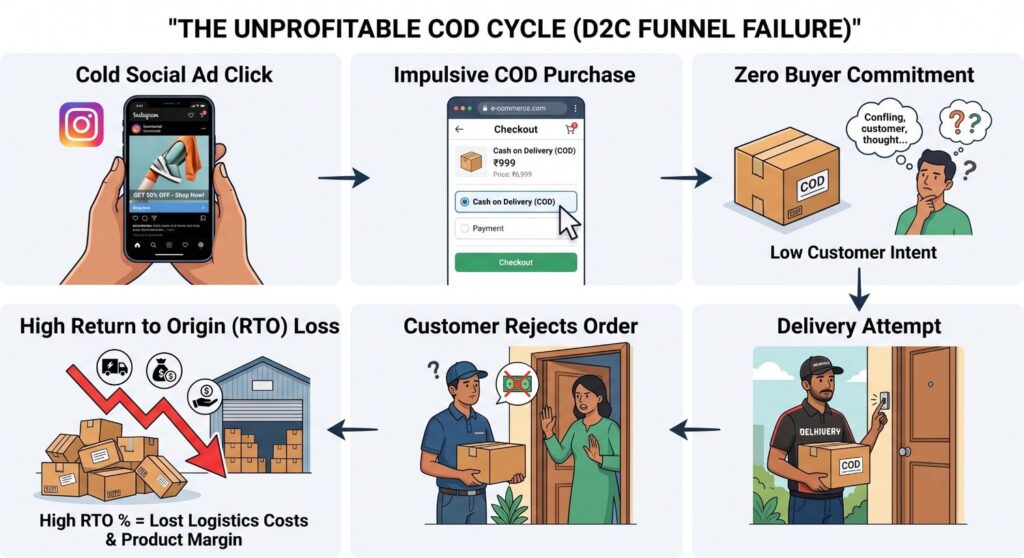
When users encounter no friction or financial commitment during a COD order, impulse buyer remorse sets in within hours. If your website does not immediately validate COD intent through automated verification (such as WhatsApp OTP verification or automated order confirmation calls), your delivery success rate drops drastically, leading to crippling Return to Origin (RTO) logistics costs.
Conversely, if you completely remove COD to avoid RTO, your conversion rate on cold social traffic may drop by 50% or more, as cautious buyers refuse to pay upfront for an unfamiliar brand.
5. High Mobile Speed Latency on Indian Cellular Networks
According to mobile usability research published by Google Developers, 53% of mobile site visits are abandoned if a web page takes longer than 3 seconds to load.
In India, while 5G rollout is expanding rapidly, millions of users still browse social media on fluctuating cellular networks or congested public Wi-Fi.
When a user clicks an ad or a link in a Reel, Instagram opens a web view. If your website is weighed down by heavy uncompressed PNG images, bloated JavaScript bundles, or dozens of third-party Shopify apps, the page load time stretches to 5–8 seconds.
Because social media users operate in a rapid-scrolling mindset, a 3-second load delay results in a immediate drop in traffic before your value proposition even renders.
6. Message Disconnect: Ad Creative vs. Homepage Trap
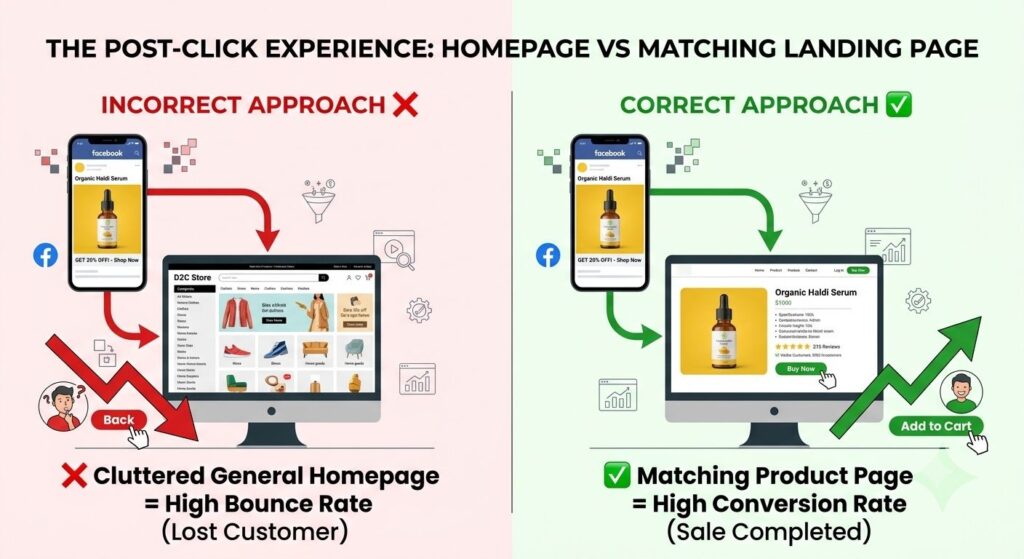
Sending social media ad traffic to your website’s generic homepage (yourbrand.in) is one of the most common and expensive mistakes in digital marketing.
Imagine a potential buyer clicking an Instagram Reel showcasing a specific Organic Vitamin C Skin Serum on sale for ₹599. They click the link, expecting to land directly on a purchasing page for that exact serum. Instead, they are dumped onto a generic homepage showcasing fashion wear, body washes, hair accessories, and brand mission statements.
This structural mismatch forces the user to navigate complex menus to find what originally caught their attention. Distracted social users will not search through your site; they will simply close the tab.
Expecting a cold visitor who discovered your brand 30 seconds ago on TikTok or Instagram to immediately make a high-ticket purchase (e.g., ₹2,500+) on their first visit is unrealistic.
Most purchasing decisions require between 7 and 13 touchpoints before a consumer feels confident enough to buy. If your website offers only an all-or-nothing approach—either “Buy Now” or “Leave”—you lose 98% of your visitors forever.
By failing to offer micro-conversions (such as downloading a free guide, taking a product quiz, or subscribing via WhatsApp for an exclusive discount), you forfeit the opportunity to capture contact details and build long-term relationships through free owned-media channels.
The 7-Step Actionable Framework to Fix Low Conversions
To transform your online store into a high-converting sales engine for social traffic, apply this field-tested procedural framework.
Replace standard multi-step checkout pages with Indian express checkout infrastructure (such as Razorpay Magic Checkout, Shopflo, or GoKwik). These tools automatically detect returning users across the Indian e-commerce network, pre-fill saved delivery addresses, and offer seamless 1-click UPI intent. Users can approve transactions inside PhonePe or Google Pay in under 10 seconds.
2.Integrate Floating WhatsApp Commerce & Live Chat:Time required: 2 Hours.
Install a persistent WhatsApp Chat Button anchored to the bottom right corner of your mobile site. Indian consumers appreciate the ability to ask real-time questions about product authenticity, sizing, or delivery timelines. Integrating automated WhatsApp AI agents (via platforms like Interakt, Wati, or BiteSpeed) allows you to resolve hesitation instantly and boost conversions by 15–25%.
3.Optimize Trust Signals Above the Fold:Time required: 1 Day.
Ensure key trust markers are instantly visible on mobile screens without requiring scrolling:
Display clear pricing in Indian Rupees (₹) with explicit tax details (“Inclusive of all taxes”).
Show estimated delivery dates powered by postal code lookups (e.g., “Delivered in 3-4 days to Mumbai 400001 via Blue Dart”).
Embed verified GSTIN and physical Indian warehouse addresses in the footer.
Feature video testimonials and authentic customer photo reviews prominently under the main CTA.
Stop sending ad traffic to your homepage. Create dedicated, single-product landing pages using mobile-first builders (like Replo, PageFly, or Unbounce). Ensure the page headline, hero image, and promotional offer exactly match the creative hook used in your social ad campaign.
Set up Automated WhatsApp Verification where users must confirm their COD order via an OTP or button click before fulfillment.
Offer an enticing Prepaid UPI Discount (e.g., “Get extra ₹50 OFF + Free Shipping on Instant UPI Payments”). This shifts cost-conscious buyers from COD to prepaid, securing your revenue and eliminating RTO risk.
6.Compress Assets & Optimize Mobile Page Speed:Time required: Half Day.
Audit your website speed using Google PageSpeed Insights. Convert all product imagery to modern WebP formats, remove unused Shopify app scripts, defer non-critical JavaScript, and utilize a Global Content Delivery Network (CDN) like Cloudflare to keep mobile load times under 2 seconds on 4G networks.
Over 70% of social media users who add items to their cart will abandon the session. Set up automated abandoned cart recovery workflows across WhatsApp Business API and SMS (using platforms like Klaviyo or Shipway). Trigger a personalized message 15 minutes after abandonment featuring a direct 1-click link to resume checkout.
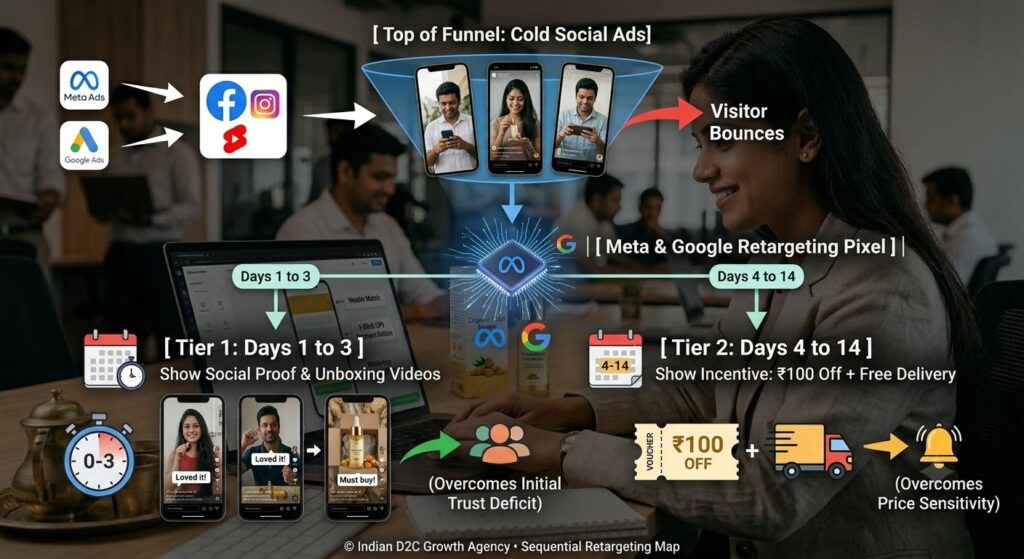
How to Build Middle-of-Funnel Retargeting for Cold Social Traffic
Because cold social traffic rarely converts on touchpoint #1, your digital ad strategy must include a structured Middle-of-Funnel (MOF) Retargeting Engine.
The 3-Tier Retargeting Architecture
Tier 1 Retargeting (Days 1–3 Post-Visit): Focus on Trust & Social Proof
Ad Creative: Feature user-generated unboxing videos, press mentions, and customer reviews.
Goal: Reassure the visitor that your brand is legitimate and that hundreds of real customers love your product.
Ad Creative: Offer a limited-time incentive (e.g., “We saved your cart! Use code SAVE100 for ₹100 OFF your first order”).
Goal: Provide a financial push to convert hesitant browsers into first-time buyers.
Tier 3 Retargeting (WhatsApp Broadcasts): Direct Owned Channel
Send a personalized WhatsApp notification 2 hours after a user leaves the site without completing their order, offering instant assistance via live chat.
Stop Wasting Your Social Media Ad Spend
Driving social media traffic to an unoptimized website is like pouring water into a leaky bucket. Every visitor who bounces represents wasted ad spend and lost customer lifetime value.
By eliminating payment friction with 1-click UPI, adding instant WhatsApp support, establishing clear local trust signals, and deploying mobile-first landing pages, you can plug the leaks in your funnel and maximize your return on ad spend (ROAS).
Need Help Optimizing Your Store’s Conversion Rate?
Is your ad spend disappearing into high clicks and low sales revenue? Get a Free 15-Minute Funnel Audit for Your Store.
Our e-commerce conversion experts will analyze your mobile checkout flow, UPI deep-linking, page load speeds, and trust architecture to provide a customized, actionable blueprint to double your sales.
What is a good conversion rate for social media traffic in India?
A healthy conversion rate for social media traffic on Indian D2C stores ranges between 1.0% and 1.8%. Top-performing stores utilizing optimized 1-click UPI checkouts, WhatsApp support widgets, and dedicated mobile landing pages can achieve conversion rates between 2.5% and 3.5%.
Why is my bounce rate so high from Instagram Reels traffic?
High bounce rates from Instagram Reels usually result from slow mobile load speeds, broken post-click messaging (sending users to a generic homepage instead of the specific product shown in the video), or intrusive popups that block mobile screens upon arrival.
Should I offer Cash on Delivery (COD) to increase social media sales in India?
Yes. Disabling Cash on Delivery in India can cause you to lose up to 50% of potential sales, particularly from customers in Tier 2 and Tier 3 cities. To mitigate high Return to Origin (RTO) risks, implement automated WhatsApp/SMS order verification before dispatching COD orders, or offer a small discount for prepaid UPI payments.
How can I reduce payment drop-offs on mobile devices?
To reduce payment drop-offs on mobile devices, switch from traditional multi-step checkout forms to integrated 1-click express checkout solutions (like Razorpay Magic Checkout or Shopflo). Ensure your checkout supports seamless deep-linking to major UPI apps like PhonePe, Paytm, and Google Pay.
Deepak Singh
Digital Marketing Associate
Deepak Singh is a results-oriented Digital Marketing Associate at Rannlab Technologies, with a proven track record of boosting organic traffic and brand engagement. He specializes in using data analytics to optimize SEO, email marketing, and social media campaigns.
Table of Contents
Send Us a Message
Headquarters
Greater Noida, India
805, 8th Floor, Om Tower, Alpha-I Commercial Belt, Block E, Alpha I, Greater Noida, UP 201310