
Every year, modern marketing departments, regional product groups, and global communications teams deploy millions of corporate URLs across social media feeds, transactional SMS sequences, offline QR codes, and automated email workflows. Yet, despite this massive digital footprint, a shocking percentage of organizations treat their external web tracking links as simple, static utilities.
When corporate link infrastructure is decentralized, unmonitored, and managed through disjointed, consumer-grade software tools, it quickly morphs from a minor administrative task into a systemic operational threat.
Implementing a formalized enterprise link management strategy is the only way for growing brands to defend against broken user experiences, expensive regulatory compliance penalties, and severe brand-impersonation cyber attacks. At enterprise scale, tracking links function as the digital connective tissue mapping your external media directly back to your secure internal infrastructure.
By applying strict governance rules, role permissions, and programmatic automation to this layer of your tech stack, your team can eliminate manual workflow bottlenecks and guarantee data transparency across every corporate asset.
The Three Fundamental Pillars of Enterprise Link Security
To construct a resilient system capable of handling millions of programmatic click events without breaking, an organization must align its technical framework around three foundational governance pillars.
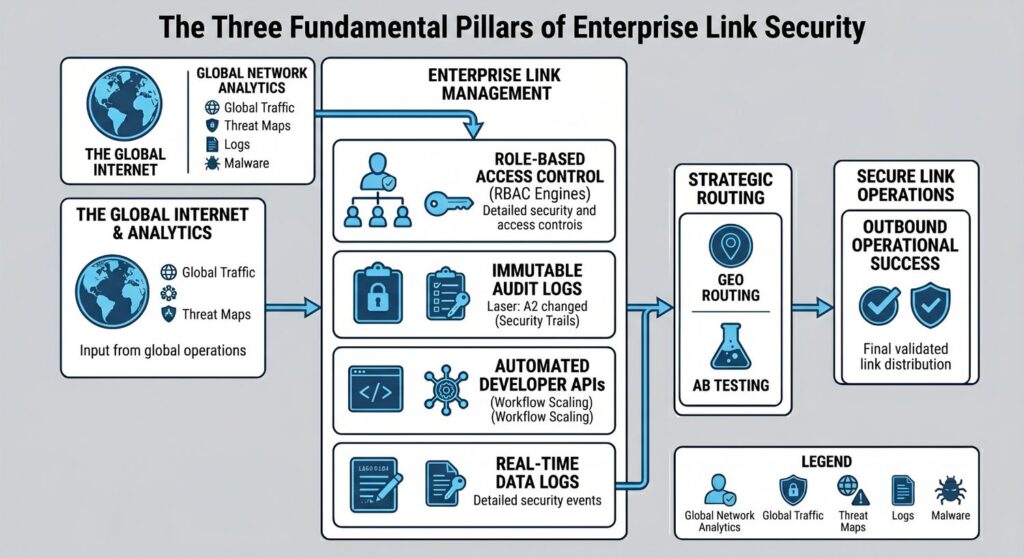
1. Granular Role-Based Access Control (RBAC)
Sharing a single, universal administrative password or providing full system clearance to every employee inside an organization is an absolute recipe for catastrophic human error. True link security depends entirely on enforcing the principle of least privilege through automated user access mapping.
- Content Creators & Marketers: Granted restricted “Creation-Only” parameters. This enables teams to generate custom short URLs, set custom tracking aliases, and build mobile-responsive app links without giving them the destructive power to delete active corporate pathways or alter top-level root domains.
- Growth Analysts & Account Managers: Provided localized “View-Only” metrics access. These users can evaluate live channel traffic, study geographical demographic trends, and export campaign conversion matrices without exposing internal workspace configurations.
- IT Administrators & Security Personnel: Retain exclusive domain authorization. Only certified system administrators possess the credentials needed to attach new custom branded short domains, update global data privacy scripts, or change workspace-level user permissions.
2. Immutable Audit Logs and Tracking Trails
When a high-value marketing campaign link suddenly begins failing or mistakenly routes traffic to an unintended landing page, manual root-cause detection drains valuable time. Corporate security officers and infrastructure teams require an ironclad, unalterable digital paper trail to determine exactly how and when system states changed.
Enterprise-ready shorteners log every action within an immutable account database. These granular audit histories permanently record the specific time of an edit, the precise network IP address used, and a complete text comparison showing exactly what tracking values or target destination URLs were altered. This degree of structural transparency protects multi-million dollar ad investments and fulfills mandatory international digital accountability standards.
3. Programmatic, Developer-First API Workflows
Attempting to handle link distribution using human hands does not scale in modern operations. When engineers or growth specialists must manually build out, shorten, and append tracking variables to separate links for massive transactional databases, campaign execution stalls and input errors skyrocket.
Integrating developer-friendly REST APIs allows your developers to build programmatic URL shortener utilities straight into your native applications, internal corporate CRMs, or active digital marketing tech stacks. Whether your system needs to generate millions of hyper-personalized short URLs for localized SMS tracking or dynamically generate brand-verified QR codes for printed logistics collateral, API automation eliminates operational latency while ensuring flawless tracking uniformity.

7 Strategies to Master Enterprise Link Management
To safely transition your organization out of data fragmentation and into highly optimized, brand-aligned operations, implement these seven core tactical strategies:
1. Establish Branded Custom Short Links
Generic URL shorteners look highly suspicious to modern web users and frequently trigger automated desktop anti-virus flags. Transitioning all corporate communications to custom branded domains improves link click-through rates (CTR) by up to 34% by acting as an immediate signal of safety and authority. For example, replacing a random string link with a structured, identifiable variant like yourbrand.co/summer-sale transforms an ugly tracking URL into a clear corporate asset.
2. Implement Smart Device-Context Redirects
Do not waste your hard-earned mobile ad traffic by sending users to generic desktop landing pages. Utilize smart links capable of analyzing device context in real time. When an individual taps your short link, the routing engine must instantly detect their operating system:
- iOS Devices: Pass the user cleanly directly into the Apple App Store.Rannlab Technologies
- Android Devices: Pass the user cleanly directly into the Google Play Store.ZipLnk
- Desktop Browsers: Serve an interactive chooser landing page.
This friction-free user path preserves conversion value and keeps tracking data beautifully clean across separate native platforms.
3. Track Comprehensive URL Shortener Analytics
A sophisticated short link does much more than simply clean up an ugly URL; it serves as a powerful real-time data collection node. Ensure your marketing and analytics platforms are capturing deep, multi-dimensional user metrics, including total click volumes, unique user reaches, click-through rates by acquisition channel, real-time geographic distributions, operating system splits, and traffic source variations.
4. Deploy Dynamic Destination Link Rotation
Marketing target requirements can shift mid-campaign. Rather than manually updating static URLs embedded inside thousands of live emails, print materials, or expensive influencer videos, use dynamic short links. This lets system managers switch out underlying target destinations instantly on the back end while the published public-facing URL remains exactly the same.
5. Standardize Naming Conventions and Custom Aliases
Without strict administrative rules, cross-departmental platforms quickly degrade into total chaos. Enforce a unified, company-wide taxonomy for all custom URL aliases. Establish uniform naming patterns to guide team creation:
brand.co/product-launchbrand.co/webinar-junebrand.co/pricing-offer
6. Enforce Rigorous A/B Testing Frameworks
Maximize bottom-of-funnel conversions by utilizing an A/B testing infrastructure directly within your tracking links. Distribute a single, static short URL across your marketing collateral, but direct traffic to two distinct destination targets based on precise, pre-defined split percentages (such as a clean 50/50 split). This lets your conversion optimization teams confidently contrast feature signup completion rates and landing page performances with minimal disruption.
7. Mandate Full Alignment with Global Data Privacy Laws
In a landscape governed by strict legal frameworks like the EU’s General Data Privacy Regulation (GDPR) and the California Consumer Privacy Act (CCPA), how you collect data matters. Your organization must guarantee that click tracking mechanisms safely anonymize consumer IP addresses and handle regional data requests without violating compliance boundaries.
Strategic Value: Why Executive Governance Rules Matter
Investing in dedicated infrastructure is an explicit optimization tactic that heavily influences your brand’s bottom line and data defense frameworks.
| Corporate Priority | Operational Vulnerability | Enterprise Strategy Fix |
|---|---|---|
| Risk Management | Staff members publishing broken links, misconfigured redirects, or typo-ridden target paths. | Centralized Approval Engine to double-check target values prior to production deployment. |
| Data Protection | Malicious third-party bad actors gaining entry to redirect paths to point traffic to phishing zones. | SSO & SAML 2.0 Integration to immediately terminate access when personnel leave the firm. |
| Scale and Velocity | Production delays caused by manual team creation of complex, parameter-heavy campaign tracking codes. | Programmatic REST APIs that allow software applications to create thousands of compliant links instantly. |
Methodical Multi-Phase Integration Blueprint
Migrating an international corporate structure from messy, fragmented link tracking to a unified, compliant, and fully automated enterprise framework requires a highly disciplined execution timeline.
Infrastructure Consolidation
Month 1: Discovery & Security Auditing
Examine every single operational department to track down shadow IT accounts, unapproved custom domains, and scattered generic shortening tools. Bring all existing link configurations under a single managed administrative account.
Access Architecture Engineering
Month 2: Workspace Mapping & Identity Setup
Establish secure corporate sub-workspaces mapped out by distinct regional business divisions or sub-brands. Implement Single Sign-On (SSO) authentication protocols and assign granular user roles to enforce strict security boundaries.
Programmatic Marketing Launch
Month 3: API Integration & Automated Workflows
Connect engineering groups with core developer APIs. Embed programmatic link generation utilities straight into consumer notification channels, corporate content management systems (CMS), and active customer databases.
Privacy Architecture Verification
Month 4: Compliance Audits & Performance Scale
Run end-to-end data processing audits with compliance teams to guarantee tracking pixels respect international regulations. Launch advanced link tracking configurations, multi-destination A/B tests, and smart device redirects.
Strategic Feature Checklist for Software Procurement
When your security and procurement panels are assessing potential technological software choices, bypass generic consumer applications. Ensure your selected solution contains deep architectural capabilities built specifically for complex corporate enterprise frameworks:
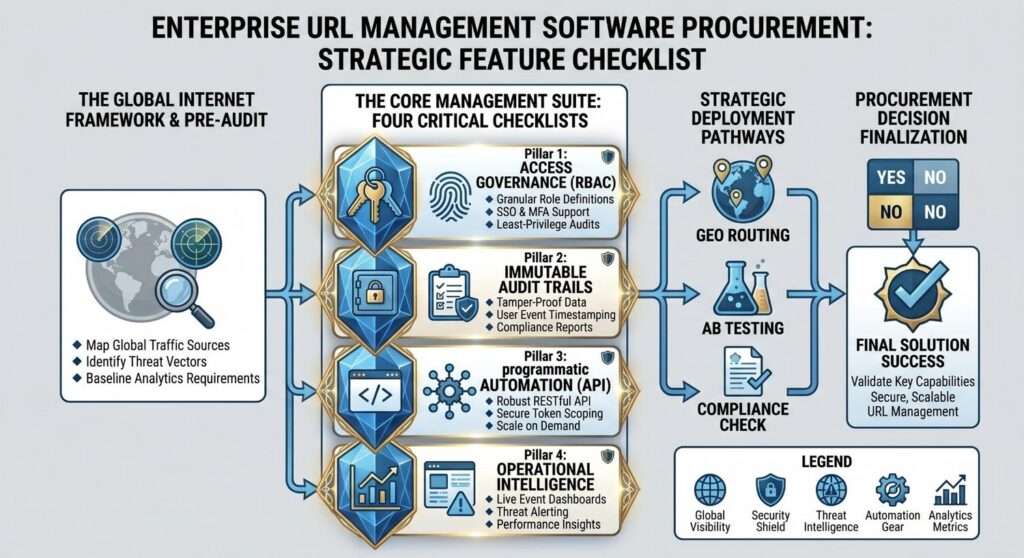
- Multi-Tenant Isolation Units: The program must support complete data separation between isolated sub-workspaces while giving global executives overarching data visibility.
- Scoped Developer API Credentials: Your engineering teams must be able to generate highly limited API access tokens tailored for single, specific system tasks to prevent administrative credential leak hazards.
- Advanced Tracking Compliances: The software should feature specialized data anonymization engines that natively shield personal user profiles in strict compliance with current international privacy mandates.
Final Takeaway: Cultivate a Resilient Digital Foundation
At scale, your digital links are much more than simple throw away URLs. They serve as highly strategic, data-rich channels that hold immense performance and brand security value. Continued reliance on fragmented, unbranded tools exposes your organization to unnecessary data leaks and operational friction.
Implementing a centralized governance system protects your marketing investments, hardens your cyber defenses, and unlocks programmatic efficiencies that allow your teams to move incredibly fast. Treat your link architecture with the same technical respect and security discipline as your primary core applications.
Secure Your Link Assets Globally with ZipLnk
Take absolute command over your brand’s digital footprints and tracking networks. ZipLnk arms large corporate teams with secure multi-tenant workspaces, granular role-based permissions, ultra-fast developer APIs, and audit-ready compliance tracking frameworks.
Eliminate marketing link chaos and shield your corporate pipelines from redirect vulnerabilities today.
Contact us today
