
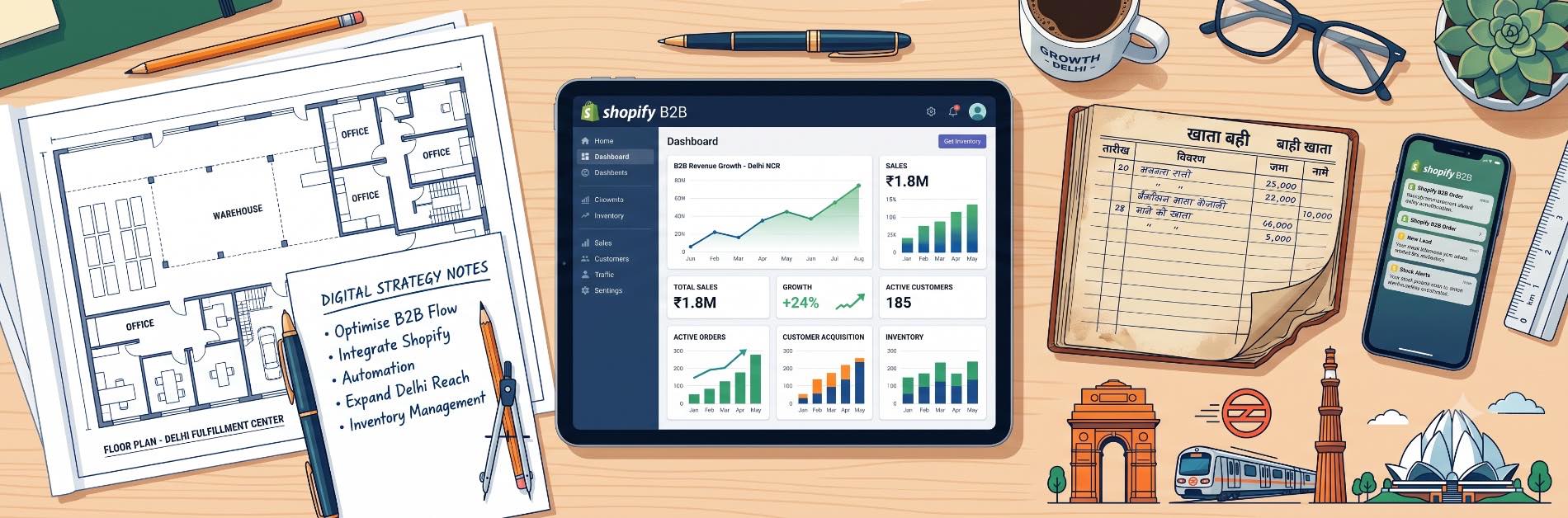
If you are a manufacturer, wholesale distributor, or enterprise brand navigating the bustling manufacturing corridors of Okhla, Bawana, or the historic wholesale lanes of Sadar Bazar and Chandni Chowk, mastering Shopify B2B eCommerce Delhi is no longer just a futuristic concept—it is an immediate business necessity.
For decades, the North Indian wholesale ecosystem has relied heavily on physical interactions. Business was driven by thick printed catalogs, relentless phone calls, manual ledger entries, and, more recently, chaotic and unmanageable WhatsApp groups. While these traditional methods built the foundation of Delhi’s massive trade network, they are now creating severe operational bottlenecks.
Today’s modern corporate buyers, retail chains, and procurement managers expect a frictionless, 24/7 digital ordering experience that mirrors their everyday consumer shopping habits. They want to log in, view their specific negotiated prices, check real-time inventory, and place bulk orders at 2:00 AM without waiting for your sales representative to wake up and reply to a text.
In this comprehensive, 1500+ word guide, we will dive deep into the ultimate blueprint for digitizing your wholesale distribution network. We will explore how leveraging Shopify Plus can drastically reduce manual administrative errors, streamline your supply chain, ensure strict Indian tax compliance, and ultimately scale your revenue to new heights.
1. The Hidden Financial Costs of Manual Wholesale Operations

Before examining the technological solutions, it is vital to understand why the old distribution model in the National Capital Region (NCR) is actively costing you money. Relying on offline channels and manual data entry creates an artificial ceiling on your growth. When we consult with legacy businesses, we typically uncover three major operational bleed areas:
The Manual Data Entry Bottleneck
When a buyer places a bulk order via a WhatsApp message or a phone call, a chain reaction of manual labor begins. Your sales team must physically check warehouse inventory, calculate the specific negotiated discount for that client, write up an initial purchase order (PO), and push the data to your accounts team. The accounts team then manually punches this order into Tally Prime or Zoho Books. This double data-entry inevitably leads to human error—wrong SKUs are shipped, incorrect discounts are applied, and hours are wasted on reconciliation.
Restricted Buyer Reach and High Friction
Your sales team is constrained by human limits; they can only service, call, and visit a limited number of clients daily. Furthermore, modern buyers are busy. If a retailer in Gurgaon wants to replenish stock late at night, but has to wait until 10:30 AM the next day for your team to send a PDF catalog and confirm pricing, you are introducing massive friction into the buying process. Friction directly leads to abandoned purchases and lost market share to faster, digitized competitors.
Inventory Blind Spots and Fulfillment Failures
Without a centralized, real-time digital system, your sales reps are selling blindly. Buyers frequently order stock that is already committed to another client, or worse, out of stock completely. This leads to awkward phone calls, partial order fulfillments, and deeply frustrated retail partners who may start looking for more reliable suppliers.
The Challenge of Credit Management
In Indian wholesale, business runs on credit. Tracking which buyer owes what, manually calculating net payment terms, and chasing down overdue invoices requires dedicated manpower. Without an automated portal, credit management becomes a chaotic mix of Excel sheets and sticky notes, increasing your financial risk and days sales outstanding (DSO).
2. Why Shopify B2B eCommerce Delhi is Replacing Legacy Systems
Historically, wholesale distributors avoided mainstream e-commerce platforms. The consensus was that platforms like Shopify were built exclusively for Direct-to-Consumer (D2C) retail. If a distributor wanted a robust wholesale portal, they had to spend tens of lakhs of rupees building a custom, hard-coded application from scratch or rely on clunky, outdated ERP web-store modules.
That landscape has completely shifted over the last two years. Leading the charge in Shopify B2B eCommerce Delhi development, we see that Shopify Plus has natively integrated enterprise-grade wholesale architecture directly into its core backend.
It is no longer just a D2C cart. Shopify Plus is now the most stable, scalable, and API-friendly solution specifically engineered to handle complex B2B buyer hierarchies, strict credit terms, and custom wholesale logic. Furthermore, its cloud-based infrastructure ensures 99.99% uptime, meaning your store will never crash during peak Indian shopping seasons like Diwali, no matter how many concurrent bulk orders are being processed.
3. Deep Dive: Core Shopify Plus Features for Indian Distributors
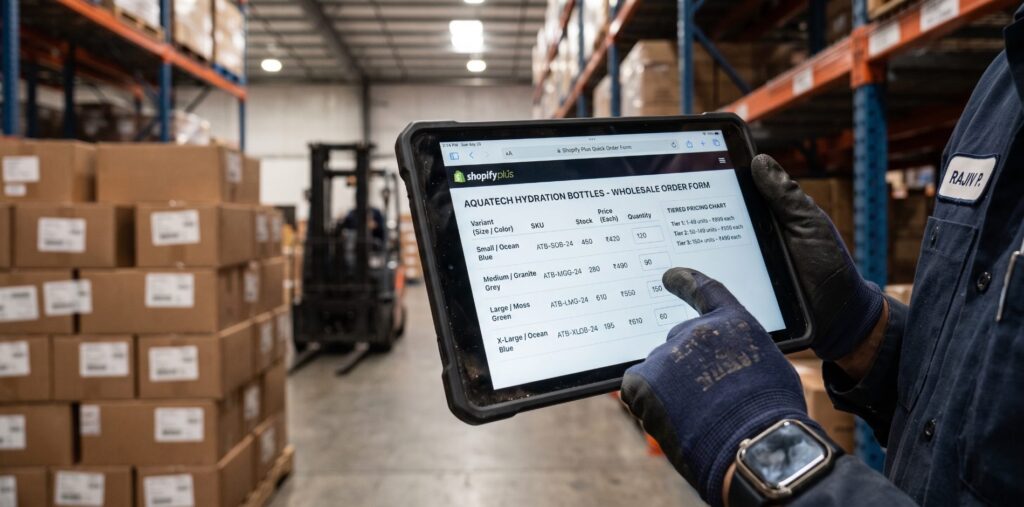
To succeed in B2B online sales, standard shopping cart functionality is entirely insufficient. Wholesale buyers behave differently than retail shoppers. Here is a deep dive into how Shopify Plus solves real-world, complex problems for wholesale businesses:
Company Profiles and Complex Buyer Hierarchies
In B2B, you are selling to corporate entities, not single shoppers. Shopify allows you to create a master “Company Profile.” Let’s say you supply hardware to a large retail chain with ten locations across NCR. You can assign different purchasing managers to the same overarching company account. You can set custom spending limits (e.g., the Noida manager can spend ₹2,00,000 without approval, while the Delhi manager can spend ₹5,00,000). All invoices and orders roll up into one unified company ledger for your accounts team to manage effortlessly.
Dedicated Wholesale Catalogs and Custom Pricing
Pricing in the wholesale market is heavily relationship-based. Your oldest distributor in Karol Bagh might command a flat 30% discount on all items, while a brand-new partner in Jaipur gets a 15% discount. Shopify Plus allows you to assign specific, customized price lists and product catalogs to different company profiles. When a buyer logs in with their secure credentials, they do not see retail prices—they only see their specific, negotiated pricing.
Volume Pricing, Minimum Order Quantities (MOQs), and Quantity Breaks
To incentivize larger average order values (AOV) and maintain wholesale margins, you must enforce buying rules. Shopify natively allows you to set Minimum Order Quantities (e.g., a buyer must purchase at least 50 units of a specific SKU). Furthermore, you can configure volume-based quantity breaks (e.g., Buy 1-50 units at ₹500/unit, 51-200 units at ₹450/unit, 200+ units at ₹400/unit). The math calculates automatically at checkout, eliminating the need for buyers to haggle over phone calls.
Net Payment Terms and Credit Vaulting
Shopify Plus allows you to assign specific payment terms (Net 30, Net 45, Net 60) directly in the admin panel for trusted clients. When an approved buyer checks out, they do not have to enter a credit card or UPI ID. They simply select “Pay on Terms.” The system registers the order, pushes it for fulfillment, and automatically tracks the invoice due date, sending automated email reminders as the payment deadline approaches.
Easy Reordering and Quick Order Forms
B2B buyers know exactly what they want. They don’t want to browse lifestyle images. Shopify’s B2B architecture supports “Quick Order Forms,” where buyers can simply type in SKU numbers, add 50 different product variants (like different sizes and colors of a t-shirt) to their cart from a single screen, and checkout in under two minutes. They can also access their order history and click “Reorder” to duplicate a past purchase instantly.
4. Crucial Ecosystem Integrations: GST, ERP, and Logistics
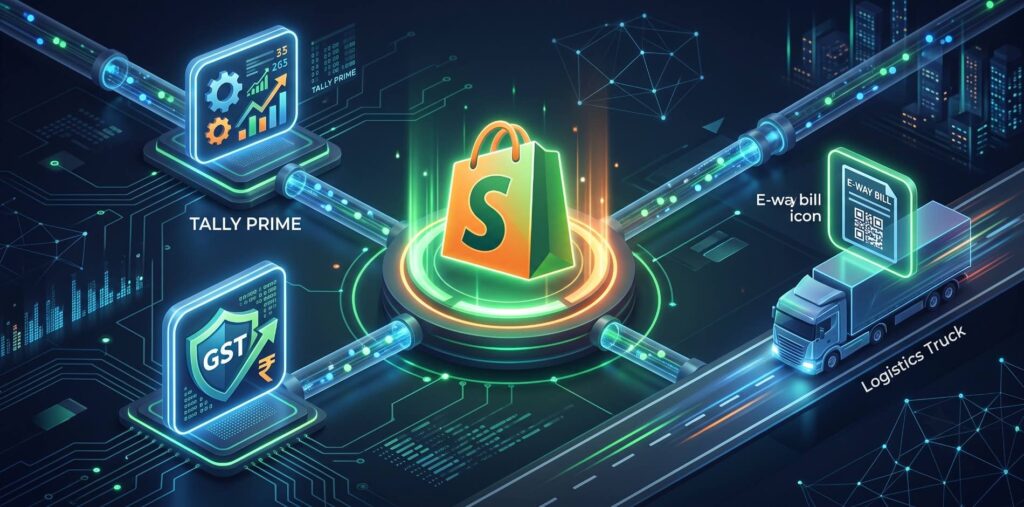
Having a beautiful, fast storefront is only 50% of the battle. To make a Shopify B2B eCommerce Delhi operation fully functional and legally compliant, your digital portal must communicate seamlessly with India’s complex software and taxation ecosystem.
Automated GST Compliance and E-Invoicing
India’s taxation structure requires absolute precision. We integrate top-tier tax applications (like ClearTax, or custom APIs) directly into the Shopify checkout flow. This ensures that B2B buyers must input their verified GSTIN during the registration process. At checkout, the system automatically calculates CGST, SGST, or IGST based on the state lines of the buyer and seller. Most importantly, it generates government-compliant B2B tax invoices—complete with accurate HSN codes—instantly.
Bi-directional ERP Sync (Tally Prime, Zoho Books, Microsoft Dynamics)
This is the holy grail of wholesale digital transformation. Using custom middleware and API integrations, we connect Shopify directly to your accounting and ERP software.
- Order Push: When a purchase order is generated online, it is instantly pushed to Tally Prime as a sales order.
- Inventory Pull: When your warehouse receives new stock and logs it into the ERP, Tally pushes real-time inventory updates back to Shopify. This bi-directional sync completely eliminates manual data entry, ensuring your website and your ledger are always in perfect harmony.
Heavy Freight and B2B Logistics Integrations
Standard D2C shipping apps cannot handle wholesale distribution. B2B requires LTL (Less Than Truckload) or FTL (Full Truckload) shipping logic. We configure your Shopify store to integrate with B2B logistics aggregators (like Shiprocket Cargo, Delhivery B2B, or Rivigo). This automates waybill generation, E-way bill compliance, and calculates accurate freight rates based on volumetric weight directly at checkout, so you never undercharge for bulk shipping.
5. The 6-Step Digital Transformation Blueprint
Transitioning traditional, offline wholesale buyers to a digital portal is a significant behavioral shift. It requires a strategic, phased approach rather than a sudden overhaul. Follow this proven 6-step roadmap for guaranteed success:
Step 1: Deep Data Structuring and Cleanup Do not touch a single line of code until your data is pristine. Gather all your SKUs, map out precise HSN codes, standardize your product descriptions, write clear weight dimensions for shipping, and clearly define your buyer tiers and discount rules in a master spreadsheet.
Step 2: Platform Architecture and UX Design Develop a B2B-optimized Shopify theme. The User Experience (UX) for B2B must focus strictly on speed and utility. Implement grid layouts, quick-add buttons, and advanced search bars that allow buyers to search by SKU or barcode.
Step 3: ERP, Tax, and Logistics Integration Connect your existing Tally/Zoho software, set up your GST invoicing rules, and integrate your freight partners. This phase requires rigorous stress-testing. We typically run hundreds of dummy orders to ensure tax calculations and inventory deductions match perfectly across the cloud and your local servers.
Step 4: The Closed Beta Soft Launch Do not force all your clients onto the platform on day one. Identify your top 15 to 20 most tech-savvy buyers. Invite them to beta-test the portal. Gather their feedback on the user interface, page loading speeds, and the checkout process. Fix any remaining bugs based on real user data.
Step 5: Incentivized Buyer Onboarding To drive widespread adoption, you must give traditional buyers a reason to change their behavior. Offer an “online-exclusive” discount (e.g., an extra 2% off or free freight shipping) for their first three orders placed through the Shopify portal instead of via phone or WhatsApp.
Step 6: Sales Team Repositioning Once the system is live and handling the bulk of your order intake, your sales team is freed from the burden of data entry. Retrain them to focus on relationship-building, acquiring new wholesale accounts across India, and analyzing purchase data to upsell existing clients.
6. Conclusion: Future-Proofing Your Enterprise

The transition from a manual, offline distribution model to a pan-India digital wholesale operation yields an undeniable Return on Investment (ROI). By embracing Shopify B2B eCommerce Delhi, you are guaranteeing zero manual data-entry errors, drastically faster payment cycles, heavily reduced administrative overhead, and a highly scalable sales channel that never sleeps.
A standard, out-of-the-box website template simply cannot handle the complex realities of Indian commerce. You need an architecture engineered for immense volume, complex pricing hierarchies, and strict local compliance.
Stop losing lucrative bulk orders to slow, manual processes and inventory blind spots. If you are ready to implement a true digital transformation strategy and dominate the wholesale market, you need a specialized enterprise development partner who understands both the code and the local business landscape.
Contact us Today
