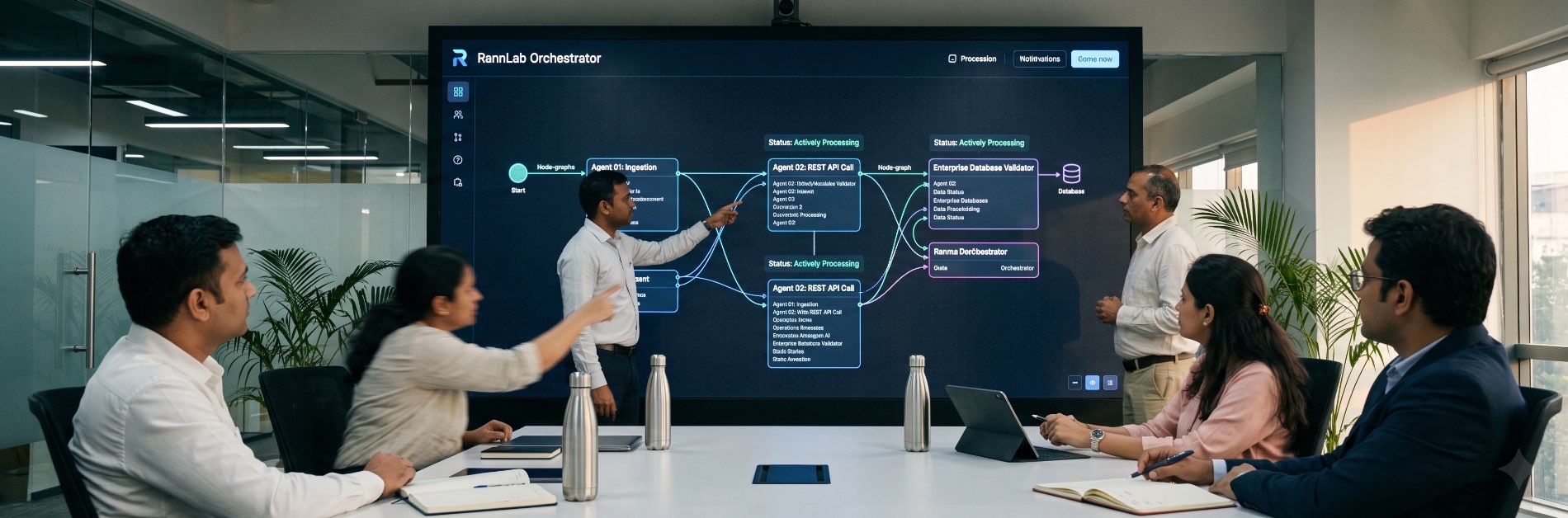
Agentic AI workflow automation for enterprises replaces static, rule-based RPA and passive chatbots with autonomous, multi-agent systems capable of planning, tool execution, and self-correction. By deploying specialized AI agents governed by role-based access controls (RBAC) and parse-safe pipelines, enterprises reduce manual processing overhead and IT costs by up to 40% while maintaining 100% audit compliance.
Most enterprise AI initiatives stall right after the proof-of-concept phase. Why? Because leadership teams buy a conversational co-pilot when what their operations actually need is an autonomous digital workforce.
A standard LLM wrapper can summarize a PDF or draft an email. It cannot, however, detect a roadside fleet breakdown via WhatsApp, triangulate GPS coordinates, query an ERP for the nearest mechanic, validate warranty coverage, and dispatch a repair crew across 10 regional languages without human intervention. That requires Agentic AI.
At RannLab Technologies, after delivering custom software and AI automation for over 100 global enterprises, we’ve seen firsthand that scaling agentic workflows isn’t a prompt-engineering challenge—it’s a systems architecture challenge.
Choose Your Lens: What Does Agentic AI Mean for Your Role?
Instead of a one-size-fits-all overview, find your specific executive priorities below:
- For CTOs & VP of Engineering: Your bottleneck is LLM latency, token limits on massive payloads, and hallucinated API calls. Jump to Section 2 to see how we solve token exhaustion using 25-KE Chunked Batchingand Parse-Safe JSON Repair.
- For COOs & Operations Heads: Your bottleneck is cross-departmental handoffs and human error in repetitive logistics, procurement, or onboarding tasks. Jump to Section 3 for real-world deployment metrics across Logistics, EdTech, and Healthcare.
- For CISOs & Compliance Officers: Your bottleneck is data leakage, shadow AI, and regulatory compliance (HIPAA, PHIPA, IT Act 2000, SOC2). Jump to Section 4 on Governance-as-Code and Secure SDLC.
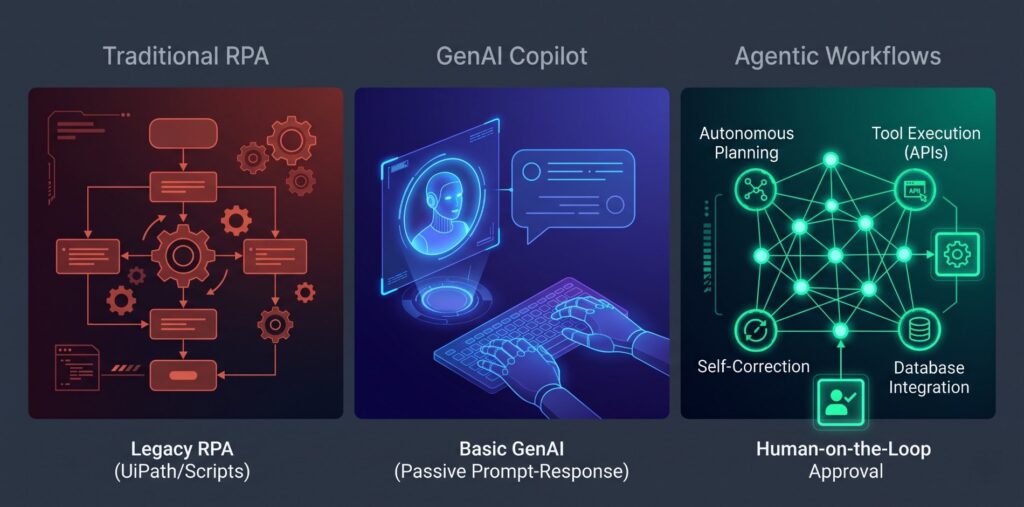
1. Traditional RPA vs. GenAI Co-Pilots vs. Agentic AI Workflows
To justify board-level ROI, technical leaders must distinguish between legacy automation, basic generative AI, and true agentic orchestration.
| Architectural Dimension | Legacy RPA (UiPath / Scripts) | Basic GenAI Co-Pilots | Enterprise Agentic AI Workflows |
|---|---|---|---|
| Core Mechanism | Rigid if/then screen scraping & static rules | Passive prompt-response (requires human trigger) | Goal-driven autonomous planning, tool use & memory |
| Unstructured Data Handling | Fails when UI or document layout changes | Summarizes text, but cannot execute multi-step actions | Parses messy inputs, repairs broken schemas & triggers APIs |
| Error Recovery | Crashes & halts pipeline until human fixes script | Hallucinates or asks user to re-prompt | Self-corrects via automated validation loops & fallback models |
| Human Oversight Model | High maintenance (breaks on software updates) | Human-in-the-Loop (human drives every step) | Human-on-the-Loop (agents execute; humans approve edge cases) |
| Primary Enterprise Value | Repetitive data entry | Individual employee productivity | End-to-end cross-application process orchestration |
2. The Engineering Reality: How to Stop AI Agents from Breaking in Production
Any developer can spin up a single AI agent in a sandbox over a weekend. When you push that same agent into an enterprise environment with 50+ domain models, legacy databases, and strict SLA requirements, three things usually break: context windows overflow, JSON outputs malform, and API costs skyrocket.
When engineering enterprise AI systems at RannLab, we replace fragile single-prompt chains with a 4-Layer Federated Agent Architecture:
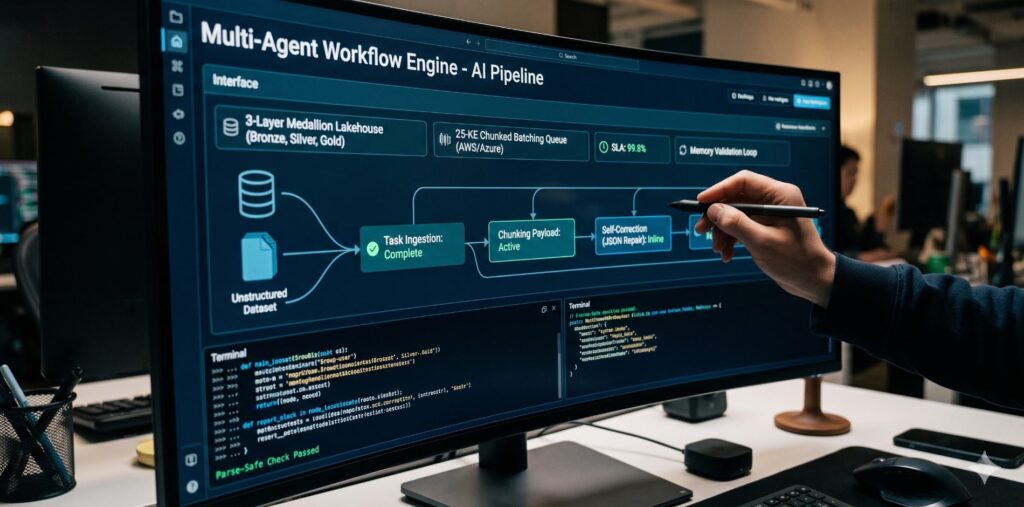
Layer 1: The Data Foundation (3-Layer Medallion Lakehouse)
Agents are only as intelligent as the enterprise context they can access. Before an agent reasons, we structure proprietary data—whether from EMR systems like Accuro and OSCAR, ERP logs, or IoT telemetry—into a Bronze-Silver-Gold Medallion Architecture on AWS or Azure. Grounding agents in clean, structured proprietary data reduces inference error rates by up to 40%.
Layer 2: Workload Optimization & 25-KE Chunked Batching
When processing massive enterprise payloads (such as mapping complex curricula, auditing multi-page legal contracts, or analyzing clinical histories), standard LLM calls hit token ceilings and truncate outputs.
- The RannLab Pattern: Instead of passing monolithic payloads to a single expensive “hero model”, we architect scalable background workers using 25-KE (Knowledge Element) chunked batching pipelines paired with automated, parse-safe JSON repair mechanics.
- The Result: Even when processing units with 180+ knowledge points, the system achieves a 100% large-unit success rate with zero manual skeleton setup, compressing hours of manual mapping into 5 minutes.
Layer 3: Multi-Agent Swarm Orchestration
Instead of forcing one massive LLM (like GPT-4o or Claude Opus) to do everything, we split workflows across task-specific micro-agents:
- Ingestion & Triage Agent: Extracts entities from unstructured inputs (voice notes, PDFs, WhatsApp messages).
- Execution & Tool-Use Agent: Calls internal REST/GraphQL APIs, queries SQL/MongoDB databases, or triggers Aadhaar eSign / Video KYC verifications.
- Validator / Critic Agent: Cross-checks the output against business rules before committing changes to production databases.
Layer 4: Human-on-the-Loop (HOTL) Escalation
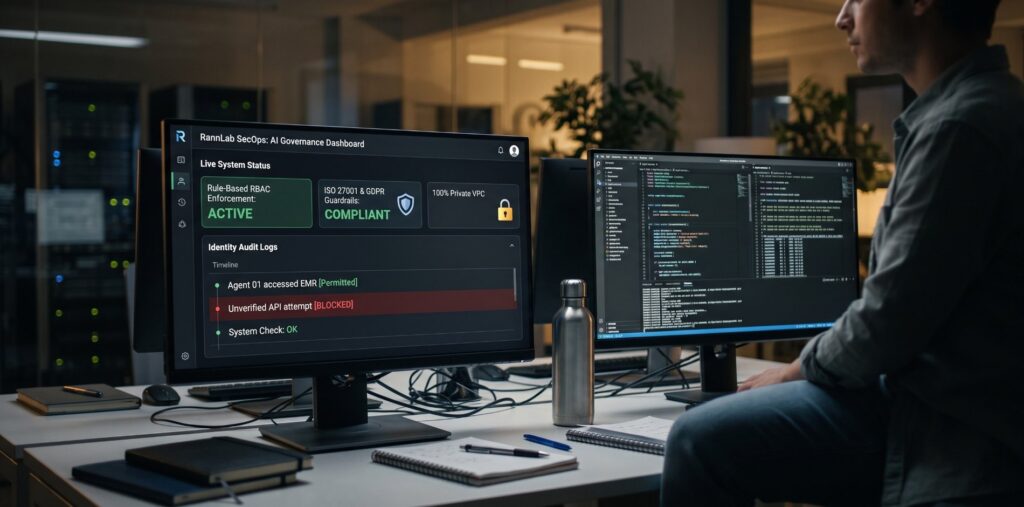
Autonomous does not mean unchecked. Using multi-user peer validation states and route-level Role-Based Access Control (RBAC), agents execute 90%+ of routine transactions autonomously while routing low-confidence edge cases or high-value financial approvals directly to human supervisors.
3. Battle-Tested Blueprints: Agentic AI in Action Across Industries
Search engines and enterprise buyers alike look for proof over promises. These three production deployments demonstrate how custom agentic workflows solve high-friction operational bottlenecks:
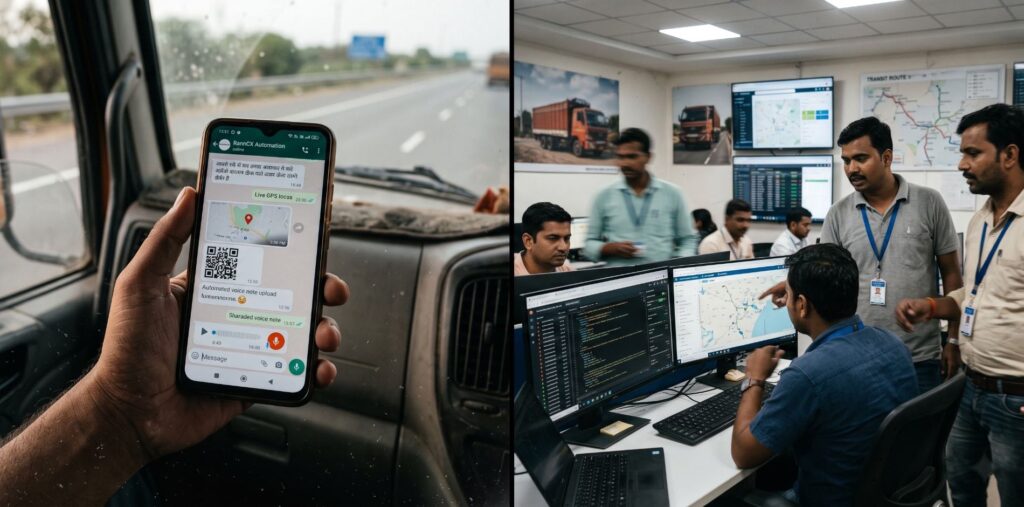
🚛 Case Blueprint 1: Fleet & Logistics (Autonomous Roadside Crisis Resolution)
- The Bottleneck: When a commercial truck breaks down on a highway, language barriers between drivers and central dispatchers delay recovery, costing fleet operators thousands in downtime.
- The Agentic Workflow: Built on the RannCX Platform and WhatsApp Business API, drivers simply scan a single QR code inside the cab. An autonomous conversational agent interacts across 10+ regional languages, captures voice/location telemetry, diagnoses the breakdown category, and dispatches emergency roadside assistance automatically.rannlab.com
- Production Impact: 5,000+ trucks covered with a single scan, turning chaotic 45-minute phone trees into an automated resolution in minutes.
🎓 Case Blueprint 2: EdTech & Enterprise LMS (Automated Ingestion & Mapping)
- The Bottleneck: Instructional designers and compliance teams spend weeks manually converting raw training documents into structured LMS modules (such as Moodle or custom Node.js/React platforms).
- The Agentic Workflow: An asynchronous Python/Node.js pipeline ingests raw course documentation from AWS S3, decomposes it via OpenAI agents, repairs formatting anomalies automatically, and packages validated units across 59+ domain models and 3 export formats.
- Production Impact: 0% manual skeleton setup, 5-minute end-to-end mapping time, and 100+ structured units generated seamlessly.
🏥 Case Blueprint 3: Healthcare & Digital Trust (Private-by-Default Data Pipelines)
- The Bottleneck: Healthcare providers struggle to unify patient wearables, unstructured clinical notes, and disparate EMRs without violating strict data residency laws (HIPAA, PHIPA, or India’s ABDM).
- The Agentic Workflow: Deploying private-by-default cloud agents on Microsoft Azure and Databricks that reconcile multi-source clinical data, integrate with legacy EMRs, and enforce automated audit trails.
- Production Impact: 100% private-by-default cloud security with seamless cross-EMR interoperability.
4. Governance-as-Code: How to Deploy Autonomous Agents Without Failing Your Audit
The #1 reason CISOs block agentic AI deployments is the fear of an autonomous agent executing an unauthorized database deletion or leaking PII to a public model training set.
At RannLab, every AI system is engineered under our Secure SDLC & AI Code Governance Framework:
- Zero Data Retention & Private Endpoints: Enterprise data never trains public foundation models. We deploy models via private Azure OpenAI, AWS Bedrock, or self-hosted open-source weights inside isolated VPCs.
- Least-Privilege Tool Sandboxing: An agent tasked with reading invoice PDFs is cryptographically restricted from accessing payroll tables. Permissions travel with the agent via strict route-level RBAC.
- Immutable Audit Trails & Kill Switches: Every reasoning step, tool call, and API payload is logged in an immutable audit trail—ensuring compliance with ISO 27001, SOC2, GDPR, HIPAA, and the IT Act 2000.
Frequently Asked Questions
What is the difference between an AI chatbot and an agentic AI workflow?
An AI chatbot is a conversational interface that responds to user prompts with text. An agentic AI workflow is an autonomous backend system that takes a high-level business goal, breaks it into sub-tasks, queries internal databases, executes actions across third-party software (like SAP, Shopify, Moodle, or WhatsApp Business API), validates its own output, and logs the transaction without human prompting.
How long does it take to deploy an enterprise AI agent into production?
Using an agile milestone-based delivery model, a Strategic Assessment and Working Proof-of-Value takes 2 to 4 weeks, while a fully integrated, ISO-certified production deployment (such as RannLab’s multilingual logistics AI or EdTech ingestion platform) takes 3 to 6 months from architecture blueprint to go-live.
Can agentic AI integrate with legacy monolithic software?
Yes. Even if your core enterprise software lacks modern REST APIs, agentic systems can bridge legacy monoliths using event-driven microservices wrappers, secure database read-replicas, and hybrid RPA-to-API connectors, enabling modernization without risky “rip-and-replace” downtime.
🚀 Ready to Architect Your Autonomous Workforce?
Don’t let your AI strategy get stuck in “chatbot purgatory.” Whether you are an enterprise in Delhi NCR, Greater Noida, or scaling globally across North America, Europe, or the Middle East, RannLab Technologies brings battle-tested engineering across Generative AI, Cloud DevOps, and Secure Enterprise Software.
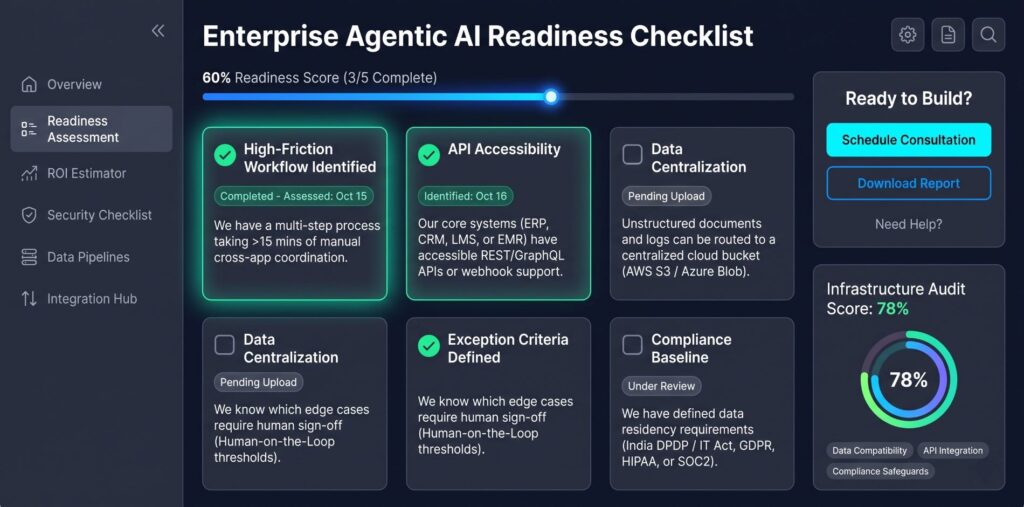
- Book a 2-Week Strategic AI Readiness Assessment: Get a fixed-scope architecture blueprint, token-cost estimation, and ROI analysis tailored to your tech stack.
- Visit Our Engineering Hub: 805, Om Tower, Alpha-I Commercial Belt, Greater Noida, UP 201310 | Schedule Your Free Architecture Consultation → .
