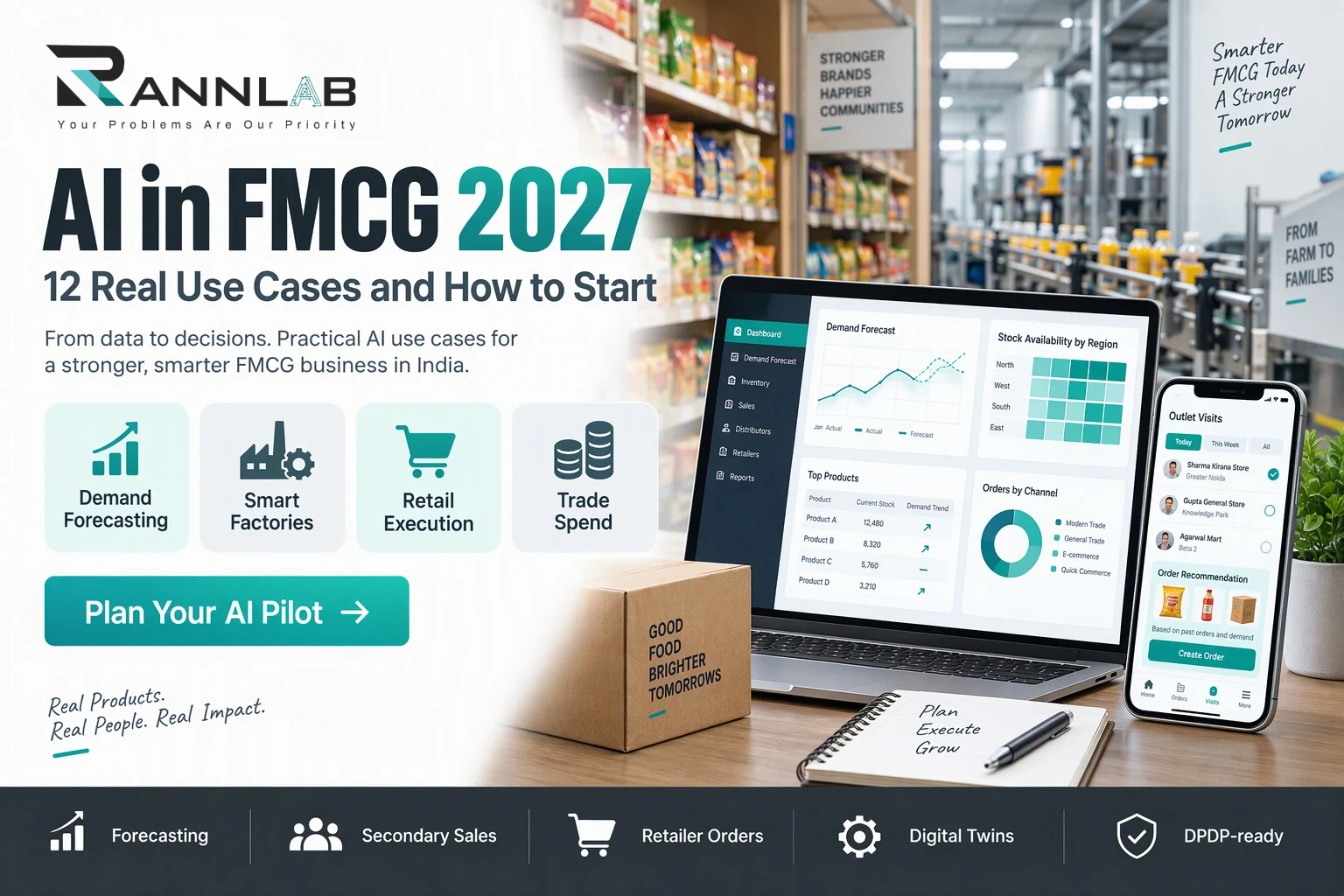
AI in FMCG means using machine learning, generative AI and automation to run a consumer goods business with better forecasts, fewer stockouts, faster factories, smarter trade spend and sharper marketing. The 12 AI in FMCG use cases below cover the whole value chain, from demand forecasting and digital twins to secondary sales tracking and retailer ordering. The best way to start is one use case, one data source and one 90-day pilot.
Large brands are already well past experiments. In June 2026, Unilever said it plans to build more than 40 new AI-enabled factory digital twins over 18 months. Closer to home, HUL describes AI running through its consumer, customer and operations ecosystems. But you don’t need a global budget to begin. Most mid-sized Indian brands already hold the data they need in their DMS, sales force app, ERP and WhatsApp conversations.
This AI in FMCG 2027 guide explains each use case, shows AI in FMCG examples from real companies, covers what makes AI in FMCG India different, and gives you a 90-day plan to start. For budgets across other software projects, see our software development cost in India guide.
At a glance
- Best first AI in FMCG use cases for most Indian brands: secondary sales visibility, field sales guidance, retailer reorder nudges and trade scheme validation
- Best first AI in FMCG use cases for larger manufacturers: demand forecasting, inventory replenishment and factory digital twins
- Data you need first: SKU-level sales, distributor stock, scheme and promotion history, and outlet data
- Pilot length for AI in FMCG: about 90 days, with one metric agreed before you start
- Biggest risks: poor channel data, low field adoption and unverified vendor claims
- Always plan for: human approval on sensitive decisions, and DPDP-ready consent for personal data
What Is AI in FMCG?
AI in FMCG is the use of data-driven software that learns from patterns to make or support decisions across a fast-moving consumer goods business. It includes three kinds of AI:
- Predictive AI forecasts demand, flags machine faults and scores outlets by their potential.
- Generative AI drafts product images, captions, recipes, reports and replies.
- Agentic AI and automation carries out steps in a workflow, such as nudging a retailer to reorder, with rules and human oversight.
AI in FMCG works because the industry combines high volumes, thin margins, short shelf lives and a huge number of small decisions every day: what to produce, where to ship, which outlet to visit, which scheme to run. AI in FMCG helps most where those decisions are made on stale data or by instinct.
AI in FMCG India: Why the Opportunity Is Different
AI in FMCG India has its own shape. A few facts explain why the use cases that work here are often different from those at a global brand:
- The kirana store is the channel. One industry analysis puts roughly 12 million kirana stores at close to 80% of FMCG sales, supplied through more than 400,000 distributors.
- Visibility ends at the distributor. Brands see primary sales, meaning what they ship to distributors, in detail. Secondary sales, from distributor to retailer, are where the picture blurs, so stock piles up on some routes while shelves go empty on others.
- Growth is shifting to harder markets. Salesforce India reports that rural India grew 8.4% in Q4 FY25 against 2.6% for urban India, which puts more pressure on scattered, low-density routes.
- Field teams churn. The same Salesforce piece cites distributor churn of 15–30% and sales force attrition of 30–40% a year, so any tool must work for a new joiner on day one.
- WhatsApp is the real operating system. Distributors and retailers already coordinate by phone and WhatsApp, so tools that fight that habit usually fail.
An industry piece in ETRetail says around 43% of Indian FMCG companies have already adopted AI for forecasting, supply chain and consumer analytics. Treat that number as indicative, because definitions of “adopted” vary.
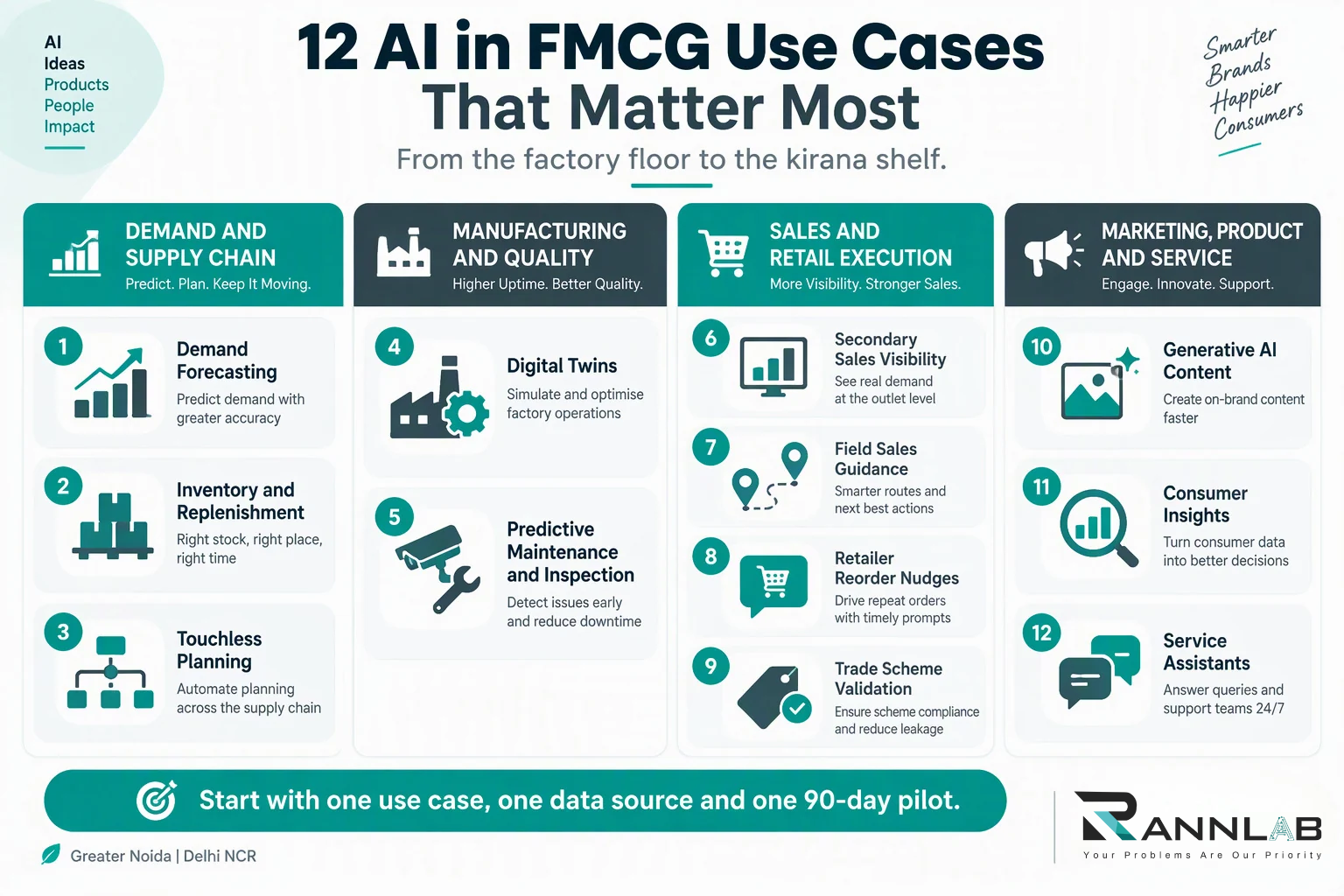
AI in FMCG Use Cases: The 12 That Matter Most
Here is the full list of AI in FMCG use cases at a glance. Difficulty and data needs are my planning judgments, so adjust them to your own business.
| # | Use case | Area | Main data needed | Starting difficulty |
|---|---|---|---|---|
| 1 | Demand forecasting and sensing | Supply chain | SKU-level sales history, promotions, calendar | Medium |
| 2 | Inventory and replenishment | Supply chain | Stock by node, lead times, sales | Medium |
| 3 | Touchless supply chain planning | Supply chain | Clean master data across systems | High |
| 4 | Digital twins and process optimisation | Manufacturing | Live line and sensor data | High |
| 5 | Predictive maintenance and quality inspection | Manufacturing | Machine data, defect images | Medium |
| 6 | Secondary sales visibility | Distribution | Distributor stock and sales | Low |
| 7 | Field sales and retail execution | Sales | Beat, visit, order and shelf photo data | Low to medium |
| 8 | Retailer ordering and reorder nudges | Sales | Outlet order history | Low |
| 9 | Trade promotion and scheme validation | Commercial | Scheme rules, claims, offtake | Medium |
| 10 | Generative AI for content and personalisation | Marketing | Brand assets, product data | Low |
| 11 | Consumer insights and product development | R&D and marketing | Reviews, social data, test results | Medium |
| 12 | Service assistants and internal copilots | Support | FAQs, order data, policies | Low |
Demand and supply chain
The first AI in FMCG use cases sit in planning, where a small accuracy gain protects both sales and working capital.
1. Demand forecasting and demand sensing
AI forecasting uses sales history plus signals such as festivals, weather, promotions and regional behaviour to predict demand at SKU and location level. This matters in India because demand is local. An ETRetail piece notes that a mustard oil brand is perceived very differently in Bareilly than in Delhi or Kolkata, which a single national forecast flattens.
Real example: Unilever says its Forecast Engine Utility produces a weekly 104-week forecast covering more than 5 million product-customer combinations across 40 operating markets.
How to start: Pick 20 to 50 SKUs in one region. Use two to three years of sales history, add your festival and promotion calendar, and compare the model’s forecast accuracy with your current method for 8 to 12 weeks.
2. Inventory and replenishment
Once demand is predicted, AI can suggest what to ship and when, so each distributor or retailer holds the right stock.
Real example: Unilever’s AI-driven customer connectivity model synchronises forecasts and sales data with retail customers. Its pilot with Walmart in Mexico raised product availability at the point of sale to 98%, and the model is rolling out across 30 key customers.
How to start: Begin with auto-replenishment suggestions for your top 20 distributors, and keep a human approving the first orders.
3. Touchless supply chain planning
This goes beyond forecasting. The aim is a plan that largely builds itself, with planners handling only the exceptions.
Real example: P&G and OMP describe a redesign that consolidates 35 overlapping planning processes into 20, with about 80% of planning already running touchlessly and a projected 50% reduction in planner effort. That figure is a vendor case study, so treat it as an ambition.
How to start: Don’t. At least not first. Touchless planning needs clean, harmonised data, so most brands should do use cases 1 and 2 before this one.
Manufacturing and quality
AI in FMCG manufacturing is mostly about waste, downtime and consistency.
4. Digital twins and process optimisation
A digital twin is a virtual model of a machine or production line that uses live data to monitor and predict performance. Teams use it to find problems earlier and test changes before touching the real line.
Real example: Unilever reports that at its Raeford plant a twin predicts 95% of process-flow restrictions, with waste down 20% and capacity up 10%. At its Gandhidham site in India, real-time control recommendations helped cut quality defects by 30% over four years.
How to start: Choose one line and one metric, such as waste, downtime or changeover time. Connect the data first, and add the twin only when the baseline is clear.
5. Predictive maintenance and quality inspection
AI watches machine signals and camera images to flag faults before they stop a line or reach a customer.
Real example: At Unilever’s Tinsukia factory in India, an AI vision system made product changeovers 85% faster, and generative AI helped cut manufacturing defects by 21%, according to a trade report. P&G has also described using edge AI on factory equipment to reduce downtime.
How to start: Put sensors on the one or two machines that cause the most downtime, or add a camera at the packing stage to catch label and fill errors.
Sales, distribution and retail execution
For many Indian brands, AI in FMCG starts here, because the data already sits in DMS and field apps.
6. Secondary sales visibility and distributor management
AI turns patchy distributor data into outlet-level demand estimates, flags dead stock and warns of stockouts before they cost sales. Vendors in this space report that AI-led auto-replenishment reduces stockouts by up to 30%. These are vendor claims, so test them on your own data.
How to start: Get daily stock and sales files from your top distributors, even by WhatsApp or spreadsheet at first, and build a single dashboard. Most brands find the first value in simply seeing the data.
7. Field sales and retail execution
AI can plan beats, suggest the next outlet to visit, recommend which scheme to pitch and read shelf photos to check whether products are displayed correctly. Salesforce India argues that agentic AI should take over manual work such as promotion setup, visit planning and approvals, so people can focus on execution.
How to start: Pilot AI beat planning in one area. Make sure the app works offline, because many routes in tier 2 and tier 3 markets have patchy networks.
8. Retailer ordering and reorder nudges
Instead of waiting for a salesman’s visit, AI suggests what each retailer should order next and sends the reminder.
Real examples: Coca-Cola has piloted AI with bottlers to send retailers customised ordering suggestions based on past orders and market data. HUL’s retail ordering app Shikhar had digitised more than 1.2 million retailers, and automation built on WebEngage lifted orders from previously inactive outlets by 9%, according to the vendor’s case study.
How to start: Send WhatsApp or push reorder nudges to dormant outlets in one region, in the local language, and measure repeat orders against a control group.
9. Trade promotion and scheme validation
Schemes, distributor margins and retailer discounts together can take a large share of revenue. FireAI, an analytics vendor, estimates trade spend at 8–15% of net revenue for most FMCG brands and says claim validation is often manual and leakage hard to prove.
Real example: HUL says AI supports its market-mix modelling platforms, which help marketers choose the right media, channel and frequency.
How to start: Match scheme claims against secondary sales for one region and one quarter. Flag claims that exceed likely offtake, and have a person review each flag.
Marketing, products and service
These AI in FMCG use cases are the easiest to start, but need the strongest brand and compliance controls.
10. Generative AI for content and personalisation
Generative AI drafts product images, captions, descriptions and campaign variants far faster than manual production, and can adapt them by region and language.
Real examples: Unilever said in 2025 that its AI and digital twin workflow produces product imagery about twice as fast at roughly 50% lower cost. Nestlé uses 3D digital twins to create product visuals for e-commerce. Coca-Cola has run generative AI campaigns such as Create Real Magic.
How to start: Use it for marketplace listings first, where volume is high and risk is low. Keep brand rules, a claims checklist and human approval in the loop.
11. Consumer insights and product development
AI mines reviews, social posts and test data to spot unmet needs, and helps developers balance ingredients, cost and nutrition.
Real examples: Nestlé’s recipe optimisation tool helps developers manage trade-offs between ingredients, nutrition, cost and sustainability. Unilever says it has cut concept-to-pilot timelines to 12 weeks, and HUL runs an Agile Innovation Hub for rapid prototyping with real-time consumer feedback.
How to start: Take one category and mine a year of marketplace reviews for themes, such as taste, pack size or price. Share the findings with your product team monthly.
12. Service assistants and internal copilots
AI assistants answer distributor and retailer questions, check order status and summarise long documents, with a human behind them for exceptions.
Real examples: Coca-Cola has piloted Microsoft Copilot for tasks like summarising email threads and building presentations. MIT Sloan Management Review reports that P&G uses AI to equip customer service representatives.
How to start: Build a WhatsApp assistant for distributors that handles order status, scheme questions and invoice requests, with a clear hand-off to a person. See our guide to AI chatbot development with a WhatsApp AI agent.
AI in FMCG Examples: What Leading Companies Report
These AI in FMCG examples show the range of what large brands describe publicly.
| Company | What it reports | Use case |
|---|---|---|
| Unilever | 98% on-shelf availability in a Walmart Mexico pilot | Inventory and replenishment |
| Unilever | 95% of process-flow restrictions predicted at one plant, 20% less waste, 10% more capacity | Digital twins |
| Unilever | 40+ new factory digital twins planned over 18 months | Manufacturing scale-up |
| HUL | 1.2M+ retailers on its Shikhar app, and 9% order uplift from inactive outlets in an automation case | Retailer ordering |
| Coca-Cola | AI ordering suggestions piloted with bottlers | Retailer ordering |
| Nestlé | Recipe optimisation and virtual prototyping | Product development |
| P&G | About 80% of planning touchless in an OMP programme | Supply chain planning |
All of these AI in FMCG examples are company or vendor claims. Use them to see what is possible, not to promise results to your board.
AI in FMCG 2027: What to Plan For
For AI in FMCG 2027 planning, these are practical points to build into your roadmap. They are planning judgments, not market statistics, so validate them against your own data:
- Agentic AI will move into field and distributor workflows. This is the biggest shift for AI in FMCG 2027 planning. Salesforce India is already writing about agents that handle visit planning and approvals, so expect your vendors to pitch them.
- Digital twins will spread from giants to mid-sized plants. Unilever’s 40-twin programme sets the pattern, and the tools will follow.
- Generative AI will become routine in marketing. The question will shift from “should we?” to “how do we keep it on brand and compliant?”
- Data foundations will decide the winners. Brands with clean SKU, outlet and distributor data will move faster than those still reconciling spreadsheets.
- Consent and governance will matter more. India’s DPDP Rules were notified in November 2025, and most obligations phase in over the following 12 to 18 months. The official text is on the MeitY DPDP Rules page.
How to Start AI in FMCG: A 90-Day Plan
You don’t need a big programme to start AI in FMCG. You need a clear problem, usable data and one owner.
Step 1: Pick one AI in FMCG use case with a scorecard (week 1)
Score each candidate from 1 to 5 on four questions, then pick the top one.
| Question | Why it matters |
|---|---|
| How much money or time does this problem cost us today? | Gives the pilot a clear business case |
| Do we already have the data? | Missing data is the most common reason pilots stall |
| Can one team own it? | Pilots that span five departments stall |
| Can we measure the result in 90 days? | You need proof before you scale |
Step 2: Check your data (weeks 1 to 3)
- Do SKU codes, outlet IDs and distributor IDs match across ERP, DMS and SFA?
- How far back does clean sales history go?
- Are promotions and schemes recorded, with start and end dates?
- Who owns each dataset, and can you share it with a partner?
Step 3: Decide whether to buy, build or automate (week 3)
| Option | Use it when | Watch out for |
|---|---|---|
| Buy a ready-made product | The problem is common, such as basic SFA or DMS | Limited fit with your schemes and workflow |
| Build custom | Your workflow is unique or the data is a competitive advantage | Higher upfront cost and a longer start |
| Automate with rules and RPA | The task is repetitive and the rules are clear, such as scheme claim checks | Brittle when the rules change often |
Many brands combine all three. Buy the standard tools, automate the repetitive steps, and build only the part that is truly yours.
Step 4: Run the AI in FMCG pilot (weeks 4 to 12)
- Fix one metric and a baseline before you begin, for example forecast accuracy, stockout days or repeat orders.
- Keep the scope to one region, one category or one distributor group.
- Put a named business owner in charge, not only a technical lead.
- Review results every two weeks, and write down what you learn.
Step 5: Decide at day 90
Scale it, fix it or stop it. A pilot that teaches you why something doesn’t work is still a good result if you stop it early.
Which metrics to track
| Use case | Metrics |
|---|---|
| Forecasting and replenishment | Forecast error, stockout days, working capital tied in stock |
| Secondary sales and field sales | Visit compliance, active outlets, lines per call |
| Retailer ordering | Repeat order rate, orders from dormant outlets |
| Trade promotion | Claim leakage, scheme ROI |
| Content | Time to publish, cost per asset, approval rejections |
| Factory | Waste, downtime, defects, changeover time |
Risks and Guardrails for AI in FMCG
- Bad data gives confident wrong answers. This is the most common failure in AI in FMCG projects. Fix master data before you fix models.
- Field adoption decides everything. If a salesman or distributor finds the tool slow, they will route around it. Design for offline use, local languages and low-end phones.
- Vendor claims are not guarantees. Ask for a pilot on your own data, and for the baseline the vendor measured against.
- Keep humans in the loop for AI in FMCG decisions. Unilever describes progressive automation “with human oversight”, which is a good rule for pricing, credit and scheme decisions.
- Check generative AI output. Review claims, nutrition statements and regional language before anything is published.
- Handle personal data properly. Retailer phone numbers, consumer data and WhatsApp opt-ins all need clear consent, access control and retention rules under DPDP.
How to Choose a Partner for AI in FMCG
Judge every AI in FMCG partner on three filters: proof, process and paper.
- Proof. Ask for a live system in a distribution-heavy business, not only a demo, and speak to a client.
- Process. Ask how they clean data, how they test against your current method and what happens when the model is wrong.
- Paper. The contract should state the scope, the metric, who owns the data, models and code, and what you can take with you if you leave.
For a wider vendor checklist, read our guide on how to choose a software development company in Noida. The same three filters apply.
How RANNLAB Fits, and How to Test Us
RANNLAB Technologies is a Greater Noida software company building software since 2013. Our AI and automation services cover predictive analytics and machine learning models, including sales forecasting and demand prediction, AI chatbots, robotic process automation, natural language processing and computer vision. Our chatbot development services include WhatsApp agents, and our custom software development team builds the dashboards, APIs and integrations that connect AI to your DMS, ERP and field apps.
For AI in FMCG India, we’d start where the data already exists: secondary sales dashboards, retailer reorder nudges, scheme claim checks and WhatsApp assistants for distributors. Put the same questions to us that you’d put to any AI in FMCG partner: what will the pilot measure, who owns the data and models, and what happens when the model is wrong?
Frequently Asked Questions
What is AI in FMCG?
AI in FMCG is the use of machine learning, generative AI and automation to improve decisions across a consumer goods business, including forecasting, inventory, manufacturing, sales, trade promotion and marketing.
What are the main AI in FMCG use cases?
The most common AI in FMCG use cases are demand forecasting, inventory replenishment, digital twins, predictive maintenance, secondary sales tracking, field sales guidance, retailer ordering, trade scheme validation, generative AI for content, consumer insights and service assistants.
Which companies are using AI in FMCG?
These AI in FMCG examples come from Unilever, HUL, Nestlé, Coca-Cola and P&G, which all describe using AI across forecasting, factories, retail execution, marketing and product development. Results quoted publicly are company-reported.
How is AI in FMCG India different from other markets?
In AI in FMCG India projects, most sales flow through kirana stores and distributors, secondary sales data is patchy, field teams churn and WhatsApp is the main working tool. That makes secondary sales visibility, retailer ordering and field execution especially valuable.
How do I start with AI in FMCG?
Pick one use case with a scorecard, check your data, decide whether to buy, build or automate, and run a 90-day pilot with one metric and one owner.
What should I plan for in AI in FMCG 2027?
Plan for agentic AI in field and distributor workflows, digital twins reaching more plants, routine generative AI in marketing, a stronger data foundation and DPDP-ready consent.
Do small and mid-sized FMCG brands need AI in FMCG projects?
They don’t need everything, but they can benefit from a few focused use cases. Secondary sales dashboards, reorder nudges and scheme validation are good places to start because the data already exists in their DMS and field apps.
What data do I need for AI in FMCG?
For most AI in FMCG use cases, you need, at minimum, SKU-level sales history, distributor stock, outlet data, and your scheme and promotion history. Consistent IDs across ERP, DMS and field apps matter as much as volume.
Can AI replace my field sales team?
No. The better use is to guide the team: which outlet to visit, what to pitch and what to reorder. People still build the relationships that drive sales in general trade.
Is it safe to use generative AI for FMCG marketing?
Yes, with controls. Set brand rules, keep a claims checklist, require human approval and review regional language output before publishing.
How long does an AI in FMCG pilot take?
About 90 days for a well-scoped pilot with clean data. A foundation project such as unifying distributor data can take longer, so budget for it separate
Plan Your First AI Pilot With RANNLAB
Tell us your channel mix, your systems and the problem that costs you the most today. For your first AI in FMCG pilot, we’ll suggest the smallest version worth running and share a phase-wise scope, with no obligation.
Prefer a quick chat? Message us on WhatsApp.
