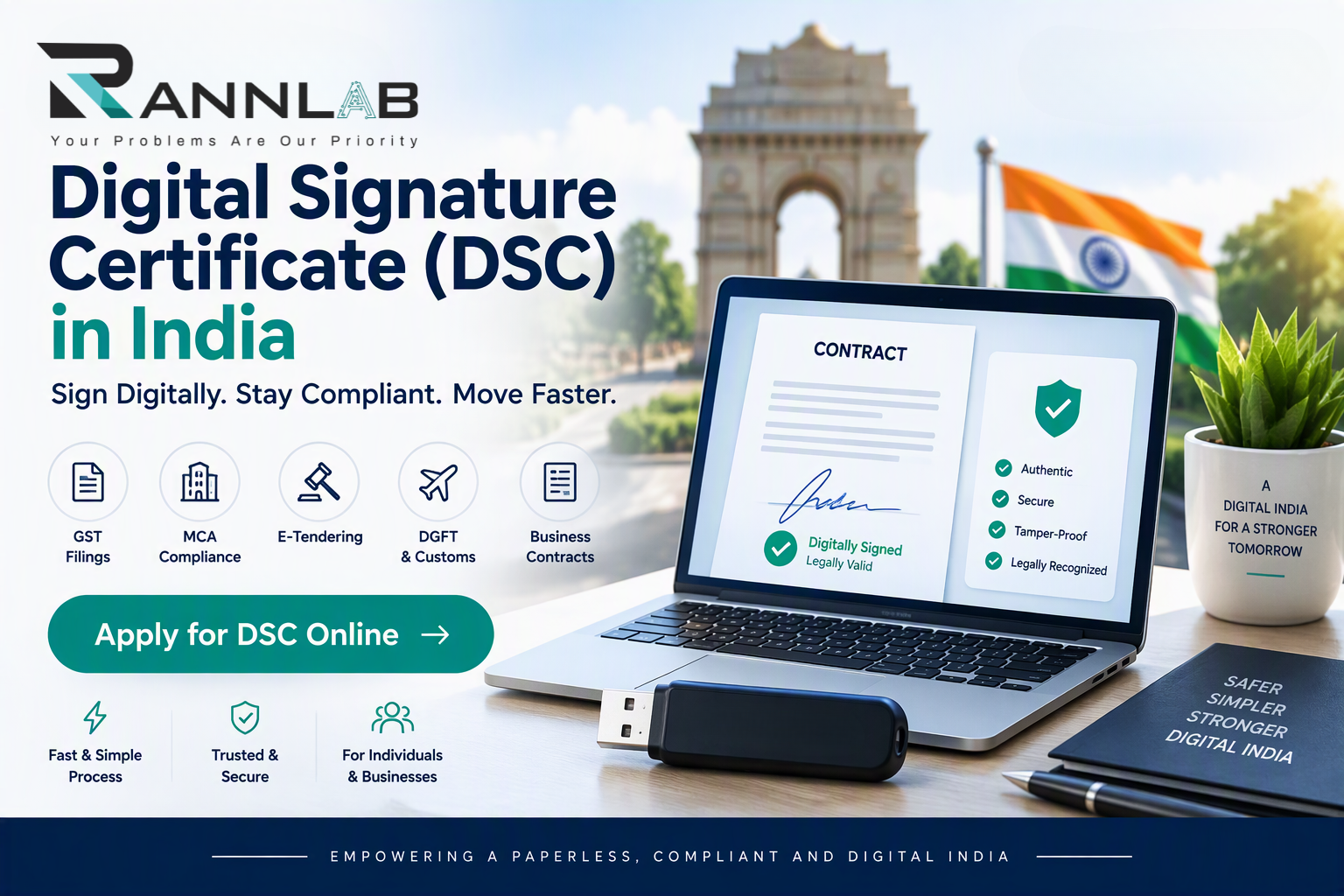
Paper contracts, wet-ink signatures, and courier delays are being replaced by a digital signature certificate (DSC). A DSC is now needed for GST returns, company filings, e-tenders, DGFT work, and signing business documents. This guide covers what a DSC is, which class you need, what it costs, and how to apply online.
What Is a Digital Signature Certificate?
A digital signature certificate is the electronic equivalent of a physical signature, issued by a licensed Certifying Authority (CA). It proves who you are and that a document has not been altered after you signed it.
A DSC typically contains:
- The holder’s name and other identity details
- The public key
- The certificate’s serial number and validity period
- The issuing Certifying Authority’s name and digital signature
Under the Information Technology Act, 2000, a digital signature made with a valid DSC is legally recognised and carries the same weight as a handwritten signature for most purposes.
Types of DSC: Class 2 vs Class 3
Class 2 certificates were used mainly for filings such as income tax returns and company registration, where identity is verified against a trusted database. The Controller of Certifying Authorities has stopped issuing new Class 2 certificates, so existing ones remain valid only until they expire.
Class 3 digital signature certificate is now the standard. It requires the strongest identity verification and is accepted for:
- E-tendering and e-procurement
- Company and LLP registration and MCA filings
- GST registration and return filing
- Customs, DGFT, and import-export portals
- Income tax e-filing
- Signing business contracts and agreements
If you’re unsure which to pick, choose Class 3. It is the safe default for individuals and businesses.
What Is a DSC Token?
A DSC token is a small USB device, similar to a pen drive, that stores your digital signature certificate and private key securely. The key cannot be copied out of it, which makes it safer than a file stored on a computer. Most government portals ask for a token-based DSC. You’ll plug it in, install the driver, and enter your PIN each time you sign.
Digital Signature Certificate Cost
The cost depends on three things:
- Class of certificate (Class 3 costs more than older Class 2 certificates)
- Validity (1, 2, or 3 years; longer validity usually works out cheaper per year)
- Purpose, since certificates for e-tendering or DGFT, or combined signing and encryption, are priced differently
The USB token is usually a separate charge unless you already have one. Prices vary between providers, so compare the total (certificate plus token plus any service fee) rather than just the headline price.
Need a Digital Signature Certificate?
Explore Class 3 DSC options for digital signing and business requirements in India.
Get Your DSC →Who Needs a DSC?
- Company directors and LLP partners, for MCA/ROC filings and company registration
- GST taxpayers, as DSC is mandatory for companies and LLPs filing returns (other taxpayers may be able to use EVC or Aadhaar-based authentication)
- Chartered accountants and tax professionals, for filing on behalf of clients
- Contractors and vendors, for e-tendering and e-procurement
- Importers and exporters, for DGFT and customs portals
- Businesses, for signing contracts and agreements digitally
Building a Digital Trust or PKI Solution?
RANNLAB works on Digital Trust solutions including eSign, eKYC, PKI management and digital signature integrations for enterprise platforms.
Explore Digital Trust Solutions →How to Apply for a Digital Signature Certificate Online
The process is fully online with most licensed providers:
- Choose a licensed Certifying Authority. Only CAs licensed by the CCA can legally issue a DSC.
- Select the class, usage type, and validity. For most business needs, that means Class 3.
- Fill in the application form with your name, email, mobile number, and address.
- Upload documents. Typically this means PAN, Aadhaar or another address proof, and a passport-size photo. Organisations may also need proof of the business.
- Complete identity verification. Most CAs offer Aadhaar-based eKYC or a short video verification, so you don’t need to meet anyone in person.
- Pay the fee online.
- Receive your DSC. After approval, the certificate is loaded onto a USB token and couriered to you, or issued digitally.
- Install the token driver and test it on the portal you need to use.
Tip: Make sure the name on your documents matches the name you enter exactly. A mismatch between the applicant’s name and the documents is one of the most common reasons for rejection.
How to Apply a DSC for GST Filing
- Make sure you hold a valid Class 3 DSC on a token.
- Install the token driver and the emSigner utility (or the one your provider recommends).
- Log in to the GST portal and register the DSC against the authorised signatory.
- Use the DSC to sign when filing returns.
Which DSC Is Best for Business Contracts?
For contracts and agreements, a Class 3 DSC with signing capability is the best choice. It carries the highest identity assurance, is widely accepted, and can be used across MCA, GST, and tender portals, so one certificate covers most of your needs. If you also need to encrypt documents, ask your provider about a combined signing and encryption certificate.
How to Choose a Trusted DSC Provider in India
Trusted providers are licensed Certifying Authorities, such as eMudhra, Capricorn, Sify, (n)Code, and Protean. Check the current list on the CCA website. When comparing, look at:
- Licensing: the provider must appear on the official CCA list
- Turnaround time: how quickly the certificate is issued
- Support: help with driver installation and portal registration
- Pricing transparency: no hidden token or courier fees
- Verification options: Aadhaar eKYC or video KYC for a fully online process
Validity and Renewal
Most DSCs are valid for 1, 2, or 3 years. A DSC cannot be extended once it expires, so you’ll need to apply for a renewal, and doing it a few weeks before expiry avoids missed filing deadlines. If your token is lost or your private key is compromised, contact your CA immediately to revoke the certificate.
Frequently Asked Questions
Is a digital signature certificate legally valid in India?
Yes. The IT Act, 2000 gives legal recognition to digital signatures created with a valid DSC.
Can I get a free DSC?
Some government schemes and limited-time offers exist, but most DSCs are paid. Be cautious of unlicensed providers advertising “free” certificates.
Can I use one DSC for GST, MCA, and income tax?
In most cases, yes. A Class 3 DSC is accepted across these portals, but register it on each one.
How long does it take to get a DSC?
With online verification, it can be issued within a day or two, plus courier time for the token.
What if my name doesn’t match my documents?
The application will likely be rejected. Make sure your name is the same on your PAN, Aadhaar, and application form.
Conclusion
A digital signature certificate is now a basic requirement for running a business in India. Pick a Class 3 DSC from a licensed provider, keep your documents consistent, and renew before expiry. Done right, you can get set up in a day or two and sign everything from GST returns to contracts without paperwork.
Ready to Get Your Digital Signature Certificate?
Explore Class 3 DSC options for digital signing and common business requirements including GST, MCA, Income Tax and tender submissions. For enterprise requirements, RANNLAB can also help with Digital Trust, eSign, eKYC and PKI solutions.
Need help with an enterprise requirement? Talk to RANNLAB →
