
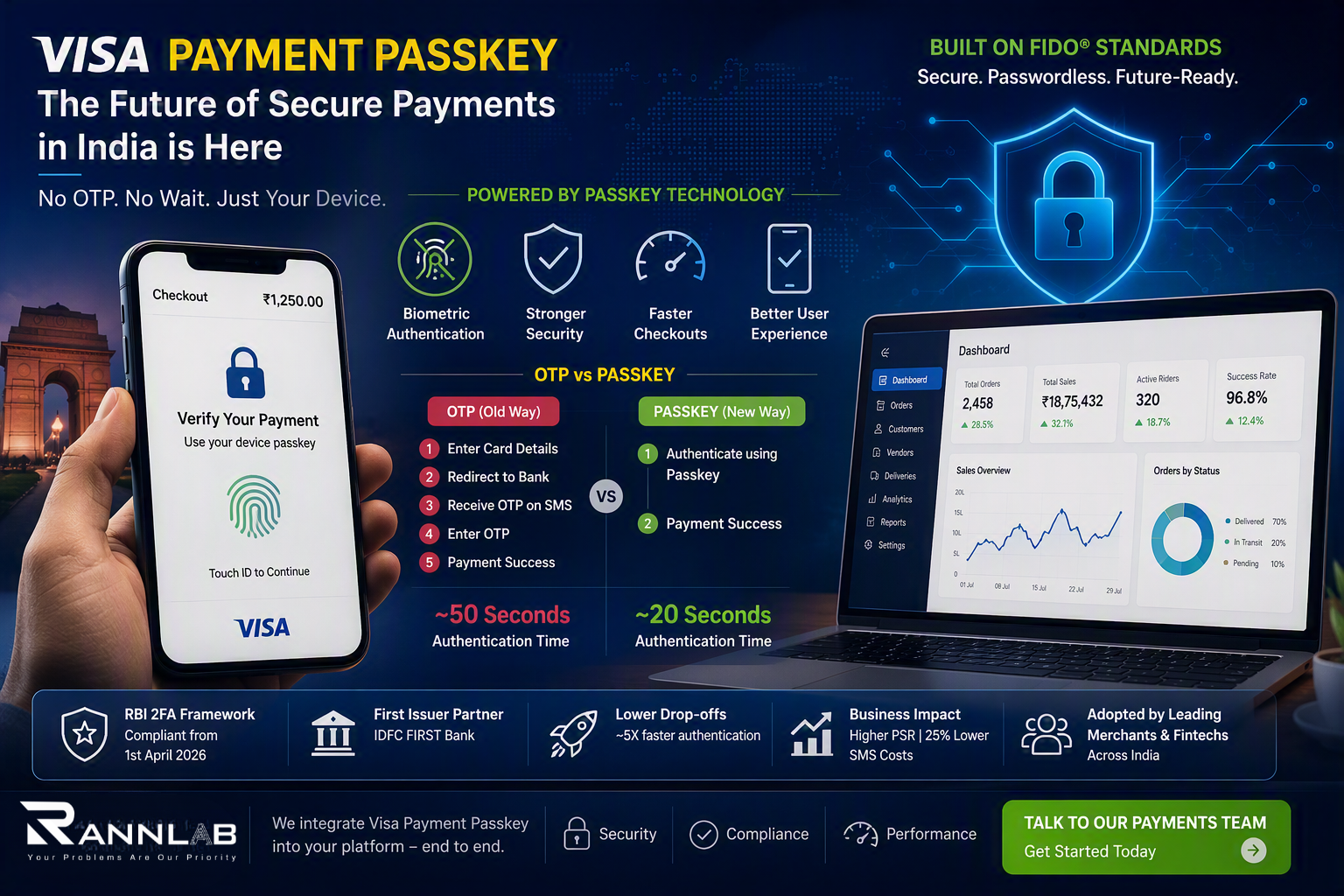
Visa Payment Passkey integration is now the most consequential change to Indian card checkout since tokenization. Visa Payment Passkey went live in India in July 2026 with IDFC FIRST Bank as first issuer, and the RBI’s authentication framework took effect on 1 April 2026 — which means every merchant still routing card authentication exclusively through SMS OTP is now operating on borrowed time and losing conversions to it.
This guide covers what Visa Payment Passkey is, the regulation driving it, what Visa Payment Passkey integration genuinely involves, and how to decide whether to build it or route through a partner.
What is Visa Payment Passkey?
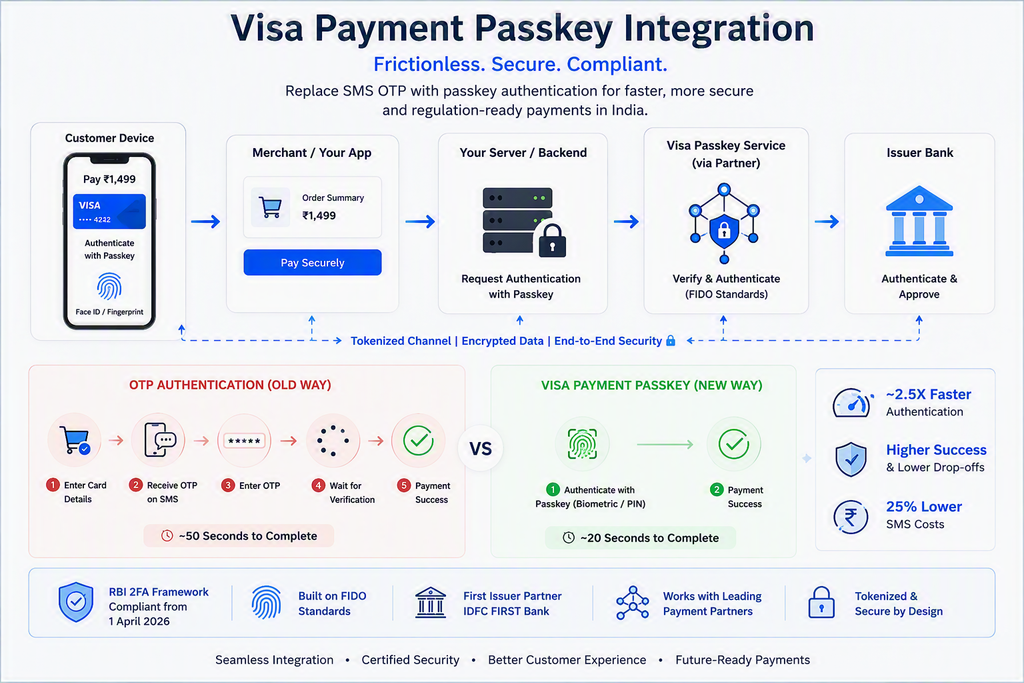
Visa Payment Passkey lets cardholders authenticate an online payment using their device’s native unlock — fingerprint, facial recognition, PIN, password or pattern — instead of receiving and entering a one-time password.
It is built on FIDO standards, the global authentication framework that lets a device or browser verify identity without passwords or OTPs. The authentication stays bound to the user’s device. Nothing travels over SMS.
Enrolment is one-time. Once a cardholder sets up a passkey, the same authentication works across every participating merchant and platform where the service is enabled.
Why the RBI framework makes Visa Payment Passkey unavoidable
This is not a Visa product launch you can ignore until competitors move. It is regulatory.
The RBI Authentication Directions, 2025 expanded two-factor authentication beyond SMS OTP, requiring two independent factors with at least one dynamically generated for all domestic digital payment transactions from 1 April 2026. The framework retained the two-factor requirement but explicitly permitted alternatives to SMS OTP.
That single change reversed the incentive. OTP was the compliant default for a decade. It is now one option among several, and demonstrably the worst-performing one.
The Visa Payment Passkey business case: what OTP costs you
OTP-based checkout has been the single largest friction point in Indian online card payments. Transactions fail because of delayed OTP delivery, weak network connectivity, wrong entries and redirect issues — every one of them an abandoned cart that had already cleared intent.
The measured improvements are substantial:
| Metric | Reported outcome |
|---|---|
| Checkout authentication time | Dropped from ~50 seconds to ~20 seconds |
| Passkey adoption among repeat users | 61% reported by MakeMyTrip in a first rollout |
| SMS cost reduction | 25% cut in the same rollout |
| Payment success rate | Significant uplift expected versus OTP |
Model that against your own numbers. If you process 100,000 card transactions a month at a 12% OTP-related failure rate, a five-point improvement in payment success rate is 5,000 recovered transactions monthly. At an average order value of ₹1,500, that is ₹75 lakh in recovered GMV a month — before counting the SMS cost you stop paying.
Who is already live with Visa Payment Passkey
Visa Payment Passkey launched with IDFC FIRST Bank as the first banking partner, available to select users at merchants including Myntra, Paytm, MakeMyTrip, Tata Starbucks, Reliance Digital and EatSure.
The integration backbone runs through fintech partners: Juspay, Wibmo, Razorpay, PayU, Pine Labs, BillDesk, M2P Fintech and Paytm Payments Services.
Mastercard reached India first, selecting the market for the global launch of its Payment Passkey Service in August 2024, built on EMVCo, W3C and FIDO Alliance standards with partners including Axis Bank, Juspay, Razorpay, PayU and bigbasket. Both networks are now live here. The question for merchants is no longer whether, but how.
What Visa Payment Passkey integration actually involves
This is where most planning goes wrong. Teams budget for an SDK drop-in and discover a certification programme.
1. Determine your integration route. You either integrate directly with the network, or route through a payment aggregator or fintech partner already certified. The second path is faster and correct for most merchants. The first makes sense only at very high volume or where you control your own payment stack.
2. Visa Payment Passkey enrolment flow design. The cardholder has to create a passkey before they can use one, and the moment you choose to ask matters enormously. Interrupt a first checkout and you lose the sale. Ask post-transaction, or on a subsequent visit, and adoption climbs. This is a product decision that determines your entire adoption curve — not an engineering detail.
3. Device binding and lifecycle. Passkeys bind to a device. You must handle the cases: user gets a new phone, uses a desktop browser, shares a family device, or clears browser data. Each needs a defined path, and getting this wrong generates support volume that swamps the conversion gain.
4. Fallback handling. Not every user, device or browser will support passkeys on day one. Your checkout must degrade gracefully to OTP without a dead end. A failed passkey attempt that strands a customer is worse than never offering one.
5. Certification and test transactions. Before production, you run certification against network and issuer test environments, then live transaction validation with an issuing bank. This stage involves coordination across your team, the network, the aggregator and the issuer — and it is where timelines slip, because you are dependent on four calendars, not one.
6. Measurement. Instrument passkey versus OTP separately from the start: authentication success rate, time to authenticate, drop-off at each step, and payment success rate by cohort. Without this split you cannot prove the business case internally, and the programme loses budget at the next review.
Visa Payment Passkey integration: build in-house or use a partner?
| Direct integration | Via aggregator or fintech partner | |
|---|---|---|
| Time to live | Longer — full certification | Shorter — partner is certified |
| Engineering load | High | Moderate |
| Control over UX | Complete | Constrained by partner flow |
| Right for | High-volume merchants owning their payment stack | Most merchants |
Our recommendation for most merchants planning Visa Payment Passkey integration: route through a certified partner first, capture the conversion gain quickly, and evaluate direct integration only once volume genuinely justifies owning the stack.
Visa Payment Passkey security and compliance considerations
Passkeys improve the security posture, but the surrounding obligations do not relax:
- Tokenisation still applies. Visa positions passkeys as working alongside tokenisation, not replacing it.
- DPDP Act compliance. Biometric authentication happens on the device — the biometric never reaches your servers. Your privacy notice must say so accurately, because customers will ask.
- Audit logging. Retain authentication events with the same rigour you apply to transactions.
- Fraud monitoring. Passkeys reduce OTP interception and phishing, but do not eliminate account takeover through other vectors. Existing controls stay.
Where RannLab fits
RannLab Technologies builds payment and digital trust infrastructure — PKI, eSign, eKYC and authentication systems — for regulated environments. We have delivered Visa Payment Passkey integration for an Indian fintech platform, working directly with network and issuer teams through certification and live transaction validation with an issuing bank.
That experience is narrow and specific, which is the point. Visa Payment Passkey integration is not a generic mobile SDK task. It requires someone who has already been through certification, seen where issuer test environments behave differently from production, and designed an enrolment flow that users actually complete.
What we deliver:
- Integration assessment — your current checkout, aggregator relationships and realistic effort
- Enrolment UX design — the decision that determines adoption
- Implementation across .NET, Java, Node.js, PHP and Python stacks, See Our Capabilities
- Certification support — coordination through network, aggregator and issuer testing
- Fallback and lifecycle handling — device changes, unsupported browsers, graceful degradation
- Measurement instrumentation — so you can prove PSR uplift internally
Talk to our payments team
Tell us your monthly card transaction volume, current payment aggregator, and where OTP failures are costing you most. We will come back with a realistic integration route, effort estimate and timeline.
Talk to our payments team
Every OTP failure is a customer who had already decided to buy. Tell us three things and we will show you what passkeys recover.
- Monthly card transaction volume
- Your current payment aggregator
- Where OTP failures cost you most
You get back a realistic integration route, effort estimate and timeline — from engineers who have been through certification, not a sales deck.
RannLab Technologies Pvt. Ltd. — Greater Noida, Delhi NCR. Payments · PKI · eSign · Digital Trust Infrastructure.
Frequently asked questions
What is Visa Payment Passkey?
A FIDO-based authentication method allowing Visa cardholders to approve online payments using their device’s fingerprint, facial recognition, PIN, password or pattern instead of an SMS OTP. It went live in India in July 2026 with IDFC FIRST Bank.
Is Visa Payment Passkey mandatory for merchants?
No. But the RBI Authentication Directions, 2025 required two independent authentication factors with at least one dynamically generated from 1 April 2026, and explicitly permitted alternatives to SMS OTP. Merchants relying solely on OTP face both compliance scrutiny and measurable conversion loss.
Which banks support Visa Payment Passkey in India?
IDFC FIRST Bank is the first issuing partner. Additional issuers are expected as the rollout expands.
Does it replace tokenization?
No. Visa positions passkeys as complementary to tokenization, adding an authentication layer rather than replacing card credential security.
What happens if a customer’s device does not support passkeys?
Your checkout must fall back to OTP. Graceful degradation is a mandatory part of the integration, not an optional enhancement.
How long does integration take?
It depends heavily on route. Routing through an already-certified aggregator is materially faster than direct network integration, which requires full certification against network and issuer test environments.
Does the biometric data reach my servers?
No. Authentication happens on the user’s device using its native unlock. The biometric never leaves the device, which is why your privacy notice should describe the flow accurately.
Is Mastercard’s passkey service different?
Mastercard launched its Payment Passkey Service in India in August 2024, built on EMVCo, W3C and FIDO Alliance standards. Both networks now operate passkey authentication in India, and merchants generally need to plan for both.
