

In 2026, launching an online store is no longer just about listing products and integrating a payment gateway. The modern digital retail landscape is fiercely competitive. If your site is slow, your checkout is cluttered, or your architecture is outdated, shoppers will bounce to a competitor within seconds.
Expert ecommerce website development requires a precise balance between high-performance technical architecture and behavioral psychology. You are not just building a website; you are engineering a conversion engine.
Summary:
- Cart Abandonment: The global cart abandonment rate sits at approximately 70.22%. Fast, frictionless checkouts are mandatory.
- Architecture: Headless ecommerce separates the frontend presentation from the backend database, resulting in lightning-fast load times.
- Performance: A 1-second delay in page load time can reduce conversions by up to 7%. Core Web Vitals are directly tied to revenue.
- Mobile-First: With over 77% of cart abandonments happening on mobile devices, responsive, thumb-friendly design is critical.
What is Ecommerce Website Development?
Ecommerce website development is the specialized process of building online platforms that facilitate the buying and selling of physical or digital goods. It involves setting up secure web architecture, integrating product databases, configuring payment gateways, and optimizing the user experience (UX) to maximize the conversion rate from visitor to buyer.
1. The Real Cost of Bad Architecture: A Conversion Rate Analysis
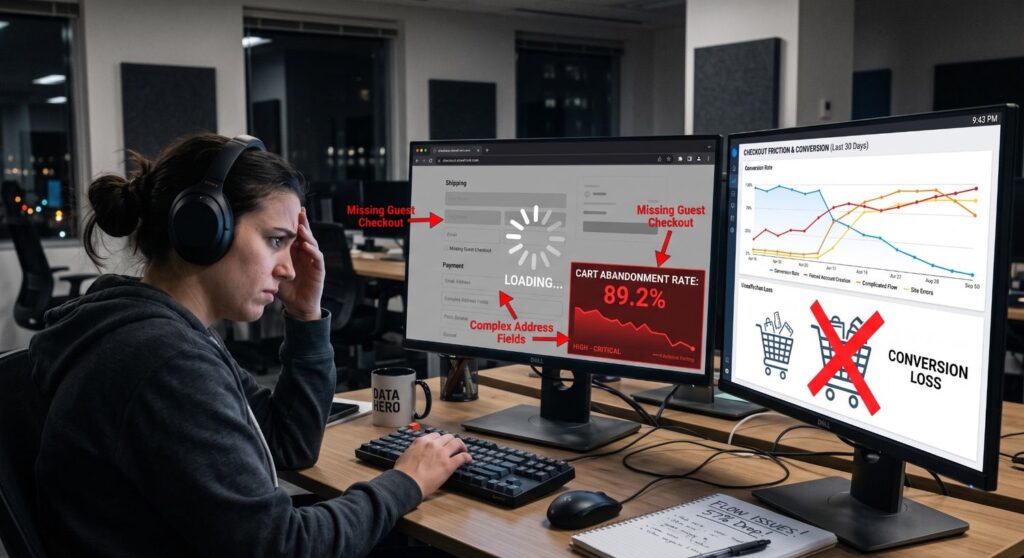
Before looking at the code, developers and brand owners must understand why ecommerce architecture matters. The metric that rules them all is the Shopping Cart Abandonment Rate.
According to the Baymard Institute’s continuous meta-analysis (updated with 2025/2026 data), the average documented online shopping cart abandonment rate is a staggering 70.22%. That means 7 out of 10 users who add an item to their cart will leave without paying.
Why does this happen? Aside from “just browsing,” the top UX and architectural failures include:
- Extra Costs Too High (40%): Shipping and fees calculated too late in the process.
- Forced Account Creation (18%): Blocking the guest checkout path.
- Too Long/Complicated Checkout (17%): Forms with too many fields.
- Website Errors or Crashes (17%): Unstable server architecture and poorly coded scripts.
Effective ecommerce website development directly solves these issues by prioritizing speed, stability, and a frictionless user interface.
2. Modern Ecommerce Architecture Best Practices
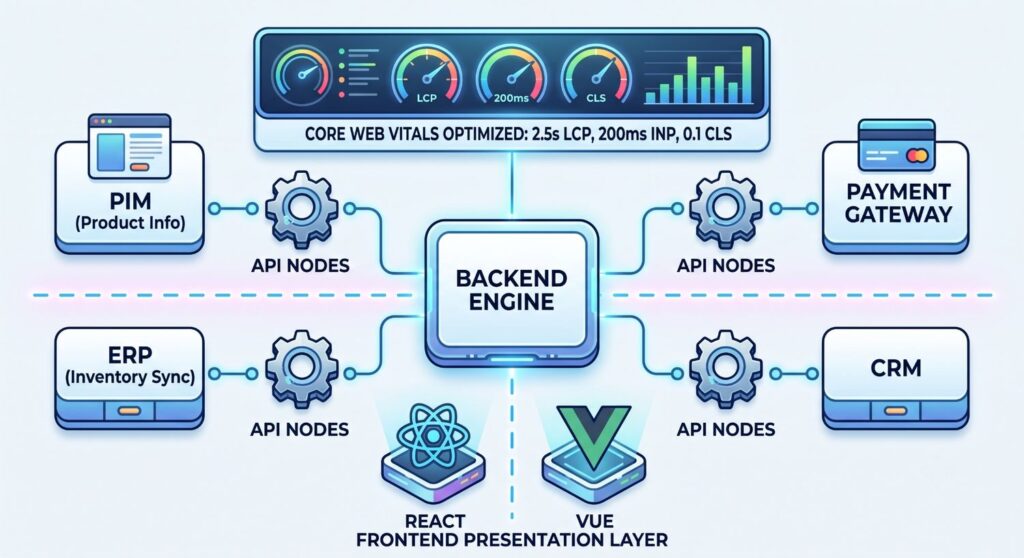
To combat cart abandonment and scale your online store, your technical foundation must be flawless. Here are the 2026 architecture best practices for ecommerce platforms.
A. The Shift to Headless Ecommerce
Traditional monolithic platforms (where the frontend design is permanently glued to the backend database) struggle to keep up with modern speed requirements.
Headless ecommerce architecture decouples the frontend (the glass) from the backend (the engine) using APIs.
- The Backend: Powered by platforms like Shopify Plus, BigCommerce Enterprise, or a custom Node.js/PostgreSQL build, managing logic, inventory, and security.
- The Frontend: Built using modern JavaScript frameworks like React.js, Next.js, or Vue.js.
The Result: Because the frontend is decoupled, pages can be pre-rendered or statically generated. This leads to near-instantaneous load times, allowing developers to deploy immersive, app-like experiences without bottlenecking the server.
B. Mastering Core Web Vitals
Google’s Core Web Vitals are a ranking factor, but in ecommerce website development, they are a revenue factor.
- Largest Contentful Paint (LCP): Must occur within 2.5 seconds. Optimize hero product images using next-gen formats (WebP/AVIF) and implement lazy loading for off-screen elements.
- Interaction to Next Paint (INP): Ensure UI elements like “Add to Cart” buttons respond instantly (under 200 milliseconds) by minimizing heavy JavaScript execution on the main thread.
- Cumulative Layout Shift (CLS): Keep it under 0.1. Ensure product images and promotional banners have defined width and height attributes so the “Buy” button doesn’t jump around while the user is trying to click it.
C. Omnichannel API Integrations
Your architecture must seamlessly connect to third-party microservices. A modern ecommerce stack is actually an orchestration of APIs:
- PIM (Product Information Management): For syncing descriptions and pricing across web, mobile apps, and social media shops.
- ERP (Enterprise Resource Planning): For real-time inventory synchronization.
- Payment Gateways: Integrating Apple Pay, Google Pay, Stripe, and Buy-Now-Pay-Later (BNPL) services directly into the product page to bypass standard checkout friction.
3. Conversion Rate Optimization (CRO) in Development

Building a fast site is only half the battle; the layout must guide the user psychologically. Incorporate these CRO-focused development strategies:
The “One-Page” vs. “Multi-Step” Checkout Debate
Baymard’s usability research reveals that an ideal checkout flow can be as short as 12 to 14 form elements.
- Best Practice: Utilize a streamlined, localized multi-step checkout with an omnipresent progress bar.
- Code Implementation: Use HTML5 autofill attributes (
autocomplete="shipping address-line1") to let browsers automatically fill in the user’s data, drastically reducing mobile friction.
High-Fidelity Product Pages (PDP)
The Product Detail Page (PDP) is where the buying decision is made.
- Dynamic Media: Support 3D models, AR (Augmented Reality) try-ons, and high-resolution video without tanking the page speed (using lazy-loaded iFrames and CDN video hosting).
- Trust Signals: Hardcode dynamic trust badges, real-time inventory counters (“Only 2 left in stock!”), and verified user reviews high up in the DOM tree.
4. Security and Compliance

When processing financial data, trust is paramount. 19% of abandonments occur because users do not trust the site with their credit card information.
- PCI-DSS Compliance: Never store raw credit card data on your servers. Use tokenization via established payment gateways.
- Edge Security: Implement a robust Web Application Firewall (WAF) via Cloudflare or Fastly to mitigate DDoS attacks and bot-driven inventory hoarding (scalper bots).
- Data Privacy: Ensure built-in, modular consent banners that comply with GDPR, CCPA, and emerging global privacy laws by default.
5. Integrating with Your Broader Web Strategy
Ecommerce development does not happen in a vacuum. The principles of secure coding, hiring the right talent, and choosing the right framework apply to all web builds.
Frequently Asked Questions (FAQ)
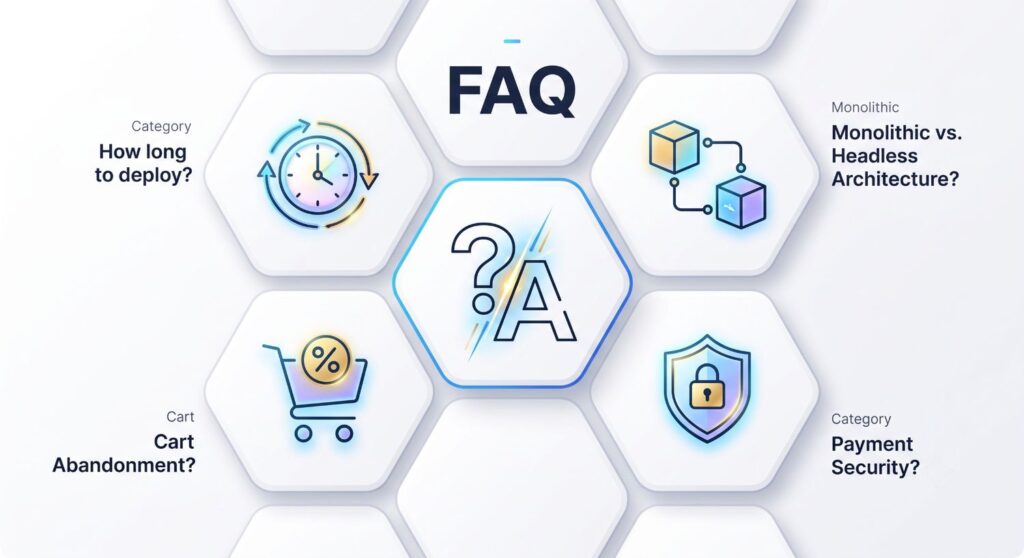
What is headless ecommerce? Headless ecommerce is an architectural design where the frontend user interface (what the shopper sees) is separated from the backend logic (inventory and payment processing) via APIs. This allows for faster page speeds and more flexible design.
How does website speed affect ecommerce conversion rates? Website speed has a direct correlation with revenue. Studies show that a single second delay in page load time can decrease conversion rates by 7%. Fast sites retain user attention and prevent frustration-based cart abandonment.
How can developers reduce shopping cart abandonment? Developers can reduce abandonment by implementing guest checkout options, reducing the number of checkout form fields, optimizing for mobile-first indexing, offering one-click payment methods (like Apple Pay), and ensuring the site is secured with visible SSL certificates.
Ready to Maximize Your Online Revenue?
Stop losing customers to slow load times, clunky checkouts, and outdated monolithic platforms. If you are ready to implement modern ecommerce website development strategies and upgrade your architecture to a high-converting powerhouse, our experts are ready to help.
