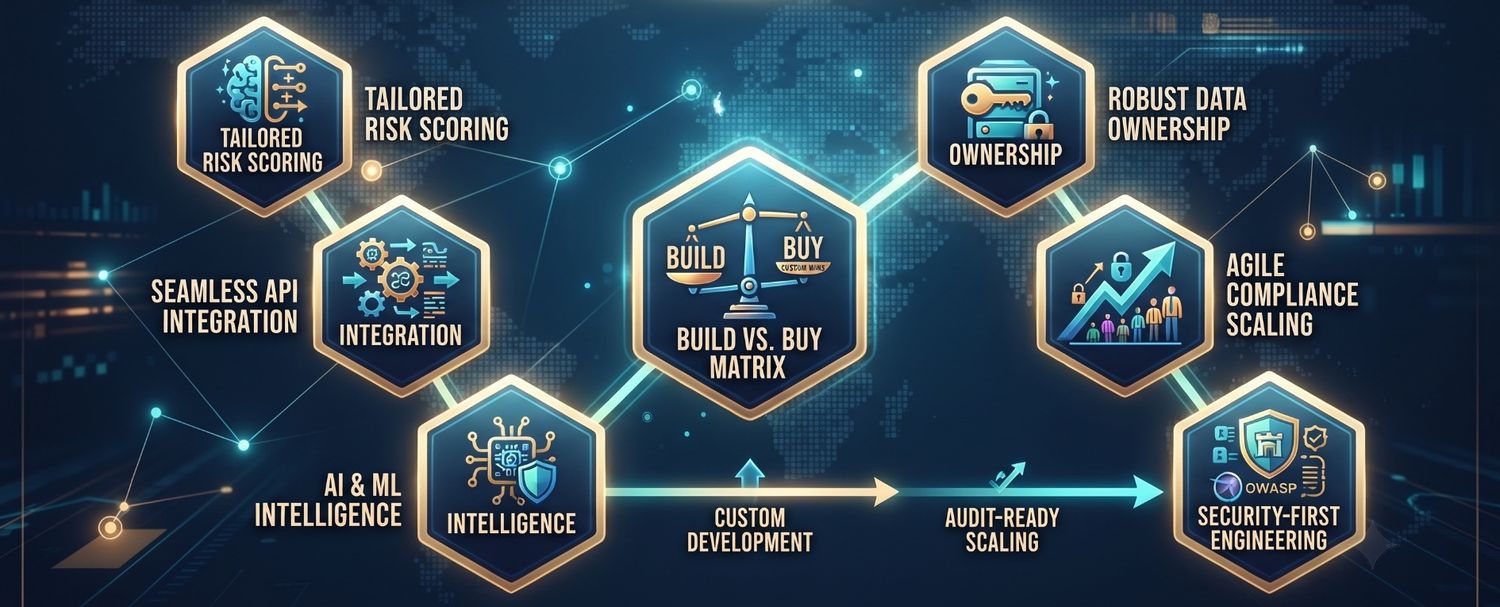
This guide provides a comprehensive deep dive into why industry leaders are pivoting toward custom Fintech KYC compliance software and how to strategically architect a system that turns regulation into a competitive advantage.
In the financial technology sector of 2026, the mantra “move fast and break things” has been permanently replaced by “move smart and secure everything.” For modern fintech enterprises, compliance is no longer a peripheral operational requirement—it is the bedrock of customer trust, the gatekeeper to global market expansion, and a critical component of your product’s UX.
As regulatory bodies worldwide—from the EU’s AMLA to global watchdogs like the Financial Action Task Force (FATF)—continue to raise the bar, the limitations of “out-of-the-box” third-party compliance tools have become glaringly apparent. Fintechs that rely on monolithic, off-the-shelf vendor solutions often find themselves trapped in a paradox: they have the innovative product features to scale, but their compliance infrastructure is too rigid to keep up.
1. The “Fintech Paradox”: Scaling Without Friction
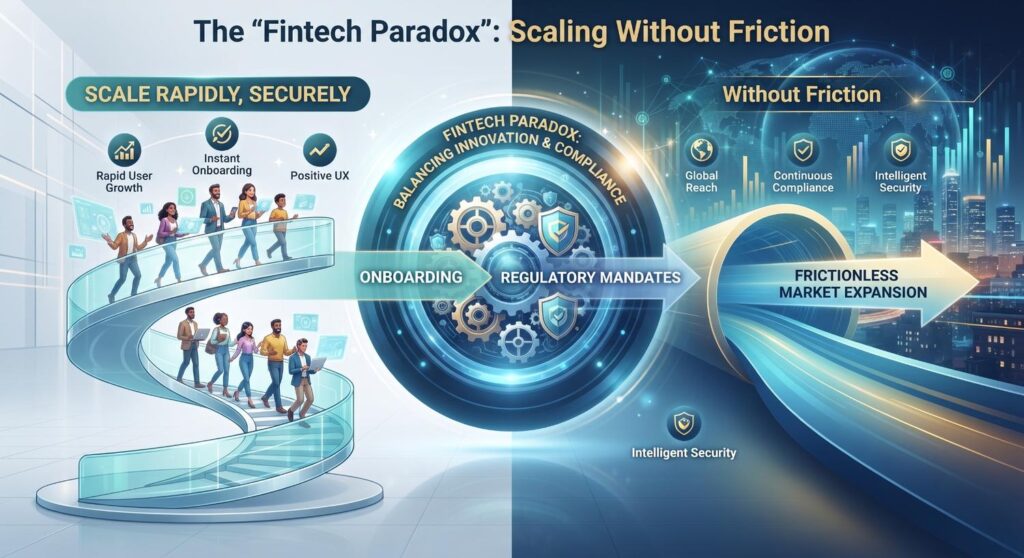
The core struggle for any scaling fintech is balancing rapid user acquisition with stringent regulatory mandates. If your onboarding process takes 15 minutes due to manual verification, your churn rate will skyrocket. Conversely, if your risk monitoring is too lax, you invite regulatory penalties that can shutter your business.
The Failure of Legacy Approaches
- Data Silos: Many firms use disparate, disconnected tools for document verification, sanctions screening, and transaction monitoring, resulting in fragmented data that is nearly impossible to audit.
- Black-Box Algorithms: Third-party providers often use opaque logic for risk scoring. When a transaction is blocked, your internal compliance team has no visibility into why, making it impossible to explain or correct false positives efficiently.
- High Variable Costs: Relying solely on a third-party vendor for your Fintech KYC compliance software creates unpredictable OPEX as your user base scales. Licensing fees per user can cripple your margins as you grow.
By developing a custom solution, you own the logic, the data, and the cost structure, allowing for long-term predictability.
2. Why Custom Fintech KYC Compliance Software Wins
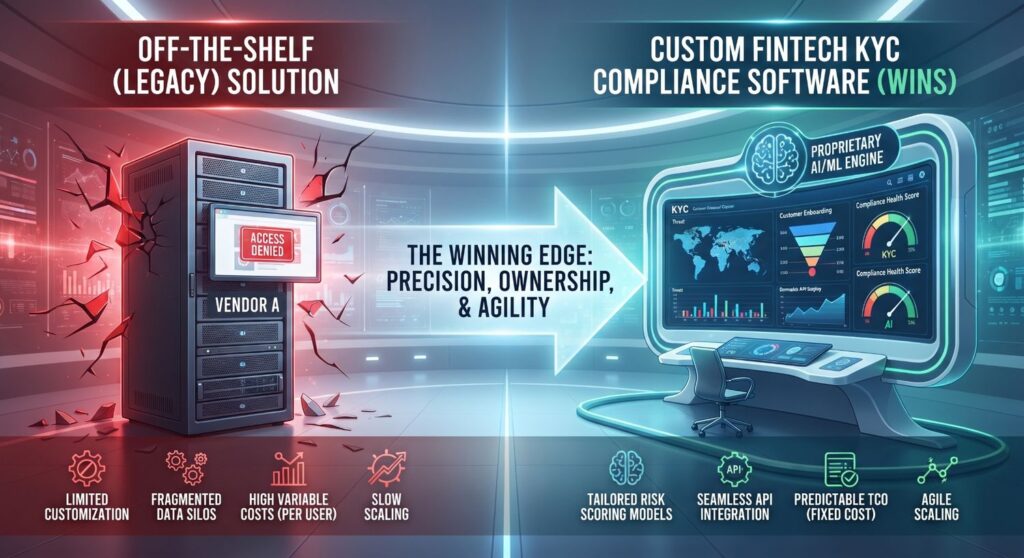
Off-the-shelf software promises “plug-and-play” simplicity, but often delivers “one-size-fits-none” performance. Custom Fintech KYC compliance software allows you to build a system that aligns with your specific risk appetite, geography, and product stack.
Tailored Risk Scoring Models
Every fintech product is unique. A digital wallet has a different risk profile than a high-frequency trading platform. Custom development enables you to build proprietary AI-driven risk scoring models that weigh variables—like geographical exposure, transaction velocity, and behavioral patterns—according to your specific business model.
Seamless API Integration
Why force your developers to build around a rigid third-party vendor? Custom solutions provide the flexibility to integrate your compliance layer directly into your existing user journey. Whether it’s an in-app biometric scan or real-time transaction monitoring, the compliance layer becomes a transparent part of your user experience. If you are looking to learn more about our development methodology, read our Custom Software Engineering services.
3. Advanced Technical Architecture for Compliance
A bespoke compliance engine allows you to integrate security directly into the application layer. Instead of treating compliance as a sidecar process, you treat it as a native feature of your software architecture.

Intelligence through AI and Machine Learning
Modern compliance is about patterns, not just rules.
- Behavioral Biometrics: Custom systems can track user patterns—mouse movements, typing speed, and device fingerprints—to flag potential account takeovers in real-time, long before a financial transaction occurs.
- NLP for Adverse Media: Instead of just checking basic databases, custom-built Natural Language Processing (NLP) engines can crawl global news feeds for “negative sentiment” associated with high-risk clients, providing a proactive rather than reactive stance.
- Zero-Knowledge Proofs (ZKP): For privacy-conscious markets, you can architect your KYC flow to verify user attributes (e.g., “is the user over 18?”) without storing sensitive PII on your servers, significantly reducing your GDPR/Data Sovereignty risk footprint.
4. The Build vs. Buy Decision Matrix
Many stakeholders ask, “Why build when there is software available to buy?” The answer lies in the Total Cost of Ownership (TCO) and Strategic Agility.
| Criteria | Third-Party Vendor (Buy) | Custom Fintech KYC Compliance Software |
|---|---|---|
| Initial Investment | Lower | Higher |
| Customization | Limited to vendor roadmap | Unlimited; tailored to your product |
| Long-Term Scalability | Diminishing returns (costs scale with users) | High ROI (fixed costs, infinite scale) |
| Data Ownership | Vendor-controlled | Fully proprietary |
| Compliance Alignment | Shared responsibility | Precision-engineered to your license |
The Verdict: If you are a pre-revenue startup, a standard vendor might suffice. However, once you enter the growth phase—or if you operate in high-complexity sectors like cross-border payments or crypto—custom development becomes the more fiscally responsible and strategically sound path.
5. Roadmap to Implementation
Transitioning to custom compliance software requires a structured approach. At Rannlab Technologies, we follow a rigorous methodology to ensure the transition doesn’t disrupt your daily operations.
Phase I: Discovery & Risk Profiling
We work with your compliance and legal teams to map out your specific regulatory environment. We don’t just ask, “What are you doing?” but “What are your regulatory vulnerabilities?”
Phase II: Architecture Design
We design a microservices-based compliance layer. This ensures that if the sanction screening module needs an update, it can be deployed independently without taking down the entire KYC onboarding flow.
Phase III: Integration & Testing
We integrate the new compliance engine into your existing product ecosystem using robust APIs. This phase includes rigorous “Shadow Testing,” where the new system runs in parallel with your old process to ensure accuracy before final cutover.
6. Security-First Engineering
At Rannlab, we understand that for a fintech, a bug in the compliance engine isn’t just a technical glitch—it’s a potential regulatory violation.
We bridge the gap between complex engineering and financial domain expertise. Our team has a proven track record of delivering secure, scalable, and audit-ready Fintech KYC compliance software for high-growth financial institutions.
Our commitment to your project includes:
- Secure SDLC: Every line of code is written with security as the primary requirement, adhering to OWASP standards.
- Audit-Trail Transparency: We build comprehensive logging systems that make your next regulatory audit a breeze, not a burden.
- Agile Scalability: We build for tomorrow, ensuring your compliance engine can handle 10x or 100x growth without performance degradation.
7. Frequently Asked Questions
How do we handle global regulatory fragmentation?
The key is a modular architecture. By building a “Compliance Orchestration Layer” within your Fintech KYC compliance software, you can route verification requests based on user geography. A user in the EU gets a GDPR-compliant flow, while a user in Southeast Asia follows local regional protocols.
How do we prevent custom software from becoming a maintenance burden?
We leverage modern DevOps practices (CI/CD pipelines) and containerization (Docker/Kubernetes). This allows your team to automate the testing and deployment of compliance updates, reducing manual maintenance efforts by up to 70% compared to legacy systems.
Can custom software integrate with legacy banking cores?
Yes. We specialize in “Middleware Engineering,” creating secure wrappers and APIs that allow modern, agile compliance modules to communicate seamlessly with monolithic, legacy banking systems.
Conclusion: Transform Compliance into a Growth Driver
In the competitive world of fintech, your ability to onboard users safely and rapidly is your biggest competitive advantage. By moving away from rigid, one-size-fits-all vendors and toward a custom-built, intelligent compliance infrastructure, you protect your reputation while setting the stage for aggressive, compliant growth.
Are you ready to move beyond the limitations of standard compliance tools?
Contact the engineering team at Rannlab Technologies today for a preliminary technical audit of your existing compliance workflows and discover how our Fintech KYC compliance software solutions can secure your future.
